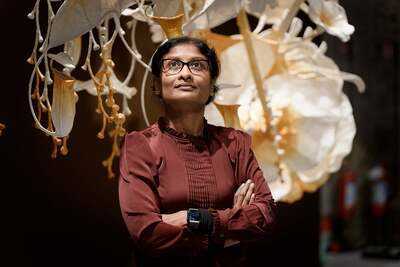
Sonam Kalra's musical expression transcends cultural boundaries with remarkable fluidity. With training in both Indian classical and Western music, she has established a unique artistic identity that harmoniously integrates Sufi, gospel, bhakti, and various global spiritual sounds.
An Organic Shift to Sufi Music
For Kalra, her venture into Sufi music was not a deliberate decision but rather a natural evolution influenced by her faith and a blend of diverse musical and spiritual elements.
Reflecting on her journey, she shares, “I’ve always been spiritual in many ways… faith-oriented from the time I was a child.” Her early performances in gospel music raised eyebrows, particularly as a Sikh woman singing Christian devotional songs. Her response was both simple and revolutionary: “Faith is something that calls to you… God is not religion and religion has no God.” For her, devotion transcends any single tradition, belonging instead to what she describes as the “religion of humanity.”
A Defining Moment in Nizamuddin
This philosophy reached a pivotal moment at the dargah of Sufi Inayat Khan in Nizamuddin, where she was invited to perform. “A Sikh girl singing gospel music was now being welcomed into a seemingly Islamic space,” she recalls. “That inspired me to merge these faiths, allowing them to flow into one another.”
The Birth of The Sufi Gospel Project
From this realization emerged The Sufi Gospel Project, an ambitious musical initiative that combines Sufi, gospel, bhakti, Gaelic chants, and Buddhist influences into a cohesive expressive form.
Global Performances and Universal Messages
Over the past 15 years, Kalra has performed in nearly 30 countries, including prestigious venues like the Sydney Opera House and the Pyramids of Giza, as well as major festivals such as Jahan-e-Khusrau and the Jaipur Literature Festival. “It’s been quite special; we have received standing ovations everywhere we have performed,” she notes, emphasizing that the themes of equality and inclusion resonate universally. Kalra believes that the allure of Sufi music lies not solely in its tradition but in its profound message. “I truly believe in this language of equality and inclusion,” she states, drawing inspiration from mystic poets like Kabir and Bulleh Shah, whose words transcend religious and geographical boundaries.
Exploring Universal Love Through Music
Her recent concert, Ibadat- Songs of the Mystics, was presented in collaboration with HCL Concerts. “It was titled Ibadat because I delved into the poetry of mystic writers who consistently return to the theme of universal love. In this context, ibadat — meaning worship — transcends ritual practices and physical spaces. In the Sufi tradition, it evolves into something much broader: an expression of love, surrender, and a profound connection with the divine. At its essence, it also embodies the belief in the equality of all beings and the divine presence within everyone, making inclusivity a fundamental aspect of its philosophy.” Kalra commends HCL for supporting non-commercial music.
Partition Stories Through Music
Kalra's work also delves into historical narratives through music, particularly in her project Partition- Stories of Separation. With ancestral ties to Rawalpindi and Sargodha, she approached the topic through poetry and shared human experiences rather than politics. “We do not speak of blame; we speak of friendship, shared loss, and shared humanity,” she explains. This project featured poetry from Amrita Pritam, Faiz Ahmed Faiz, and Ustad Daman, along with survivor testimonies and narrative storytelling. “Let history not repeat itself,” she emphasizes, advocating for dialogue over division.
Influences from a Musical Family
Growing up in Delhi, Kalra's upbringing significantly influenced her perspective. Coming from a family that cherished the arts, she was surrounded by a diverse musical environment, with influences ranging from Begum Akhtar and Bhimsen Joshi to Frank Sinatra and Pink Floyd. She credits her parents as her “greatest gurus,” instilling in her a belief in equality and openness. “We were taught we were not equal to men — we were better than men,” she recalls, describing a household that fostered confidence and independence.
A Lifelong Learner
Her musical education began at the tender age of four, under the guidance of maestros like the Dagar Brothers, followed by Shubha Mudgal and Sarathi Chatterjee. Yet, she continues to view herself as a student. “Sikh means learner,” she states. “I hope I never stop learning.”
The Essence of Composition
When asked about her favorite composition, she finds it difficult to choose, likening it to selecting a favorite child. However, she highlights Man Manam, created for Coke Studio, for its emotional resonance, and Wohi Khuda Hai for its lyrical power. “A composition must elevate your soul,” she asserts. “The lyrics must carry weight.”
Art as a Responsibility
Central to her philosophy is the belief that art carries a responsibility. She posits that artists serve as the conscience of society, tasked with nurturing empathy and challenging divisions. “We progress when we cease to use religion, nations, and identities to foster separation,” she argues. Instead, she advocates for greater support of non-mainstream arts, which she believes can inspire reflection and dialogue among audiences.
A Profound Message
For Kalra, the ultimate message is both simple and profound. “If there is a religion you wish to follow,” she gently advises, “follow the religion of humanity.”