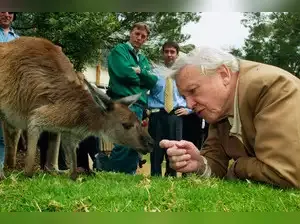
Sir David Attenborough, British naturalist, broadcaster, and documentary filmmaker, celebrated his 100th birthday on May 8, 2026, marking a remarkable life spent documenting the natural world and advancing environmental awareness globally.
Attenborough’s centenary has been marked by widespread tributes, special programming on broadcasters like the BBC, and reflections on his influence stretching across nearly eight decades of work in television and conservation communication.
Born on May 8, 1926, in Isleworth, England, Attenborough’s early fascination with nature, from collecting fossils and insects to observing wildlife, laid the groundwork for a lifelong career.
He completed a natural sciences degree at the University of Cambridge before being called up for two years of national service in 1947. After completing his service, he married his wife Jane, whom he had met at university, and took a position in educational publishing before eventually moving into broadcasting.
Attenborough’s career with the BBC began in the early 1950s, when natural history programming was a budding genre. He soon innovated a new style of wildlife television, blending field footage with narrative storytelling that brought remote ecosystems into living rooms worldwide.
His early series Zoo Quest in 1954 was among the first to marry on-location filming with engaging presentation, setting a template for what natural history documentaries would become.
Over the decades, Attenborough became synonymous with landmark series including Life on Earth, Planet Earth, Blue Planet, Frozen Planet and Dynasties. These productions, broadcast internationally, are credited with exposing millions to the complexity and diversity of life on Earth and turning nature programming into a mainstream genre.
Life on Earth alone has been viewed by hundreds of millions of people across the world.
He also played key roles behind the scenes, as a controller at BBC Two in the 1960s, commissioning influential programs and helping usher in technological transitions such as the move from black-and-white to colour television.
The term “Attenborough Effect” emerged to describe how his documentaries inspired public interest in wildlife conservation and environmental responsibility.
While Attenborough’s early work focused on showcasing natural beauty, his later career increasingly confronted urgent environmental issues. His documentaries in recent decades have framed topics like climate change, biodiversity loss, and plastic pollution as global concerns.
The 2017 series Blue Planet II, which included striking imagery of albatrosses feeding plastic to their chicks, contributed to widespread public and policy action on ocean plastic pollution, including corporate and government commitments to reduce single-use plastics.
Attenborough’s impact extends beyond television. He has received numerous honours, including knighthood and the Order of Merit.
At least 20 species and genera, ranging from plants to spiders and even parasitic wasps, have been named in his honour, reflecting his significance to biology and conservation communities.
Attenborough received numerous BAFTA and Emmy awards, the Prince of Asturias Award for Communication and Humanities, and induction into the Television Hall of Fame.
Even at 100, Attenborough remains engaged with his work. New documentaries and retrospectives, including Life on Earth: Attenborough’s Greatest Adventure, reflect on his career and highlight ongoing conservation challenges.
His signature message, urging audiences to “cherish the natural world” because humanity is part of and dependent on it, continues to resonate as climate and biodiversity crises intensify.
Attenborough’s centenary has been marked by widespread tributes, special programming on broadcasters like the BBC, and reflections on his influence stretching across nearly eight decades of work in television and conservation communication.
Born on May 8, 1926, in Isleworth, England, Attenborough’s early fascination with nature, from collecting fossils and insects to observing wildlife, laid the groundwork for a lifelong career.
He completed a natural sciences degree at the University of Cambridge before being called up for two years of national service in 1947. After completing his service, he married his wife Jane, whom he had met at university, and took a position in educational publishing before eventually moving into broadcasting.
Attenborough’s career with the BBC began in the early 1950s, when natural history programming was a budding genre. He soon innovated a new style of wildlife television, blending field footage with narrative storytelling that brought remote ecosystems into living rooms worldwide.
His early series Zoo Quest in 1954 was among the first to marry on-location filming with engaging presentation, setting a template for what natural history documentaries would become.
Over the decades, Attenborough became synonymous with landmark series including Life on Earth, Planet Earth, Blue Planet, Frozen Planet and Dynasties. These productions, broadcast internationally, are credited with exposing millions to the complexity and diversity of life on Earth and turning nature programming into a mainstream genre.
Life on Earth alone has been viewed by hundreds of millions of people across the world.
He also played key roles behind the scenes, as a controller at BBC Two in the 1960s, commissioning influential programs and helping usher in technological transitions such as the move from black-and-white to colour television.
The term “Attenborough Effect” emerged to describe how his documentaries inspired public interest in wildlife conservation and environmental responsibility.
Environmental advocacy
While Attenborough’s early work focused on showcasing natural beauty, his later career increasingly confronted urgent environmental issues. His documentaries in recent decades have framed topics like climate change, biodiversity loss, and plastic pollution as global concerns.
The 2017 series Blue Planet II, which included striking imagery of albatrosses feeding plastic to their chicks, contributed to widespread public and policy action on ocean plastic pollution, including corporate and government commitments to reduce single-use plastics.
Public recognition
Attenborough’s impact extends beyond television. He has received numerous honours, including knighthood and the Order of Merit.
At least 20 species and genera, ranging from plants to spiders and even parasitic wasps, have been named in his honour, reflecting his significance to biology and conservation communities.
Attenborough received numerous BAFTA and Emmy awards, the Prince of Asturias Award for Communication and Humanities, and induction into the Television Hall of Fame.
Even at 100, Attenborough remains engaged with his work. New documentaries and retrospectives, including Life on Earth: Attenborough’s Greatest Adventure, reflect on his career and highlight ongoing conservation challenges.
His signature message, urging audiences to “cherish the natural world” because humanity is part of and dependent on it, continues to resonate as climate and biodiversity crises intensify.