Kolkata: The flow of money from non-resident Indians into Kerala has remained unaffected despite the geopolitical uncertainties in the Middle East, data from leading banks operating in the state suggest.
The Kerala-based Federal Bank and South Indian Bank showed quarter-on-quarter growth in non-resident deposits inflow, indicating that the lifeline to Kerala remains largely stable despite the Iran war.
Remittances and overseas deposits play a pivotal role in the southern state's economy.
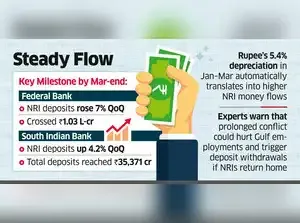
The rise in flow also reflects a 5.4% rupee depreciation between January and March. A depreciating local currency automatically translates into higher remittances on the same base amount.
(Join our ETNRI WhatsApp channel for all the latest updates)
Indians working abroad deposit their surplus money mostly in non-resident external (NRE) accounts in banks operating here, while they remit money to family members for monthly expenses using online platforms or bank wire transfers. The money deposited in foreign curreny gets converted to rupee in both the cases.
Federal Bank's non-resident deposits grew 7% quarter-on-quarter to ₹1.03 lakh crore at the end of March. The fact that the growth rate was more than rupee depreciation suggests that there has been a rise in transaction in foreign currency. The bank also enjoys a substantial market share in inward remittances.
"Remittances, as of now, remain elevated. My sense is that unless you see significant job losses and returning Indians from UAE for good into India, I don't think this story is likely to change immediately," Federal Bank managing director KVS Manian told analysts in a post-earning interaction.
South Indian Bank reported a 4.2% growth in inbound flows to ₹35,371 crore growth for the same period, largely reflecting the impact of currency depreciation.
These two banks along with State Bank of India hold the first three positions in terms of attracting NRI deposits in Kerala, people aware said.
"We have a large business in the Middle East in the area most impacted by the current crisis. Our view is that in the short run, it will be a positive for us in the sense that people living in those areas may want to transfer money back home so as to protect themselves in the future. So, there will be increased flows," South Indian Bank managing director PR Seshadri told ET.
Experts however warned that a prolonged West Asia conflict could threaten these inflows in the long run.
"The problem will happen if the issue continues over a longer period and people's livelihoods in those countries are impacted... Those balances will get drawn down when those individuals come back home," Seshadri said.
The Reserve Bank of India (RBI) data showed that more than a third of India's remittances, totalling ₹3.74 lakh crore in 2023-24, came from Gulf countries such as the UAE, Saudi Arabia, Qatar, Kuwait and Oman.
The Kerala-based Federal Bank and South Indian Bank showed quarter-on-quarter growth in non-resident deposits inflow, indicating that the lifeline to Kerala remains largely stable despite the Iran war.
Remittances and overseas deposits play a pivotal role in the southern state's economy.
The rise in flow also reflects a 5.4% rupee depreciation between January and March. A depreciating local currency automatically translates into higher remittances on the same base amount.
(Join our ETNRI WhatsApp channel for all the latest updates)
Life as usual so far The state accounts for one-fifth of foreign money sent by Indian diaspora
Federal Bank's non-resident deposits grew 7% quarter-on-quarter to ₹1.03 lakh crore at the end of March. The fact that the growth rate was more than rupee depreciation suggests that there has been a rise in transaction in foreign currency. The bank also enjoys a substantial market share in inward remittances.
"Remittances, as of now, remain elevated. My sense is that unless you see significant job losses and returning Indians from UAE for good into India, I don't think this story is likely to change immediately," Federal Bank managing director KVS Manian told analysts in a post-earning interaction.
South Indian Bank reported a 4.2% growth in inbound flows to ₹35,371 crore growth for the same period, largely reflecting the impact of currency depreciation.
These two banks along with State Bank of India hold the first three positions in terms of attracting NRI deposits in Kerala, people aware said.
"We have a large business in the Middle East in the area most impacted by the current crisis. Our view is that in the short run, it will be a positive for us in the sense that people living in those areas may want to transfer money back home so as to protect themselves in the future. So, there will be increased flows," South Indian Bank managing director PR Seshadri told ET.
Experts however warned that a prolonged West Asia conflict could threaten these inflows in the long run.
"The problem will happen if the issue continues over a longer period and people's livelihoods in those countries are impacted... Those balances will get drawn down when those individuals come back home," Seshadri said.
The Reserve Bank of India (RBI) data showed that more than a third of India's remittances, totalling ₹3.74 lakh crore in 2023-24, came from Gulf countries such as the UAE, Saudi Arabia, Qatar, Kuwait and Oman.