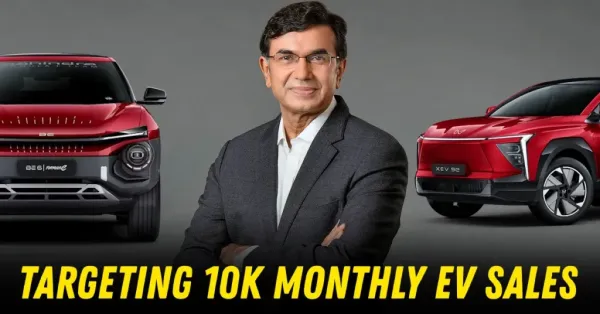
Mahindra sells roughly 60,000 cars every month. Of those, the company now wants at least 10,000 to be electric. The automaker revealed this at a recent post-earnings call. This number has a reason behind it. It’s called CAFE 3. And this number is an integral part of Mahindra’s math to stay on the right side of CAFE 3, to avoid paying hefty penalties.
CAFE stands for Corporate Average Fuel Efficiency. The third iteration of this norm, set to kick in by April 2027, requires carmakers to dramatically cut the average carbon dioxide emissions of every car they sell, taken together as a fleet.
The target drops to 88.4 grams of CO2 per kilometre, down from 113 grams per kilometre under the current CAFE 2 regime. That is a significant tightening, and it hits SUV-heavy brands like Mahindra harder than most.
Mahindra’s entire portfolio runs on large SUVs. Scorpio, XUV700, Thar, Bolero. These are vehicles that burn diesel and petrol and push average emissions up, not down.
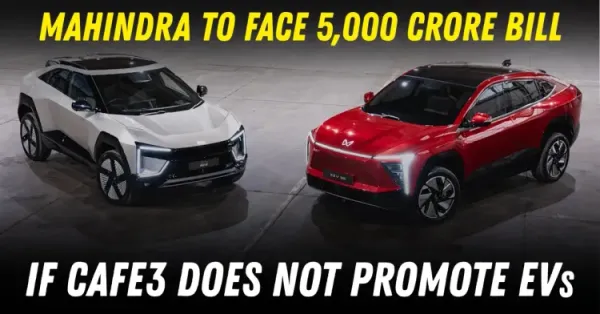
To offset those numbers, Mahindra needs to sell a large enough chunk of zero-emission vehicles so that the fleet average stays within the permitted limit.
Electric vehicles help here because CAFE 3 assigns a super-credit multiplier to them: each EV sold is counted as three vehicles in the fleet calculation. That makes every electric car sold three times as effective at pulling the average down.
Rajesh Jejurikar, Executive Director and CEO of Mahindra’s Auto and Farm Sector, has publicly stated that the company needs to reach 13 to 15 percent EV penetration by March 2027. With monthly overall volumes around 60,000 units, 13 to 17 percent translates directly to roughly 8,000 to 10,000 electric cars per month.
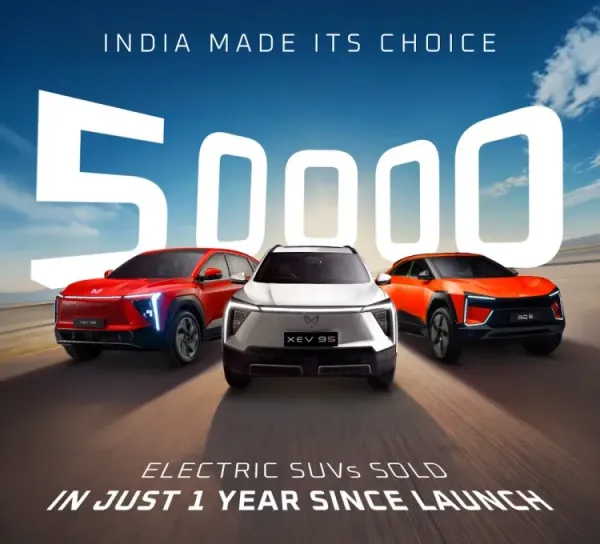
In Q4 of FY26, EVs made up 9.6 percent of Mahindra’s total SUV sales. By the last couple of months of the financial year, that number had climbed to just over 11 percent, helped by stronger deliveries of the BE 6 and XEV 9e. Current monthly EV output from the dedicated Chakan facility in Pune stands at just over 6,000 units, and the plan is to scale that to 8,000 units per month by the end of FY27.
So the production ramp-up is already underway. The gap between 8,000 units of production capacity and 10,000 units of sales needed is one that Mahindra will likely need to bridge with an additional model or expanded capacity.
Some carmakers are solving their CAFE 3 problem with a combination of strong hybrids, CNG vehicles, and EVs. Hyundai and Maruti are both pursuing that kind of multi-powertrain approach.
Mahindra has made it clear it is not going the hybrid route. The company is betting on EVs as its primary tool for compliance, which makes the EV volume target even more critical. Miss it, and CAFE 3 penalties become a real financial risk.
Beyond March 2027, Mahindra’s own estimates point to needing 18 to 20 percent EV penetration over a five-year horizon to remain fully compliant as the norms tighten further. That means the 10,000-unit monthly target is not a peak. It is closer to a floor.
The BE 6 and XEV 9e have given Mahindra a solid start. The XEV 9S has added to the line-up, and is bringing in the big numbers. But whether the company can sustain the volume ramp without a more affordable electric option in its portfolio remains the key question as the 2027 deadline draws closer. Maybe it’s time for Mahindra to bring forward the Vision S and Vision X EVs, and also bring the BE07 to the market quickly.
-
Watch: Pakistan Star Suffers Head Injury, Taken Off On Stretcher In BAN vs PAK 2nd Test

-
Varun Dhawan’s ‘Hai Jawani Toh Ishq Hona Hai’ Makers Issue Official Statement, Say ‘No Resemblance To Any Film’

-
Pakistan Captain Fatima Sana Smashes Fastest Fifty In Women's T20I History, Reaches Landmark In Just 15 Balls
-
Thailand Open: PV Sindhu Loses Quarterfinal To Yamaguchi; Satwik-Chirag Storm Into Semifinals
-
Samsung Galaxy Z Fold 8, Z Flip 8, Galaxy Glasses To Launch At Unpacked 2026 Event: What To Expect