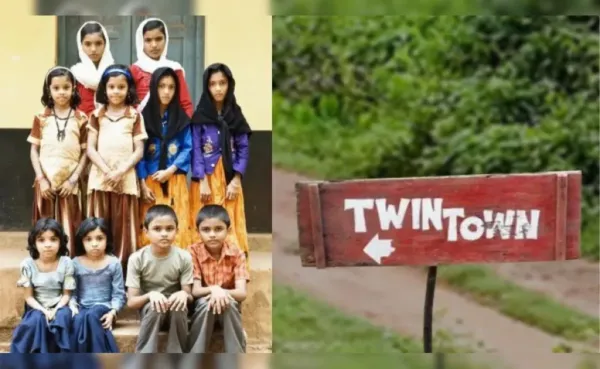
But spend a little time here, and you will begin to notice faces that look identical, children walking in pairs, and families where twins are not an exception but almost the norm.
Over time, Kodinhi has earned global attention as India’s “Twin Town”, where nearly 20 per cent of the population consists of twins. In a country that typically records one of the lowest twin birth rates, this village stands out in the most extraordinary way.
Why Is It Back In The Spotlight
The village is once again having a moment online, this time because of a widely shared advertising campaign of Flipkart, the e-commerce company, that cleverly builds on its identity.
The concept imagines a world where everything exists in pairs, using Kodinhi’s real-life phenomenon as a playful metaphor for “double” value and “double” offers.
The campaign’s humour and visual storytelling have struck a chord, with many people on social media praising its originality.
One comment summed it up neatly: “Very creative, with genuinely good jokes. They hit a home run with this concept.”
The Numbers That Make Kodinhi Extraordinary
The scale of Kodinhi’s twin phenomenon is what truly sets it apart.
In a village of around 2,000 families, there are an estimated 400 to 550 pairs of twins. The twinning rate here ranges between 42 to 45 per 1,000 births, significantly higher than India’s average of roughly 4 to 9 per 1,000.
What is even more intriguing is that this pattern is not slowing down. New pairs of twins are born every year, and the trend has been observed for at least six to seven decades.
There is also an interesting detail that adds to the puzzle. Women from Kodinhi who move away after marriage often give birth to twins elsewhere, too, hinting at a deeper, possibly genetic or environmental factor that travels with them.
A Mystery That Science Still Cannot Fully Explain
Despite years of research by Indian and international institutions, the exact reason behind Kodinhi’s high twin birth rate remains unresolved.
Scientists have explored multiple possibilities. Environmental factors such as water composition and local diet have been tested, but no consistent trigger has been found.
Unlike places such as Nigeria’s Igbo-Ora, where certain foods are believed to influence twin births, Kodinhi offers no such clear link.
The exact reason behind Kodinhi’s high twin birth rate remains unresolved.
Genetics is another strong theory, but even here, researchers have not identified a specific gene responsible for hyperovulation or higher chances of twins.
Several explanations have already been ruled out. Studies have found no evidence of pollutants, unusual chemicals, or lifestyle factors causing the trend. Religious or supernatural explanations, while part of local folklore, have also been dismissed scientifically.
And yet, the phenomenon persists.
A Community That Embraces It
Many locals see twins as a blessing, often attributing the phenomenon to divine grace or unique qualities of the village itself. These beliefs coexist comfortably alongside scientific curiosity.
The community has also taken a more organised approach to its identity. In 2008, residents formed the Twins and Kins Association (TAKA), a group that helps track twin births, support families, and collaborate with researchers trying to understand the phenomenon.
-
Cooper Connolly: Cooper Connolly’s historic century, the youngest player to do so in IPL history

-
This big change happens in the body of girls after 23 hours of eating fried garlic – News Himachali News Himachali

-
WB post-poll violence: Suvendu Adhikari’s aide shot dead in Madhyamgram

-
India, Vietnam share deep friendship: President Murmu to President Lam

-
Ek Din Actor Junaid Khan Confesses To Facing Identity Crisis For Being Aamir Khan’s Son