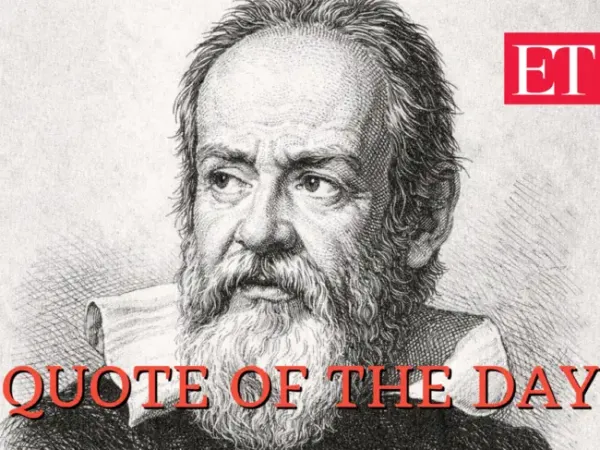
Quote of the Day: Galileo Galilei, born February 15, 1564, in Pisa, was an Italian natural philosopher, astronomer and mathematician who made fundamental contributions to the sciences of motion, astronomy and the strength of materials, as well as to the development of the scientific method. He was a pioneering Italian scientist whose work laid the foundation for modern physics and astronomy.
Living during a time when scientific inquiry often clashed with established religious doctrine, Galileo’s curiosity and commitment to observation set him apart as one of history’s most influential thinkers.
Galileo is best known for improving the telescope and making groundbreaking astronomical discoveries, including the moons of Jupiter and the phases of Venus. His support for the heliocentric model, first proposed by Nicolaus Copernicus, challenged long-held beliefs and led to his trial by the Roman Catholic Church. Despite opposition, his work revolutionized scientific methodology.
Galileo's Quote
“Measure what can be measured, and make measurable what cannot be measured.”
Galileo’s Quote: Context, meaning and interpratation
The quote reflects Galileo’s emphasis on observation, experimentation, and quantification during the early development of the scientific method. At a time when many ideas were based on philosophy rather than empirical evidence, Galileo advocated for turning abstract concepts into measurable data.
Galileo’s words underscores the importance of precision and clarity in understanding the world. It encourages transforming vague or subjective ideas into something concrete and quantifiable, enabling better analysis and deeper insight.
Galileo reminds us to seek clarity in complexity. Whether in science, business, or daily life, progress often comes from breaking down uncertainties into measurable components. His philosophy encourages critical thinking, curiosity, and a disciplined approach to problem-solving principles that remain relevant in today’s data-driven world.
Living during a time when scientific inquiry often clashed with established religious doctrine, Galileo’s curiosity and commitment to observation set him apart as one of history’s most influential thinkers.
Galileo is best known for improving the telescope and making groundbreaking astronomical discoveries, including the moons of Jupiter and the phases of Venus. His support for the heliocentric model, first proposed by Nicolaus Copernicus, challenged long-held beliefs and led to his trial by the Roman Catholic Church. Despite opposition, his work revolutionized scientific methodology.
Galileo's Quote
“Measure what can be measured, and make measurable what cannot be measured.”
Galileo’s Quote: Context, meaning and interpratation
The quote reflects Galileo’s emphasis on observation, experimentation, and quantification during the early development of the scientific method. At a time when many ideas were based on philosophy rather than empirical evidence, Galileo advocated for turning abstract concepts into measurable data.Galileo’s words underscores the importance of precision and clarity in understanding the world. It encourages transforming vague or subjective ideas into something concrete and quantifiable, enabling better analysis and deeper insight.
Galileo reminds us to seek clarity in complexity. Whether in science, business, or daily life, progress often comes from breaking down uncertainties into measurable components. His philosophy encourages critical thinking, curiosity, and a disciplined approach to problem-solving principles that remain relevant in today’s data-driven world.