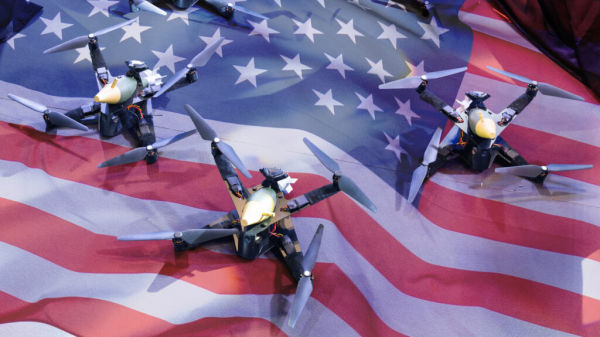
Google’s proposal for voice-controlled, autonomous drones was selected to move on in the Pentagon’s $100 million Autonomous Vehicle Orchestrator contest, but it dropped out of the challenge a few weeks later after an ethics review, according to a Bloomberg report. The competition, according to the Pentagonaims to seek ways to deliver a “human-machine interaction layer that will directly impact the lethality and effectiveness” of autonomous systems such as drones.
This decision to pull out came after hundreds of Google AI researchers signed an open letter urging the company not to allow its AI models to be used for U.S. defense purposes – not the first time employees had expressed concern with Google’s involvement with the Pentagon. In 2018, employees fought back against the use of its AI to analyze drone footage as part of Project Maven. Google stated at the time that it did not want its tech to be used to make weapons or cause harm. But its stance has continued to flip-flop — Google started developing AI and machine learning tools for the Pentagon in 2022, then hired U.S. military veterans in 2025 to help shape its AI for defense and communication.
While some employees were reportedly upset about Google’s decision to withdraw from the recent drone contest, many were also frustrated by the company’s continued involvement with the Pentagon. “We remain committed to the private and public sector consensus that AI should not be used for domestic mass surveillance or autonomous weaponry without appropriate human oversight,” a Google spokesperson told Bloomberg. While Google has dropped out of the $100 million autonomous drone contest, companies like OpenAI, Palantir, and xAI remain.
What is the Pentagon’s Autonomous Vehicle Orchestrator challenge?
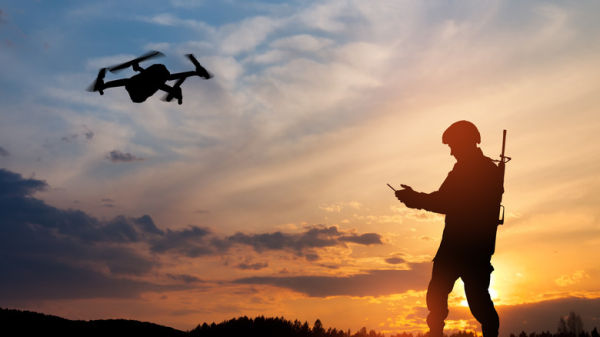
The Pentagon’s Defense Innovation Unit, the Defense Autonomous Warfare Group, and the United States Navy launched the lucrative $100 million challenge on January 13 in the hopes of finding an Autonomous Vehicle Orchestrator. Basically, the technology would allow battlefield commanders to control drone swarms with their voice, freeing them from having to push buttons and offering a new way to interface with the drones that are constantly being integrated into the military’s arsenal.
The remaining companies will compete in multiple stages over six months. These include the development of features such as “target- awareness and sharing” and “launch to termination,” according to Bloomberg. Companies that can develop the required features will receive follow-on contracts to ramp up production for active deployment.
In a press release announcing the program, Hon. Emil Michael, Acting Director of DIU and Under Secretary of Defense for Research and Engineering, stated that “This solicitation’s approach is the new standard — we’re moving fast to deliver tangible capabilities to the warfighter. Selected performers will be shoulder‑to‑shoulder with operators, and they will be proving that their capability works in an operational environment.” This isn’t the U.S. government’s only initiative to find and implement better drone technology, either, with the Department of Defense having selected three winners from its “Drone Dominance” gauntlet in 2026.