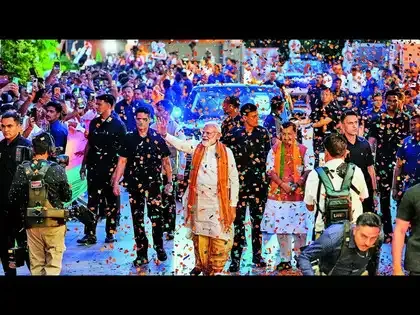
Exuding confetti
This round of assembly elections has provided Narendra Modi with significant strategic heft at a time when the leadership of most democracies are under stress and constrained by a restive, unpredictable, domestic polity. He is the only democratically elected leader to repeatedly win elections, each of which is no less significant than, say, the US midterms.
Donald Trump's ratings are at his lowest ahead of the midterms. Emmanuel Macron had a reversal in parliament soon after his re-election in 2022, then had to call for snap polls in 2024 to stabilise matters. Britain has its sixth PM in office since Modi took charge, and Germany its third chancellor. The once politically-impregnable Viktor Orban lost in Hungary after 16 yrs, causing political tremors across Europe.
In contrast, Modi, who saw his party's tally fall by over 60 seats in 2024 Lok Sabha polls, recovered within months to win Haryana and Maharashtra assembly elections. In fact, NDA has won 7 of the 11 assembly polls post-2024, which includes ousting Arvind Kejriwal's AAP from Delhi, and now effecting the most improbable of victories against a well-entrenched Mamata Banerjee in West Bengal.
This endorsement comes at a difficult time - India's handling of Trump, Pakistani terror challenge, Operation Sindoor and the ongoing West Asia crisis. Since all these have had domestic repercussions, they can't be kept out of the electoral context.
Modi now has far more domestic political flexibility and latitude to shape India's approach in his strategic imagination. Which is why India can now proactively work on ambitious strategic deals - be it on trade, energy or defence - with more certainty than other countries.
The next big strategic gain from these polls is West Bengal itself. Modi will be the first PM in almost 50 yrs since 1977 to have his party's government in West Bengal. This marks not just an end of a political hiatus but reframing of the Delhi-Kolkata strategic continuum, a gap that has troubled many governments at the Centre, particularly because of the state's national security significance.
Just last month, Calcutta High Court pulled up the West Bengal government for not complying with its earlier order to transfer land for 127 km fencing to BSF. The court had set a March 31 deadline after it ascertained that the Centre had already paid land compensation to the state. But, to its surprise, it observed on April 22 that only land for 8 km fencing had been released.
The slugfest with the party in power at the Centre has been critical to the political identity of parties governing West Bengal. Even when the Left extended support from the outside to the UPA 1 government, it aggressively sought to dictate policy, including in strategic and foreign affairs.
But this fight had started to take larger ramifications with the Banerjee government. She asserted a sort of political autonomy that conveyed a perception that Bengal was not bound by the Union, including showing affront by impeding dialogue through bureaucratic institutions.
The Centre had to intervene and take over maintenance of the West Bengal stretch of the strategically important NH-10, Sikkim's lifeline, from the state PWD because it did not prioritise its upkeep. Similarly, strategic projects to build redundancies in and about the Siliguri Corridor have been running slow due to this fight.
This can now change. The big plan to have at least two roads connecting Siliguri with Gangtok and Guwahati, with interconnections between them plus a tunnel through the 'Chicken's Neck' itself, can get much-needed strategic urgency. This is also the first time the same party is in power in Assam and West Bengal, which will further smoothen coordination.
There's also a newly elected government in Bangladesh, which lays the ground for a fresh dynamic across three spheres: India-Bangladesh (Tripura is also BJP-governed), Bhutan-India-Bangladesh, and the larger connect with India's northeast and Myanmar.
There's now no scope for an autonomous Dhaka-Kolkata channel the way Banerjee often liked to play it with Sheikh Hasina. For Dhaka, Delhi and Kolkata are now the same, seamless diplomatic channel. This clarity to the Tarique Rahman government in Dhaka is vital at a time when a new equation is to be rebuilt.
What the results have also done is put BJP for the first time in power in four states - Maharashtra, UP, Bihar and West Bengal - with 40 or more seats in Lok Sabha. This East-West axis accounts for 210 Lok Sabha seats, of which NDA fell short of 100 in 2024, but in 2 yrs, has shored itself up by winning 3 of the 4 states. (UP goes to polls next year.) It's the state elections that have re-powered the Modi 3.0.
Finally, the West Bengal win has provided an important political backup to UP for NDA. Together, Bihar, Bengal and Odisha account for 100-plus Lok Sabha seats. Of these, two states are new territories, providing additional political cushion, if needed, to ensure there's no sudden drop in Modi's heft.
The die couldn't have been better cast for Modi to execute his strategic agenda within and outside India's borders over the next few years. There are now added tiers to Modi government's political base, conveying stability and predictability in an unstable and unpredictable global environment. It's this positioning that provides the opportunity to leverage the maximum for economic growth at a time when others fight for political survival.
Assembly Elections 2026
Election Results 2026 Live Updates: Who's ahead in which state
West Bengal Election Results 2026 Live Updates
TN Election Result 2026 Live Updates
In contrast, Modi, who saw his party's tally fall by over 60 seats in 2024 Lok Sabha polls, recovered within months to win Haryana and Maharashtra assembly elections. In fact, NDA has won 7 of the 11 assembly polls post-2024, which includes ousting Arvind Kejriwal's AAP from Delhi, and now effecting the most improbable of victories against a well-entrenched Mamata Banerjee in West Bengal.
This endorsement comes at a difficult time - India's handling of Trump, Pakistani terror challenge, Operation Sindoor and the ongoing West Asia crisis. Since all these have had domestic repercussions, they can't be kept out of the electoral context.
Modi now has far more domestic political flexibility and latitude to shape India's approach in his strategic imagination. Which is why India can now proactively work on ambitious strategic deals - be it on trade, energy or defence - with more certainty than other countries.
The next big strategic gain from these polls is West Bengal itself. Modi will be the first PM in almost 50 yrs since 1977 to have his party's government in West Bengal. This marks not just an end of a political hiatus but reframing of the Delhi-Kolkata strategic continuum, a gap that has troubled many governments at the Centre, particularly because of the state's national security significance.
Just last month, Calcutta High Court pulled up the West Bengal government for not complying with its earlier order to transfer land for 127 km fencing to BSF. The court had set a March 31 deadline after it ascertained that the Centre had already paid land compensation to the state. But, to its surprise, it observed on April 22 that only land for 8 km fencing had been released.
The slugfest with the party in power at the Centre has been critical to the political identity of parties governing West Bengal. Even when the Left extended support from the outside to the UPA 1 government, it aggressively sought to dictate policy, including in strategic and foreign affairs.
But this fight had started to take larger ramifications with the Banerjee government. She asserted a sort of political autonomy that conveyed a perception that Bengal was not bound by the Union, including showing affront by impeding dialogue through bureaucratic institutions.
The Centre had to intervene and take over maintenance of the West Bengal stretch of the strategically important NH-10, Sikkim's lifeline, from the state PWD because it did not prioritise its upkeep. Similarly, strategic projects to build redundancies in and about the Siliguri Corridor have been running slow due to this fight.
This can now change. The big plan to have at least two roads connecting Siliguri with Gangtok and Guwahati, with interconnections between them plus a tunnel through the 'Chicken's Neck' itself, can get much-needed strategic urgency. This is also the first time the same party is in power in Assam and West Bengal, which will further smoothen coordination.
There's also a newly elected government in Bangladesh, which lays the ground for a fresh dynamic across three spheres: India-Bangladesh (Tripura is also BJP-governed), Bhutan-India-Bangladesh, and the larger connect with India's northeast and Myanmar.
There's now no scope for an autonomous Dhaka-Kolkata channel the way Banerjee often liked to play it with Sheikh Hasina. For Dhaka, Delhi and Kolkata are now the same, seamless diplomatic channel. This clarity to the Tarique Rahman government in Dhaka is vital at a time when a new equation is to be rebuilt.
What the results have also done is put BJP for the first time in power in four states - Maharashtra, UP, Bihar and West Bengal - with 40 or more seats in Lok Sabha. This East-West axis accounts for 210 Lok Sabha seats, of which NDA fell short of 100 in 2024, but in 2 yrs, has shored itself up by winning 3 of the 4 states. (UP goes to polls next year.) It's the state elections that have re-powered the Modi 3.0.
Finally, the West Bengal win has provided an important political backup to UP for NDA. Together, Bihar, Bengal and Odisha account for 100-plus Lok Sabha seats. Of these, two states are new territories, providing additional political cushion, if needed, to ensure there's no sudden drop in Modi's heft.
The die couldn't have been better cast for Modi to execute his strategic agenda within and outside India's borders over the next few years. There are now added tiers to Modi government's political base, conveying stability and predictability in an unstable and unpredictable global environment. It's this positioning that provides the opportunity to leverage the maximum for economic growth at a time when others fight for political survival.



Pranab Dhal Samanta
Pranab is a trusted byline in his chosen areas of national politics, governance, security and international affairs for over two decades. His column State of Play is a regular feature in The Economic Times. Has reported extensively within and outside India, including Pakistan, Afghanistan, China, Israel during his career, besides having led reporting teams across organisations. Was awarded the Ramnath Goenka Award for Excellence for his writings on the Indo-US nuclear deal.