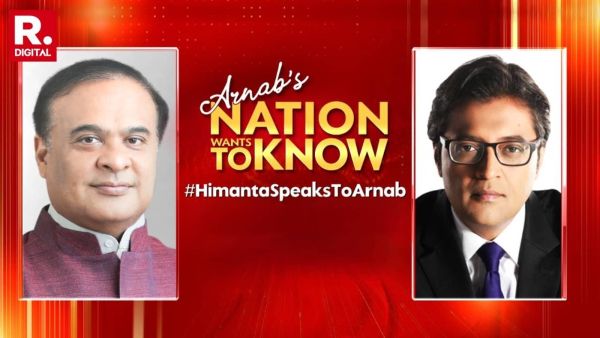
New Delhi: Assam Chief Minister Himanta Biswa Sarma, who led the Bharatiya Janata Party to a decisive victory for the third consecutive term in the state, is often criticised for being communal, and even going to the extent of labelling him as anti-Muslim. In an exclusive conversation with Republic Media Network Editor-in-Chief Arnab Goswami, Sarma broke down what is behind the tough stands he has taken and why a clear “distinction” needs to be made while analysing his approach.
In his first post-verdict interview, Sarma said that he had taken tough action against Bangladeshi Muslims, which “cannot be compared with any other state”.
“The amount of land we have recovered, the amount of action we have taken against infiltrators - these are incomparable by any standard. We have done many things which are sufficient to point out that we have taken the hardest action ever possible,” the Chief Minister explained.
#HimantaSpeakstoArnab | Arnab’s Nation Wants to Know
— Republic (@republic) May 5, 2026
Is Himanta Biswa Sarma (@himantabiswa) communal ? The leader answers Arnab’s sharp questions with absolute clarity.
Tune in now - https://t.co/HIHvujNVLc#RepublicWorld #RepublicTV #RepublicNews #IndiaNews #LiveNews… pic.twitter.com/HfkEVE0x1H
No Grudge Against Indian Muslims
Himanta Biswa Sarma was careful to point out that he is not against the Indian Muslim community, even if they are politically opposed to him.
“There is a distinction. We never touch, or we never utter a single word against the Indian Muslim community. Even if they do not vote for the BJP, I do not have a grudge. Because I feel the Hindus and Muslims, who are original inhabitants of India, they have equal rights and equal authority under the Constitution of India,” he explained, adding the caveat, “My Constitution does not extend similar privileges to the Bangladeshi Muslims. You have to make that finer distinction.”
Sarma said that while he faces harsh criticism from the “so-called secular people” for his actions, who go to the extent of labelling him as “communal”, he explained, “We must see the distinction. We have to preserve our identity. We have to protect this land - Assam and Bengal. We cannot allow, in our lifetime, to convert Assam into a Muslim-majority state through infiltration.”
#HimantaSpeakstoArnab | Arnab’s Nation Wants to Know
— Republic (@republic) May 5, 2026
“Next five years will be a golden period for Eastern India.” Himanta Biswa Sarma (@himantabiswa) shares his vision for what’s in store for the region.
Tune in now - https://t.co/HIHvujNVLc#RepublicWorld #RepublicTV… pic.twitter.com/cDxesn9rC8
'Even Assamese Muslims Suffer'
The Assam Chief Minister was careful to make a distinction in his definition of a Muslim-majority state. He said that he does not have any complaint if Indian Muslims reproduce children and surpass their fellow Hindus, demographically and naturally.
“If Indian Muslims produce children and they bypass the Hindu community, I do not have a complaint. But I cannot allow people from across the border to keep on coming, and then eventually make us a minority,” Sarma said.
Sarma pointed out that through the process of infiltration, even the original inhabitants of Assam who are Muslims by faith suffer because of differences in “culture”.
“In that process, along with the Hindu population, even original Assamese Muslims, original Indian Muslims also suffer. Because the culture is not the same. So they also remain unhappy with infiltration,” he pointed out.
Explaining his stand on taking tough actions against Bangladeshi Muslims, the Assam CM underlined, “I am not communal. But I cannot allow Assam, Bengal, or any part of India becoming a Muslim majority in our lifetime.”
#HimantaSpeakstoArnab | Arnab’s Nation Wants to Know
— Republic (@republic) May 5, 2026
“We went into the election with the confirmation that around 38-40% of the people will not vote for us.” Himanta Biswa Sarma (@himantabiswa) talks about winning the decisive victory in Assam.
Tune in now -… pic.twitter.com/Pi3d4fxZS2
Is It Possible To Stop Infiltration Permanently?
When questioned by Arnab if the problem of infiltration can be stopped permanenets especially since India shared a long land border with Bangladesh on its eastern flank, Himanta answered, “I can defer it. I cannot stop something inevitable. But we can defer it to our next generation.”
Elaborating on his game plan for preventing infiltration, Sarma said that with mandate won by the BJP in neighbouring West Bengal, where the saffron party has won more than 200 seats, the effort to stop infiltration has got a “renewed ray of hope”.
“We can hold on for another 30 years. With the election we won in Bengal, it gives us a renewed ray of hope. If Assam, Bengal, Meghalaya, Tripura and Mizoram work together, probably we can defer for a good period of time,” he said.
“Things keep on changing, new things keep on emerging in the society…our next generation can take over our battle,” Sarma admitted.
#HimantaSpeakstoArnab | Arnab’s Nation Wants to Know
— Republic (@republic) May 5, 2026
“In the next election, BJP will even win Muslim majority seats.”: Himanta Biswa Sarma (@himantabiswa) shares his multidimensional approach to social reforms.
Tune in now - https://t.co/HIHvujNVLc#RepublicWorld #RepublicTV… pic.twitter.com/rQifPskbB0
Himanta's Take On Madrasas
Himanta Biswa Sarma who is a strong opponent of the Madrasa education system, is also known for his tough actions against the minority education institutions operating in his state. Explaining his stand on madrasas to Arnab, he said, “The madrasa education system is doing injustice to the Muslim community. You can always learn many things about Islam, which is a great religion. But for that, you do not have to push your children towards theological study from the beginning of his career.”
Sarma said that children should be educated in general schools first, and after his hours of learning he can then be taught aspects relating to his religion. “They should be taught to be doctors or engineers, and simultaneously, one can teach them the theological part of religion,” he explained.
“Don't go to madrasas, go to a general school, and after the schooling period, one can still learn about his religion,” he suggested, adding that modern learning is not “anti-Muslim”. Sarma even stressed that educated Muslims are “very happy” with the Assam government's stand on madrasas.
#HimantaSpeakstoArnab | Arnab’s Nation Wants to Know
— Republic (@republic) May 5, 2026
“In school and college, we used to study about the life of Indira Gandhi and Jawaharlal Nehru, now I am taking on their grandchildren ”: Himanta Biswa Sarma (@himantabiswa) criticizes the ‘nepo babies’ of Indian politics,… pic.twitter.com/sBuqZhbyuw
-
Editorial: Address environmental concerns over data centres

-
‘Are You Chief Priest?’ SC slams Sabarimala PIL petitioner
-
Vadodara Railway Station Gets Airport-Type Lounge: Watch Video

-
Tension increases between Iran and US, missile attack in Fujairah of UAE, 3 Indians injured, will there be a big war now?
-
Cannabis high: A goldmine waiting to be tapped in India?- The Week