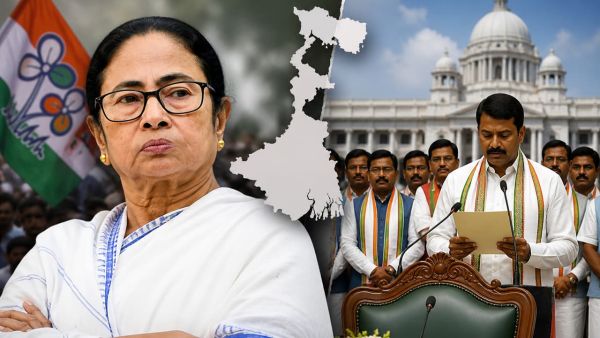
Mamata Banerjee has refused to resign after the defeat in West Bengal elections 2026. In such a situation, the same question is being raised everywhere that without resignation, how will the new government be formed and the Chief Minister sworn in? Let us know what the rules say about this.
West Bengal Assembly Election Results 2026: Mamata Banerjee's party has suffered a major setback in the results of West Bengal elections 2026. After BJP's landslide victory, Mamata Banerjee expressed displeasure over the election results and blamed BJP and the Election Commission for her defeat. Not only this, the TMC chief has also said that she will not resign from the post of Chief Minister. Mamta says that her party won the elections morally and in such a situation the question of resignation does not arise.
Can swearing in be stopped by not resigning?
After this statement, the biggest question arising is that if Mamata Banerjee does not resign, can the formation of the new government and the swearing in of the Chief Minister be stopped? Let us know what are the rules regarding this in the Constitution.
What the Constitution says: No impact on the new government
According to constitutional rules, Mamata Banerjee's resignation or not will have no impact on the formation of the new government. The Governor can appoint a new Chief Minister after the formation of the new Assembly, whether the existing Chief Minister has resigned or not.
It is necessary to complete the tenure of the assembly
According to the Constitution, the tenure of the Assembly is 5 years. The tenure of the current West Bengal Assembly will complete on May 7. After this, formation of a new government with the new assembly automatically becomes possible.
Expert opinion: No hurdles in the process
According to constitutional experts, there may be a constitutional problem in changing the Chief Minister during the tenure, but after the end of the tenure, there is no obstacle in forming a new government. Only the victory certificate issued by the Election Commission is valid. The decision of victory or defeat is decided on that basis.
Articles 172 and 164: What are the rules?
- Article 172: The tenure of the Assembly is fixed at 5 years.
- Article 164: Gives the Governor the right to appoint the Chief Minister and ministers
According to these provisions, the Governor can appoint a new Chief Minister to form the new government.
What might President's rule look like?
If a situation of constitutional crisis arises, the Governor can also recommend President's rule under Article 356. However, this step is taken only when the constitutional system in the state fails completely.
Mamta Banerjee's statement and further strategy
In a press conference held in Kolkata, Mamata Banerjee said, "I will not resign. We have not lost the elections, we have won morally. We will decide the future strategy together with the party." He also indicated that he was not in favor of going to Raj Bhavan and resigning. Overall, Mamata Banerjee's non-resignation will not have any impact on the formation of the new government or the swearing-in of the Chief Minister. Under the constitutional process, the formation of a new government with a new assembly is certain.
-
Sagittarius Daily Horoscope Today (Nov 22 - Dec 21), May 7, 2026: Steady Finances and Progress with Caution
-
Libra Daily Horoscope Today (Sept 23 - Oct 22), May 7, 2026: Librans May See Financial Growth, Minor Work Challenges Ahead
-
Mumbai Airport to remain shut for 6 hours today

-
Tamil Nadu: After TVK win, AIADMK and DMK alliance talk floats
-
Watch: Allu Arjun’s gesture towards burqa-clad woman wins hearts