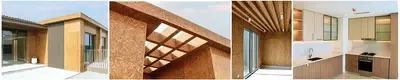
It has been over a year since DesertBoard installed a mock-up house at Dubai Creek Harbour. Conceived as a proof of concept, the structure, built using DesertBoard’s palm strand board (PSB®), demonstrates a construction material designed to be environmentally friendly, safer for indoor use, and built to last.
The structure reflects a rare example of homegrown innovation in the UAE’s building materials sector.
Over the past year, the mock-up has endured both the intense summer heat and the record rains that lashed the UAE last month. The structure has held firm. For the company’s Director, Kamal Farah, this is less about weather resilience and more about proving a broader proposition that a locally manufactured, bio-based material can replace imported wood products across construction, interiors and landscape in one of the world’s fastest-growing real estate markets.

Kamal Farah, Director DesertBoard.
“What we have proven with PSB® is that a locally manufactured material can surpass imported alternatives on performance, compliance and scale. The capability has always been there. What is changing now is how the market is evaluating materials. When you factor in lead times, ICV and sustainability, the case for local manufacturing becomes much stronger,” says Kamal Farah.
Building a domestic materials base
DesertBoard sits squarely within the UAE’s push to localise industrial production under initiatives such as Make it in the Emirates (MIITE), which aim to boost domestic manufacturing and reduce reliance on imports. The company’s model is inherently circular, sourcing raw material from date palm fronds, which is essentially a by-product generated in large volumes across the country.
“We are primary manufacturing,” says Kamal Farah. “We’re taking a raw material that would otherwise be burned or buried, releasing CO2 or methane, and turning it into something that supports construction, furniture, interiors among other sectors. That’s industrialisation at its core.”
Each year, millions of date palms in the UAE are pruned, producing biomass that has historically had limited commercial use. DesertBoard aggregates this waste through a network of farms and municipal partnerships, feeding it into a manufacturing process that produces engineered boards.
The localisation argument is as much about logistics as it is about sustainability. Imported wood boards, such as MDF, plywood or OSB, typically involve lead times of three to six months. DesertBoard says it can supply within days or weeks.
“In construction, timing is everything,” notes Kamal Farah. “If the material is here, coordination between trades becomes much easier. You shorten project timelines, and that has a real economic impact.”
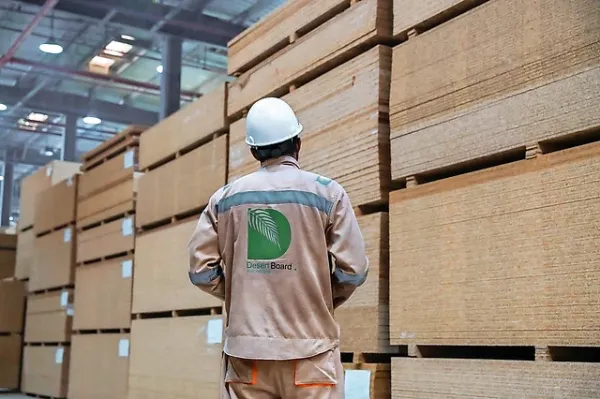
Providing a sense of scale of production, Kamal Farah adds, “Our annual production capacity is enough to fit out 200 Burj Khalifas. If you stack our boards vertically, the output would reach 36 kilometres.”
DesertBoard is positioning itself to meet the demands of large-scale developments led by players such as Emaar Properties and Aldar Properties, both of which are already using PSB® in selected projects.
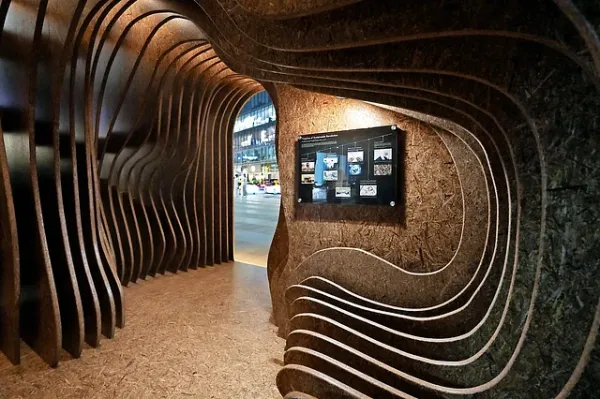
Applications are broad. The boards are being used in fire-rated doors, wardrobes, kitchens and vanities in residential towers, partitions in schools, raised flooring systems, acoustic panels, and even structural elements such as I-beams and trusses.
“We’re not just manufacturing a board,” Farah says. “We’re creating a platform material, something others can build industries on.”
Standards that compete locally and globally
PSB® is supported by a number of certifications and technical validations, including an Environmental Product Declaration (EPD), confirming its carbon profile and contribution towards Estidama and LEED frameworks.
This aligns with the UAE’s broader climate ambitions, including its net-zero target by 2050. Green building certification systems such as LEED also reward the use of low-emission, recycled or bio-based materials, potentially giving PSB® an edge in premium developments.
DesertBoard’s certifications also include In Country Value (ICV), an Abu Dhabi Quality and Conformity Council Certificate of Conformity, as well as compliance with European, British and US fire rating standards.
PSB®’s credentials on indoor air quality are equally significant. Conventional wood panels often contain formaldehyde-based resins, which can off-gas over time.
“Our PSB® boards are zero formaldehyde,” Kamal Farah says. “That means healthier indoor environments, with no off-gassing.”
Adoption lag
“Traction is clear, but widespread adoption will take time. Imports have been the default for years, and changing that mindset is a gradual process,” says Kamal Farah.
The barriers are not purely technical. The trade-off between cost and performance remains a familiar tension in construction markets globally. Developers, particularly in cost-sensitive segments, often prioritise upfront cost over life cycle benefits.
Moreover, industry inertia, entrenched supply chains and legacy building codes all play a role. In some cases, specifications still favour traditional materials, even where alternatives may outperform them.
Besides, there is also a knowledge gap. “We’ve had to educate the market, including developers, architects, contractors,” Kamal Farah says. “This is a new category. People need to understand what it can do.”
To bridge that gap, DesertBoard has expanded into downstream processing, including cutting, laminating and finishing boards in-house — lowering the barrier for customers who lack the equipment to work with new materials.
Regional and international interest
The company is making inroads in other Gulf markets, notably Saudi Arabia, which has a vast construction pipeline under Vision 2030.
“There’s a strong emotional connection there,” Kamal Farah says, referring to the cultural significance of date palms. “But beyond that, it makes commercial sense. We’re competitive, and we meet sustainability targets.”
At home, DesertBoard sees policy support as a potential inflection point. The UAE’s ICV programme, which incentivises local sourcing, could accelerate adoption.
“We’re not just ICV, we’re sustainable ICV,” Kaml Farah says. “That combination is powerful.”
The road ahead
Looking ahead, DesertBoard expects demand to accelerate over the next five years, which will lead to further expansion. “I see it really beginning to roll,”
Kamal Farah says. “We’re getting more requests, more collaborations. People want to develop products using our boards.”
The broader question is whether the construction sector, which is traditionally conservative in its approach, will move quickly enough to embrace such alternatives at scale. With stronger market adoption, we are well positioned to help steer the transition towards sustainable materials and maintain our role as regional pioneers.
— Suneeti Ahuja-Kohli is a Dubai-based freelance journalist.
-
'Curing diseased democracy': Why are voters attracted to political outsiders?

-
DC vs CSK, IPL 2026: Delhi Capitals, Chennai Super Kings in Must-Win Clash as Playoff Race Intensifies

-
All eyes on 'The Devil Wears Prada 2' stars as they bring couture drama to Met Gala 2026

-
Kiran Mazumdar-Shaw names niece Claire as Biocon successor

-
Road Rash! 39 Injured, 3 Critical After Speeding Truck Collides With Bus; Passengers Break Rear Glass To Escape -- VIDEO