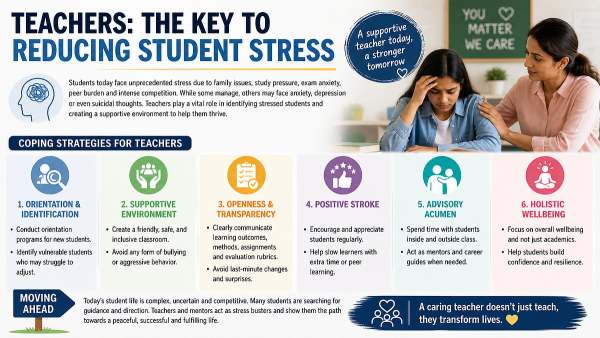
Students today face rising stress due to academic pressure, competition, and personal issues. Teachers play a key role in identifying vulnerable students and creating a supportive, transparent, and positive classroom environment to reduce anxiety and promote overall wellbeing.
Students in the current generation at all levels are experiencing unprecedented levels of stress. Family issues, study pressure, examination anxiety, peer burden, and extreme competition in the job market are some of the reasons for this. While sometimes the students can manage, other times it becomes a breaking point, and they become vulnerable, resulting in symptoms of anxiety, depression, etc. Some extreme cases may also result in suicidal tendencies.
In the above context, identifying the stressed students and strategies to mitigate them becomes crucial for teachers as students spend a significant amount of time at academic institutions, and many of these “stress stimulants” arise on account of the academic environment and pressures.
Coping Strategies:
Teachers are not trained as counsellors. Their main role is to create an enabling environment that encourages students to learn. Teachers have other responsibilities, such as research or administrative duties. Nevertheless, since schools/colleges are the shelter next only to homes and students spend a significant time of the day there, the teachers are required to create an environment where there is less stress (distress). It is a moral as well as a legal responsibility of the teacher to enhance the “overall well-being” of the students.
-
Sridhar Babu launches Rs 453 crore ITP Aero Facility project

-
Sandeep Reddy Vanga on Vijay’s win: This is what cinema can do

-
Video: Massive fire breaks out at Pista House banquet hall in Mahabubnagar

-
Iran says US military attacked civilian ships, killed 5 in Strait of Hormuz

-
Will of people supreme, says Mahua Moitra after BJP’s victory in Bengal