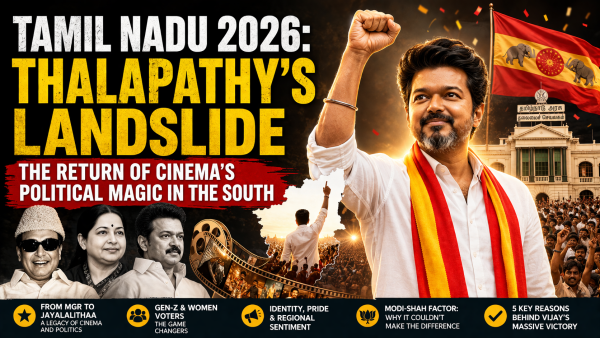
In the decades following M. G. Ramachandran and J. Jayalalithaa, Tamil Nadu’s political landscape appeared to have lost its cinematic anchor. That vacuum, long in the making, has now been filled. This moment signifies not just a transfer of power, but a broader reanimation of a distinct political culture.
From Cinema to Power: An Old Tradition, A New Face
The interplay between cinema and politics in Tamil Nadu is neither incidental nor recent.
- Between the 1960s and 1980s, M.G. Ramachandran cultivated an enduring image as a benefactor of the poor, seamlessly translating on-screen persona into political capital.
- From the 1990s to 2010, Jayalalithaa consolidated authority with a carefully constructed “Iron Lady” image, blending charisma with centralised control.
- In 2026, Vijay has crafted a hybrid narrative — that of a “youth icon” and a “system reformer.”
The anti-corruption crusader and system-defying protagonist that defined Vijay’s cinematic roles has now been projected onto the political stage with notable effect.
Gen Z and Women: The Decisive Shift
At the heart of this election lies a significant demographic realignment.
The Gen Z Factor
First-time voters appear to have embraced Vijay as a leader of their own generation. His campaign’s fluency in digital platforms — from social media outreach to meme-driven engagement — altered the contours of political communication.
Women Voters
Concerns over inflation, safety, and welfare delivery appear to have influenced voting behaviour among women. Vijay’s relatively unblemished public image contributed to a perception of credibility and trust.
The cumulative effect was the disruption of entrenched caste alignments and traditional party loyalties.
DMK Under Stalin: Governance Without Narrative?
Under M. K. Stalin, the DMK government was widely regarded as administratively stable. Yet, the electoral outcome suggests notable gaps:
- Anti-incumbency fatigue after prolonged governance
- Limited engagement with younger voters, both online and on the ground
- Localised grievances, particularly around employment and urban management
While administrative continuity remained a strength, the emotive and aspirational narrative of the election appeared to shift decisively in Vijay’s favour.
Language and Identity: A Persistent Undercurrent
The question of linguistic identity continues to shape Tamil Nadu’s political discourse. From the Anti-Hindi agitations of 1965 to contemporary debates around “one nation, one language,” the tension between regional identity and national integration has endured.
Vijay’s calibrated articulation of Tamil pride — assertive yet measured — appears to have resonated with voters, reinforcing a sense of regional selfhood without overt confrontation.
The Modi–Shah Factor: Limited Traction
Despite high-decibel campaigning by Narendra Modi and Amit Shah, the Bharatiya Janata Party struggled to translate national prominence into electoral gains in Tamil Nadu.
Key constraints included:
- A relatively weak grassroots organisational network
- Absence of a compelling local leadership face
- Limited credibility on issues tied to regional identity
The outcome once again illustrates the resilience of local political idioms over national narratives in the State.
Five Factors Behind Vijay’s Victory
- The convergence of star power with strategic political timing
- Unprecedented support from youth and women voters
- A palpable anti-incumbency sentiment
- Effective integration of digital outreach with ground mobilisation
- A nuanced invocation of regional identity
A New Chapter in Southern Politics
The 2026 mandate in Tamil Nadu is not merely about the rise of a new leader; it carries a broader political message:
In southern India, politics continues to be shaped as much by identity and emotional resonance as by developmental metrics.
Vijay’s decisive victory reaffirms three enduring realities: cinema remains a potent instrument of mass connection; the youth electorate has emerged as a decisive force; and in the contest between national and regional narratives, local sentiment retains its primacy.
-
HPBOSE 12th Result 2026 Declared: Himachal Board Class 12 Results Released—Here's How to Check Instantly..

-
HPBOSE 12th Result 2026: Himachal Board Class 12 Results Released; Saila Kashyap Tops the State by Securing 99% Marks..

-
DA Hike: Great News for Bank Employees! DA Rises to 25.70%—Here Is How Much Salary You Will Now Receive Every Month..
-
FD Rates May 2026: These FD Schemes Are a Lifeline for Old Age..
-
Gold for the Bride, Rings for the Children: Vijay Thalapathy's Promises That Will Make Him Break a Sweat to Fulfill..