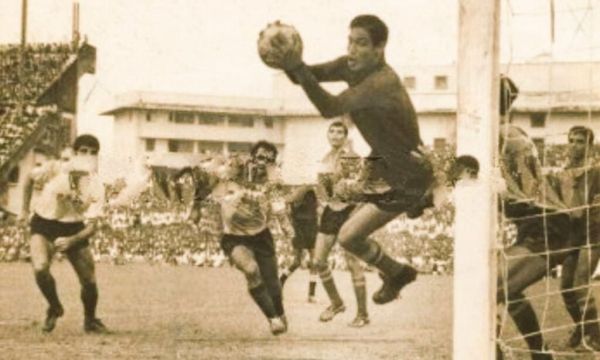
There was a time when Indian football did not chase relevance, it owned it.
Stadiums swelled with noise, names of players travelled like folklore, and victories were not just celebrated, they were felt.
In that golden age of the 1950s and 60s, when India stood tall on the Asian stage, heroes emerged from every corner of the pitch.
Some were easy to remember, artists with the ball at their feet, forwards who turned matches into theatre. And then there was Peter Thangaraj.
A goalkeeper. A name that should echo just as loudly, but somehow doesn’t.
A presence between the posts
Tall, imposing, and unmistakably confident, Thangaraj did not simply guard the goal, he commanded it.
At a time when goalkeepers were expected to stay rooted to their line, he stepped forward, both literally and metaphorically, redefining what the role could be.
Crosses into the box were not threats; they were invitations. He would rise above the chaos, pluck the ball cleanly from the air, and reset the rhythm of the game in an instant.
What followed often caught opponents off guard, a long throw, a booming clearance, the beginning of a counterattack before anyone else had processed the moment.
He wasn’t just stopping goals. He was creating possibilities.
Long before the term “sweeper-keeper” entered football vocabulary, Thangaraj was already living it.
The making of a Goalkeeper
Born in the mid-1930s in what was then Hyderabad, Thangaraj’s journey into goalkeeping wasn’t scripted.
In fact, it began elsewhere, up front, as a forward. It was only after joining the Indian Army and representing the Madras Regimental Centre that his path shifted.
Sometimes, careers change on instinct. Sometimes, on suggestion. In Thangaraj’s case, it became destiny.
The switch unlocked something extraordinary. His height, agility, and natural understanding of the game transformed him into a goalkeeper who stood apart. Success followed quickly, trophies with Services, leadership roles, and a growing reputation that would soon carry him onto the national stage.
Indian football’s golden era demanded players who could rise to the occasion. Thangaraj did just that.
He represented India at two Olympic Games, Melbourne in 1956 and Rome in 1960, standing firm against some of the strongest teams in the world.
In an era where Indian footballers often faced technically superior opposition, resilience mattered as much as skill. And Thangaraj had both.
Then came 1962.
At the Asian Games in Jakarta, India reached a defining moment.
The final against South Korea was tense, physical, and unforgiving.
Thangaraj, returning to the side despite illness, stood between victory and heartbreak. What followed was a performance built on courage, save after save, moment after moment of defiance.
India won gold. And Thangaraj was at the heart of it.
Kolkata and the Cult of a Goalkeeper
If India was the stage, Kolkata was the theatre.
Few players have experienced the intensity of the city’s football culture the way Thangaraj did.
He wore the colours of all three giants, Mohammedan Sporting, Mohun Bagan, and East Bengal, but it was in red and gold that his legend found its loudest voice.
Crowds didn’t just come to watch goals. They came to watch him.
There was something theatrical about the way he played, the anticipation before a high ball, the roar after a stunning save, the audacity of turning defence into attack in a single motion.
In a footballing culture that idolised flair, Thangaraj made goalkeeping feel just as captivating.
His résumé was formidable, Asian Games gold, continental recognition, domestic dominance, and the distinction of being named Asia’s best goalkeeper in the late 1950s.
In 1967, he became one of the rare goalkeepers to receive the Arjuna Award, a testament to his influence in a role often overlooked.
But numbers and honours only tell part of the story.
Ask those who played with him, and they speak of something else, his vision. His ability to read the game before it unfolded. His willingness to take risks. His understanding that a goalkeeper could be more than the last line of defence.
He made others better.
A legacy that still breathes
And yet, for all his brilliance, time was not kind to his memory.
As decades passed, the spotlight shifted. New heroes emerged, new narratives took over, and many from that golden generation slowly faded from mainstream consciousness.
Thangaraj, despite his towering presence in Indian football history, lived his later years away from the attention he once commanded.
In Bokaro, far from the roaring maidans of Kolkata, he spent his days in relative anonymity. When he passed away in 2008, the silence that followed felt disproportionate to the noise he once inspired.
But football has a way of remembering, even when the world forgets.
Every time a goalkeeper steps out of the box to intercept danger…
Every time a quick throw sparks an attack…
Every time a custodian dares to do more than just save, there’s a trace of Thangaraj in it.
He belonged to a time when Indian football believed in itself without hesitation. A time when players carried not just skill, but imagination. And in that era, Peter Thangaraj stood as proof that even in a position defined by caution, there is room for courage.
Perhaps he didn’t receive all the recognition he deserved. Perhaps his story isn’t told as often as it should be.
But some legacies don’t need constant retelling. They live on in influence, in inspiration, in the quiet understanding of those who truly know the game.
Peter Thangaraj was not just a goalkeeper.
He was a glimpse of what Indian football once was, and a reminder of what it can still become.
-
100 Questions in 2 Hours: Learn How the UP Lekhpal Recruitment Exam Will Be Conducted
-
UPSC Recruitment: UPSC Announces Vacancies for These Posts; Salaries in the Lakhs—Read for Details
-
Looking For A Healthy Pickle? Try This Fermented Bamboo Shoot Recipe Rich In Probiotics

-
Australia's Deputy High Commissioner Nick McCaffrey Enjoys Idlis & Medu Vada Combo; Playfully Teases Debate Between Two Iconic South Indian Dishes

-
Centre Announces 15,000 AI Scholarships For Media, Gaming & Animation With IICT, Google & YouTube