MUMBAI: Growth in third-party (TP) motor insurance premiums has edged past the own-damage (OD) segment, marking a reversal of the post-pandemic trend as enforcement against uninsured vehicles intensifies.
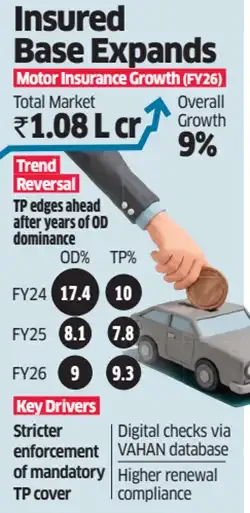
TP premiums rose 9.3% in FY26, compared with 9% growth in OD, taking overall motor insurance expansion to about 9% on an estimated base of Rs 1.08 lakh crore. This contrasts with FY24, when OD grew a stronger 17.4% against roughly 10% for TP, supported by robust vehicle sales and pricing improvements. In FY25, OD grew at 8.1% while TP grew at 7.8%. The latest shift comes despite no increase in regulated TP premium rates since the pandemic.
The reversal is notable after several years of OD-led growth. In FY22, TP grew 5.4% versus 1.7% for OD, but the trend flipped in FY23 and FY24, when OD consistently outpaced TP. FY26 marks the first meaningful swing back, albeit marginal, in favour of TP.
Also Read: Mobile money doubles to $2 trillion in 4 years as digital payments surge globally: Report
The pickup is being driven largely by tighter enforcement and improved compliance. Third-party insurance is mandatory by law, and penalties for non-compliance Rs 2,000 for a first offence and up to Rs 4,000 or imprisonment for repeat violations, are increasingly being enforced. Authorities in multiple states have stepped up checks using digital verification tools linked to the VAHAN database, bringing more uninsured vehicles into the system. Industry estimates suggest 40-45% of vehicles were previously uninsured, leaving significant headroom for growth.
"Crackdowns and better surveillance are steadily expanding the insured pool," said a senior insurance executive, pointing to state-led campaigns and insurer partnerships to improve coverage.
By contrast, OD growth remains closely tied to new vehicle sales, which have been relatively subdued. OD typically accounts for nearly 80% of premiums for private cars and is more sensitive to fresh demand cycles. TP, however, benefits both from new vehicle sales and improved renewal compliance among existing owners.
Also Read: Punjab & Sind Bank aims to cross total business milestone of Rs 3 lakh cr in FY27
Changes in the automobile market are also influencing pricing dynamics. The combined market share of Maruti Suzuki and Hyundai Motor India has declined to around 50% from roughly 75% a few years ago, with Tata Motors and Mahindra & Mahindra gaining share. Vehicles from newer players often have lower repair and spare-part costs, allowing insurers to price OD premiums more competitively.
TP premiums rose 9.3% in FY26, compared with 9% growth in OD, taking overall motor insurance expansion to about 9% on an estimated base of Rs 1.08 lakh crore. This contrasts with FY24, when OD grew a stronger 17.4% against roughly 10% for TP, supported by robust vehicle sales and pricing improvements. In FY25, OD grew at 8.1% while TP grew at 7.8%. The latest shift comes despite no increase in regulated TP premium rates since the pandemic.
The reversal is notable after several years of OD-led growth. In FY22, TP grew 5.4% versus 1.7% for OD, but the trend flipped in FY23 and FY24, when OD consistently outpaced TP. FY26 marks the first meaningful swing back, albeit marginal, in favour of TP.
Also Read: Mobile money doubles to $2 trillion in 4 years as digital payments surge globally: Report
The pickup is being driven largely by tighter enforcement and improved compliance. Third-party insurance is mandatory by law, and penalties for non-compliance Rs 2,000 for a first offence and up to Rs 4,000 or imprisonment for repeat violations, are increasingly being enforced. Authorities in multiple states have stepped up checks using digital verification tools linked to the VAHAN database, bringing more uninsured vehicles into the system. Industry estimates suggest 40-45% of vehicles were previously uninsured, leaving significant headroom for growth.
"Crackdowns and better surveillance are steadily expanding the insured pool," said a senior insurance executive, pointing to state-led campaigns and insurer partnerships to improve coverage.
By contrast, OD growth remains closely tied to new vehicle sales, which have been relatively subdued. OD typically accounts for nearly 80% of premiums for private cars and is more sensitive to fresh demand cycles. TP, however, benefits both from new vehicle sales and improved renewal compliance among existing owners.
Also Read: Punjab & Sind Bank aims to cross total business milestone of Rs 3 lakh cr in FY27
Changes in the automobile market are also influencing pricing dynamics. The combined market share of Maruti Suzuki and Hyundai Motor India has declined to around 50% from roughly 75% a few years ago, with Tata Motors and Mahindra & Mahindra gaining share. Vehicles from newer players often have lower repair and spare-part costs, allowing insurers to price OD premiums more competitively.