New Delhi: It is a classification conundrum for the battery energy storage industry. A single Harmonised System of Nomenclature (HSN) code is leading to systems being sometimes categorised as power banks, pushing up duties and complicating deployment.
The industry has sought separate HSN codes, an approved manufacturer list and tighter local content norms, along with clarity on customs duty deferment under warehouse rules for the 12-year life of storage projects.
The HSN is a globally standardised system used to classify traded goods and determine tariffs.
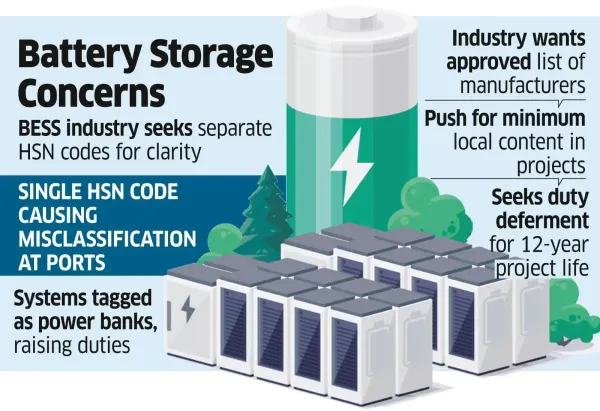 In a recent meeting with the power ministry, industry representatives said battery energy storage systems, lithium-ion cells and battery packs are currently classified under a single HSN code, leading to inconsistent interpretation at ports, people familiar with the matter told ET. Companies also asked the government to introduce an approved list of battery manufacturers and mandate minimum local content for storage projects.
On the regulatory front, the industry has sought clarity on customs duty deferment under manufacturing and warehouse regulations for the life of storage projects. "Some BESS developers are seeking customs duty deferment for the useful life of the BESS project, which is 12 years under the current 'manufacture and other warehouse regulations'," said one of the people quoted earlier.
In several cases, systems have been categorised as power banks, attracting higher customs duties. The industry has sought distinct HSN codes for cells, battery packs and storage systems to remove ambiguity and rationalise duties.
The demand comes as India scales up grid-level storage to support renewable integration, grid stability and peak power requirements during non-solar hours.
An approved list of battery manufacturers, which would act as a non-tariff barrier, could help build a domestic supply chain, industry executives said. Similar lists exist for solar modules, while a list for cell manufacturers is expected to roll out in June.
Current rules require storage systems to be charged only from co-located renewable energy sources, limiting flexibility, the person said. The industry has sought permission to charge from other sources, including non-renewable power, to optimise utilisation.
Stationary energy storage deployment is expected to accelerate during 2030-35, driven by large-scale renewable integration, grid balancing and peak-shaving requirements, with demand projected to grow at more than 23% CAGR through 2035, according to a report by the India Energy Storage Alliance.
Beyond 2035, growth is expected to moderate to about 12% annually as markets mature, although overall battery demand will continue to expand towards 2047.
The industry has sought separate HSN codes, an approved manufacturer list and tighter local content norms, along with clarity on customs duty deferment under warehouse rules for the 12-year life of storage projects.
The HSN is a globally standardised system used to classify traded goods and determine tariffs.
On the regulatory front, the industry has sought clarity on customs duty deferment under manufacturing and warehouse regulations for the life of storage projects. "Some BESS developers are seeking customs duty deferment for the useful life of the BESS project, which is 12 years under the current 'manufacture and other warehouse regulations'," said one of the people quoted earlier.
In several cases, systems have been categorised as power banks, attracting higher customs duties. The industry has sought distinct HSN codes for cells, battery packs and storage systems to remove ambiguity and rationalise duties.
The demand comes as India scales up grid-level storage to support renewable integration, grid stability and peak power requirements during non-solar hours.
An approved list of battery manufacturers, which would act as a non-tariff barrier, could help build a domestic supply chain, industry executives said. Similar lists exist for solar modules, while a list for cell manufacturers is expected to roll out in June.
Current rules require storage systems to be charged only from co-located renewable energy sources, limiting flexibility, the person said. The industry has sought permission to charge from other sources, including non-renewable power, to optimise utilisation.
Stationary energy storage deployment is expected to accelerate during 2030-35, driven by large-scale renewable integration, grid balancing and peak-shaving requirements, with demand projected to grow at more than 23% CAGR through 2035, according to a report by the India Energy Storage Alliance.
Beyond 2035, growth is expected to moderate to about 12% annually as markets mature, although overall battery demand will continue to expand towards 2047.