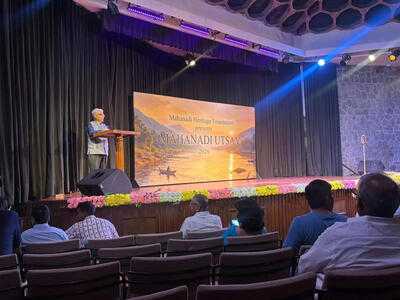
The Mahanadi is often described as the lifeline of Odisha, a river that has carried not just water, but memory, livelihood, and culture across centuries. Flowing through fertile plains and historic towns, it has shaped identities as much as landscapes. For many, it is not merely a river but a living presence, sometimes even called the Ganges of Odisha for its cultural and emotional significance.
It was this layered legacy that came into focus at
Mahanadi Utsav 2026, held at the India International Centre in New Delhi. Organised as an evening of reflection, art, and dialogue, the event brought together voices from culture, governance, and environmental discourse — all centred on one urgent theme: the story of rivers, and what they are becoming.
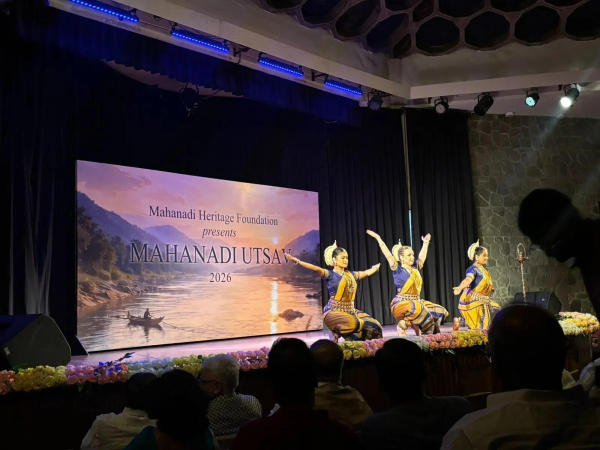
The evening opened not with speeches, but with performance, a deliberate choice that set the tone. A classical dance invocation unfolded first, measured and graceful, drawing from traditions that have long found inspiration in nature and flowing water. This was followed by a musical interlude featuring flute, tabla, and sitar, where the notes seemed to echo the rhythm of a river itself, sometimes gentle, sometimes insistent. Another dance performance followed, closing the cultural segment with a sense of continuity between art and ecology.
The discussions that followed were grounded, reflective, and at times quietly urgent.
Justice Harishankar, one of the panelists, began by appreciating the richness of classical traditions before moving into a more personal reflection. He spoke of travelling through Kerala by train, recalling how the landscape stayed with him. “Green is the most beautiful colour,” he observed, adding that a greener earth would mean a better future for all. He also noted that this was the first time he had encountered an event dedicated entirely to rivers — an idea he described as both rare and necessary, especially in a time when their importance is often overlooked.
Cmmentator Satya Narayan Sabu expanded on this thought, suggesting that rivers must be understood not just literally but also symbolically, as a
roopak, or metaphor, for continuity and life itself. He pointed out how even modern cities have historically grown around rivers, underlining their role in shaping civilisation. Rivers, he noted, are also vital for the transport of goods, quietly sustaining economies in ways that often go unnoticed. Recalling Sambalpur, he mentioned a temple with a slight tilt,!drawing a comparison to the Leaning Tower and urged people to visit the region to better understand its heritage and connection to the Mahanadi.
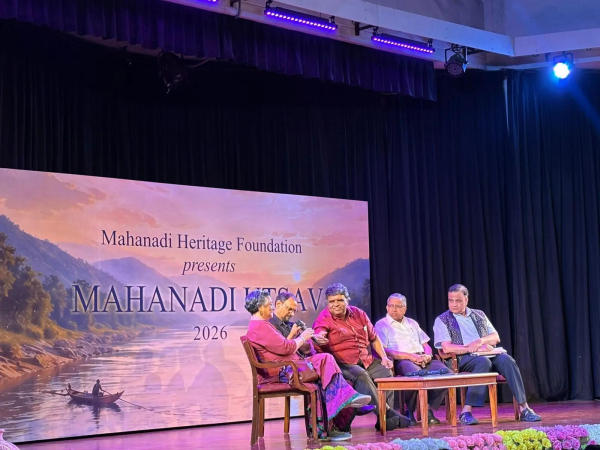
Adding an environmental perspective, Richard Mahapatra, editor of
Down To Earth, brought the conversation to a sobering reality. He remarked that rivers have existed for millions of years, far older than human civilisation, yet in recent decades, their condition has changed drastically. “Nothing in the last 45 years has been normal,” he noted, reflecting on how human activity has altered the natural balance of the planet.
He posed a stark question: what happens when a river stops flowing? It no longer remains a river, he said, but becomes a drain, losing its ability to sustain life. Referring to the Mahanadi and several other major rivers, he warned that many are now facing the threat of drying due to climate change and environmental degradation. The purpose of gatherings like this, he suggested, is to confront what humanity has done to its own natural systems.
The sentiment was echoed across the panel, including by other speakers who emphasised the urgency of awareness and collective responsibility.
If the performances celebrated the spirit of the Mahanadi, the conversations served as a reminder of its fragility. The evening, in that sense, was not just a cultural tribute but a call to attention, urging those present to see rivers not as distant entities but as living systems deeply intertwined with human survival.
-
Was BJP’s Bet On RG Kar Victim’s Mother Ratna Debnath The Game-Changer In Panihati?

-
Mandaviya To Oversee Election Of BJP’s Puducherry Legislature Party Leader
-
Vintage Rohit Sharma And Ryan Rickelton Shatter Iconic Mumbai Indians Record

-
ISL 2025-26: Braian Sánchez Penalty Earns Bengaluru FC 1-1 Draw Against Odisha FC

-
Ritika Sajdeh's Reaction To Rohit Sharma's Lucky Boundary During MI VS LSG Clash Goes Viral