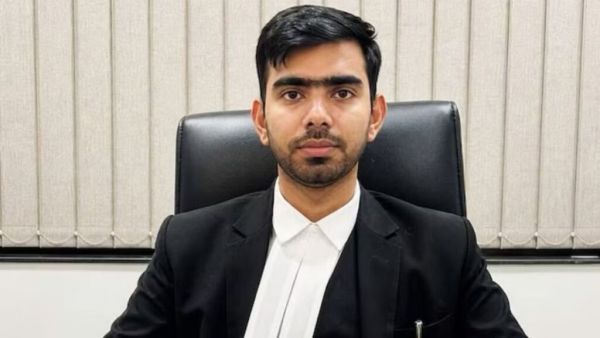
- Suspicious death of 30-year-old judge Aman Kumar Sharma
- Allegation of mental harassment and threats by wife
- The issue of mental harassment and abuse of men is discussed
Judge Aman Kumar Sharma Death : The suspicious death of 30-year-old judge Aman Kumar Sharma from South Delhi’s Safdarjung area has created a stir. After the case came to light, Aman Kumar Sharma was working as the secretary of the District Legal Services Authority (DLSA) at Delhi’s Karkarduma court. Although the police are investigating the case as suicide, Aman Sharma’s family has alleged that Aman took the extreme step due to mental harassment and threats from his wife.
The Amankumar Sharma case has once again brought to the fore the sensitive issue of harassment against men. An issue that is not often openly discussed. But the psychological abuse of men also raises a larger social and legal issue. In such situations, questions are raised as to what rights and legal protections are available to male victims of harassment. We are going to learn about it today.
The arbitrariness of banks will stop! Supreme Court strikes on check delay, High Court reprimands on account freeze
Men are also victims of harassment
In Indian society, domestic violence and harassment are generally viewed in relation to women. Section 85 of the Indian Penal Code (BNS 2023) (Section 498A of the old IPC) is a women-specific law and is limited to harassment of women. But at the same time many men also face mental, emotional and sometimes physical harassment in today’s society. Social stigma and the perception that ‘men don’t feel pain’ often prevent men from expressing their pain. According to the National Crime Records Bureau (NCRB) statistics, the number of suicides among married men is very high and family problems are one of the main reasons behind it. Despite this, harassment against men is not sufficiently discussed or taken seriously.
Place of Men in Indian Laws
The Domestic Violence Act, 2005 enacted to protect women from domestic violence in India is specifically for women. Similarly, Section 85 of BNS 2023 (Section 498A of old IPC) also applies only to women. But what are the provisions regarding violence against men? Such a question also arises. Technically, Indian law is not ‘gender-neutral’, meaning that many laws are designed to protect women only. This does not mean that men have no legal recourse.
Legal way is better than torture and suicide
If a man proves that he is being subjected to constant mental harassment, he can take appropriate action under the Indian Penal Code (BNSS) 2023. Men are falsely accused of dowry or domestic violence in marital disputes. Even in such cases men have few options.
Swaraj Dweep: Golden saga of bravery composed by Andaman; India holds a world record by hoisting the world’s largest tricolor at the bottom of the sea
In a false case of domestic violence – In a false case of domestic violence or dowry harassment, the husband can file a petition in the High Court under Section 528 of the Indian Civil Protection Code (BNSS) 2023 (earlier Section 482 of the Code of Criminal Procedure) to quash the FIR or criminal proceedings.
Drive to suicide – family arguments, differences often lead men to take extreme steps like suicide. Cases relating to incitement to such suicide now fall under Section 108 of the Indian Penal Code, BNS 2023. A conviction can lead to up to 10 years in prison and a fine. Any man abetted to commit suicide can be prosecuted under these provisions with proof.
In case of blackmail, threats and defamation – If men are threatened, blackmailed or falsely accused, a case can be filed under Section 351(1) (criminal intimidation) and Section 356(1) (defamation) of the Indian Penal Code, BNS 2023. Criminal or civil defamation suit can also be filed under section 356(3) of BNS 2023.
Divorce Options: Although the Domestic Violence Act, 2005, is primarily for women, men can apply for divorce under the provisions of the Hindu Marriage Act, 1955 by presenting evidence of harassment, physical violence or mental harassment.
The lack of clear legal provisions for male victims in cases of sexual assault has once again come under the spotlight. Experts are of the opinion that since the new Indian Penal Code (Bharatiya Nyaya Sanhita) 2023 does not directly include provisions like the old Indian Penal Code Section 377 (IPC) Section 377), there is no separate and clear legal framework for unnatural acts against men without consent.
‘Operation Lotus’ will also happen in Punjab? This is an important step taken by Chief Minister Bhagwant Mann
In present scenario such cases are booked under other sections like assault, battery or hurt. Because current rape laws seem to be limited mainly to female victims. Hence, male victims often face legal hurdles in seeking justice.
Meanwhile, in such sensitive cases in the background of matrimonial or family disputes, the counseling route is also important. Counseling and mediation available through family courts provides an effective platform for both parties to present their positions and resolve disputes.
According to experts, timely counseling and communication can improve relationships and prevent serious consequences. An opinion is being expressed that it is necessary for men to actively participate in this process and openly present their problems.
-
BMC Recruitment 2026: Apply for Fireman, Clerk, and Various Positions

-
Gujarat: BJP candidate, father arrested for cutting water supply after Panchayat poll loss
-
RRB NTPC 2026 Admit Card Released for 10+2 UG Posts

-
Kerala CM Pinarayi Vijayan demands rollback of steep LPG price hike

-
Older state pensioners given £8 weekly extra in May after triple lock change