
Listen to this article in summarized format
Loading...
××
Subscribe to

Unlock AI Briefing and Premium Content
New Year Offer 24 Hours Left
Subscribe NowAlready a member? Sign In
What's Included
- Exclusive Stories
- Daily ePaper Access
- Smart Market Tools
- Curated Investment Ideas
- Ad-lite Experience
Subscription

The act of dropping your keys on the table next to the front door is an easy, unimportant habit. As vehicles change the habit of putting them on tables is becoming a risk. By 2023, over one million cars were stolen in the United States, and investigators claim that today's criminals do not rely solely on brute force. They're combining traditional techniques combined with the latest technology in order in order to steal cars and leave any trace.
Based on the National Insurance Crime Bureau, criminals are increasingly employing sophisticated methods to take advantage of the fact that cars are keyless. Once considered a convenience, it is now a risky proposition.
Keyless entry is a the keyless entry system.
Keyless entry systems operate by continuously communicating wireless signals that connect the vehicle and the key fob. Once the car has detected the key fob in close proximity and it is able to unlock the door immediately. Analog Devices engineers Analog Devices note that more than 70% of cars today are equipped with this type of technology, usually using radio frequencies as high as 315 megahertz within the United States.
To drivers, the effortless encounter feels like magic. It's also an possibility. While these signals are not visible are able to be snatched or extended and then altered.
Relay attacks transform security into convenience
The most popular method employed by contemporary car thieves is called an attack relay. It doesn't involve breaking glass or imposing locks. Instead, it rely on the forwarding of signals.
A typical scenario is that two persons work. The one is near to the car and the other is in the vicinity of at the point where the key fob situated. Utilizing digital devices, they record and relay the signals from the fob's key to the vehicle. The car is convinced that the key is in its possession and instantly unlocks.
Industry explanations and studies show that these signals could extend up to 49 feet within a residence which means that a lock left close to a window or door could be detected by someone from the outside. The vulnerability has been researched over the years. Researchers Aurelien Francillon, Boris Danev and Srdjan Capkun of ETH Zurich demonstrated practical relay attacks against ten vehicles which allowed cars to be opened even though the keys were 160 feet away, but without a clear lines of sight.
Aluminum foil has become an interesting solution
To counter this increasing danger Some drivers have resorted towards a nebulous method that is aluminum foil. While this may sound odd however the scientific basis is solid.
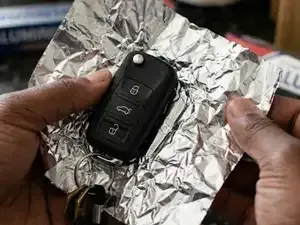
The wrapping of a key fob with foil makes a fundamental variant of what's known as"a Faraday cage. It is named after the physical scientist Michael Faraday, this concept is the process of enclosing a object with an electrically conductive material which blocks electromagnetic signals. It is explained by the National High Magnetic Field Laboratory states that enclosures block radio waves from entering and effectively separating what is in the.
If the fob's key is completely wrapped, the signal becomes difficult or impossible to relay devices recognize. Even though aluminum foil isn't precisely as effective as shielding materials, it will nevertheless significantly decrease leakage when applied in a proper manner.
A foil technique that is efficient for everyday use
Effectiveness of this strategy is contingent on the extent to which the fob's signal is covered. Small gaps may permit signals to get through. Many layers of foil, and well-sealed edges enhance the results.
It is also important to test the system. Police agencies like Warwickshire Police recommend placing the key in foil before walking towards the vehicle to determine whether it is still locked. If the car is locked, then the shielding works.
Storage habits have a significant impact on. The act of keeping keys out of entrance points such as doors and windows decreases the possibility of interference with signals, particularly when the shielding isn't completely secure.
There is a reason that one solution doesn't work sufficient
Although aluminum foil may help protect against relay attacks, it's not the ultimate security measure. The theft of vehicles can happen by other means, such as forced entry and towing.
The research continues to reveal more widespread vulnerabilities within keys-less systems. Security experts stress the importance of layering protection. Companies like Thatcham Research recommend using signal-blocking pouches, ensuring that keys can be turned off in idle mode, and keeping current with the latest security features of manufacturers.
Keyless security: the future
Automakers are already focusing to improve their products. Technology like Ultra Wide Band aim to hinder relay attacks by measuring the exact distance between the keys and the vehicle. Key fobs that are more modern contain motion sensors, which cease transmitting messages when they are still.
These solutions, however, do not have a universal application, and their efficacy varies on the type of model and brand. As of now, awareness remains among the best devices drivers use.
An unimportant change which reflects the larger change
The wrapping of a key fob with aluminum foil isn't always attractive, but it is a reflection of the growing awareness of the ways modern security threats work. With cars becoming increasingly connected and intuitive, they demand a paradigm shift in how people think about security.
The once basic object has now become an actual transmitter. Giving it extra care, for example via foil, pouches with protection and better storage methods will make a huge impact.
In an age in which theft can occur silently and quickly, small steps can keep your vehicle the same place you put it.
Based on the National Insurance Crime Bureau, criminals are increasingly employing sophisticated methods to take advantage of the fact that cars are keyless. Once considered a convenience, it is now a risky proposition.
Keyless entry is a the keyless entry system.
Keyless entry systems operate by continuously communicating wireless signals that connect the vehicle and the key fob. Once the car has detected the key fob in close proximity and it is able to unlock the door immediately. Analog Devices engineers Analog Devices note that more than 70% of cars today are equipped with this type of technology, usually using radio frequencies as high as 315 megahertz within the United States.
To drivers, the effortless encounter feels like magic. It's also an possibility. While these signals are not visible are able to be snatched or extended and then altered.
Image Credit: Gemini | Keyless car theft rises as relay attacks exploit signals
Relay attacks transform security into convenience
The most popular method employed by contemporary car thieves is called an attack relay. It doesn't involve breaking glass or imposing locks. Instead, it rely on the forwarding of signals.
A typical scenario is that two persons work. The one is near to the car and the other is in the vicinity of at the point where the key fob situated. Utilizing digital devices, they record and relay the signals from the fob's key to the vehicle. The car is convinced that the key is in its possession and instantly unlocks.
Industry explanations and studies show that these signals could extend up to 49 feet within a residence which means that a lock left close to a window or door could be detected by someone from the outside. The vulnerability has been researched over the years. Researchers Aurelien Francillon, Boris Danev and Srdjan Capkun of ETH Zurich demonstrated practical relay attacks against ten vehicles which allowed cars to be opened even though the keys were 160 feet away, but without a clear lines of sight.
Aluminum foil has become an interesting solution
To counter this increasing danger Some drivers have resorted towards a nebulous method that is aluminum foil. While this may sound odd however the scientific basis is solid.
The wrapping of a key fob with foil makes a fundamental variant of what's known as"a Faraday cage. It is named after the physical scientist Michael Faraday, this concept is the process of enclosing a object with an electrically conductive material which blocks electromagnetic signals. It is explained by the National High Magnetic Field Laboratory states that enclosures block radio waves from entering and effectively separating what is in the.
If the fob's key is completely wrapped, the signal becomes difficult or impossible to relay devices recognize. Even though aluminum foil isn't precisely as effective as shielding materials, it will nevertheless significantly decrease leakage when applied in a proper manner.
A foil technique that is efficient for everyday use
Effectiveness of this strategy is contingent on the extent to which the fob's signal is covered. Small gaps may permit signals to get through. Many layers of foil, and well-sealed edges enhance the results.
It is also important to test the system. Police agencies like Warwickshire Police recommend placing the key in foil before walking towards the vehicle to determine whether it is still locked. If the car is locked, then the shielding works.
Storage habits have a significant impact on. The act of keeping keys out of entrance points such as doors and windows decreases the possibility of interference with signals, particularly when the shielding isn't completely secure.
There is a reason that one solution doesn't work sufficient
Although aluminum foil may help protect against relay attacks, it's not the ultimate security measure. The theft of vehicles can happen by other means, such as forced entry and towing.
The research continues to reveal more widespread vulnerabilities within keys-less systems. Security experts stress the importance of layering protection. Companies like Thatcham Research recommend using signal-blocking pouches, ensuring that keys can be turned off in idle mode, and keeping current with the latest security features of manufacturers.
Keyless security: the future
Automakers are already focusing to improve their products. Technology like Ultra Wide Band aim to hinder relay attacks by measuring the exact distance between the keys and the vehicle. Key fobs that are more modern contain motion sensors, which cease transmitting messages when they are still.
These solutions, however, do not have a universal application, and their efficacy varies on the type of model and brand. As of now, awareness remains among the best devices drivers use.
An unimportant change which reflects the larger change
The wrapping of a key fob with aluminum foil isn't always attractive, but it is a reflection of the growing awareness of the ways modern security threats work. With cars becoming increasingly connected and intuitive, they demand a paradigm shift in how people think about security.
The once basic object has now become an actual transmitter. Giving it extra care, for example via foil, pouches with protection and better storage methods will make a huge impact.
In an age in which theft can occur silently and quickly, small steps can keep your vehicle the same place you put it.
( Originally published on Apr 30, 2026 )