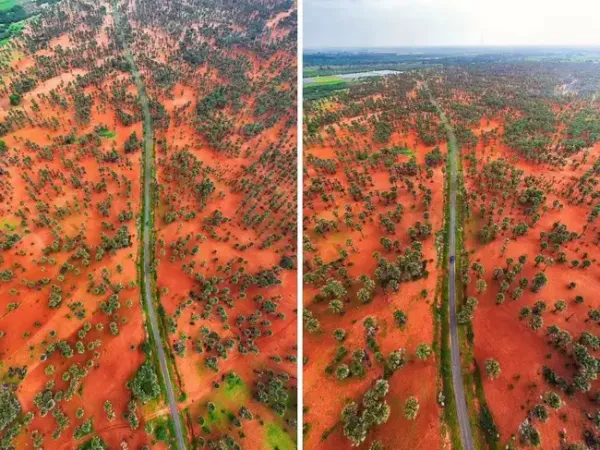
Whenever we think of Tamil Nadu, the image that comes to mind is the architecturally marvellous temples, pristine hills, and bustling coastal towns. Be it the iconic Marina Beach in Chennai or the lush green landscapes of Ooty and Kodaikanal, Tamil Nadu tourism is usually associated with spirituality, cultural heritage, and natural beauty. But do you know that beyond its famous and typical landmarks, Tamil Nadu is also home to a beautiful desert? Yes, you read that right. This hidden gem is known as Theri Kaadu.
All about Tamil Nadu’s red sand desert
Tucked away in the districts of Thoothukudi and Tirunelveli lies Theri Kaadu, a red sand desert spread across approximately 12,000 acres. As per a report by The Better India, this magical terrain is characterised by striking crimson dunes, shaped by time and the relentless forces of nature. The sand gets its bright red hue from the high levels of iron oxide.
Theri Kaadu was formed thousands of years ago, dating back to the Quaternary Period. Dubbed as ‘red dune forest’, it is believed that the desert was formed through a complex interplay of marine deposits and wind-driven processes. Recently, IAS officer Supriya Sahu shared a video of the region on X, admiring the desert’s sheer beauty.
Territorial guide to Theri Kaadu
Supriya Sahu, in her note, revealed that although Theri Kaadu is seemingly arid, these porous sands harvest rain, recharge groundwater and sustain precious freshwater springs known as Sunai in a low-rainfall region. This is nature’s water bank hidden beneath a desert of red. It is primarily divided into 3 types.
Inland Theris: The inland theris are found deeper away from the coastline and tend to remain more settled over time.
Near Coastal Theris: Mid-zone or near-coastal theris lie between the interior and the shore, where wind activity and human influence cause moderate shifts in their structure.
Coastal Theris: Closest to the sea are the coastal theris, which are the most active and ever-changing, as persistent southwest winds continuously reshape their sandy formations
Things to do in Theri Kaadu
Despite the arid conditions, there are palm and cashew trees as well as sparse vegetation that has grown here naturally, thriving in this delicate ecosystem. Some popular wildlife that tourists can spot here include fan-throated lizards, sand boas, saw-scaled vipers, jackals, Madras hedgehogs, and pangolins. Bird species like owls, green bee-eaters and black-rumped woodpeckers are also common.
Travel enthusiasts can also visit the famous Karkuvel Ayyanar and Arunchunai Kaatha Ayyanar temples, offering a fascinating blend of spirituality, local folklore, and desert scenery. Engage in photography and short hikes to explore the region and feel its raw charm.
How to reach Theri Kaadu
By Road: Theri Kaadu is 15 km from Tiruchendur and is easily accessible from Thoothukudi and Tirunelveli.
By Rail: Tiruchendur is the nearest railway station, which is well-connected to major cities in Tamil Nadu.
By Air: Thoothukudi Airport, located 60 km away, is the closest, with domestic flights from Chennai and other parts of India.
All about Tamil Nadu’s red sand desert
Tucked away in the districts of Thoothukudi and Tirunelveli lies Theri Kaadu, a red sand desert spread across approximately 12,000 acres. As per a report by The Better India, this magical terrain is characterised by striking crimson dunes, shaped by time and the relentless forces of nature. The sand gets its bright red hue from the high levels of iron oxide.
Theri Kaadu was formed thousands of years ago, dating back to the Quaternary Period. Dubbed as ‘red dune forest’, it is believed that the desert was formed through a complex interplay of marine deposits and wind-driven processes. Recently, IAS officer Supriya Sahu shared a video of the region on X, admiring the desert’s sheer beauty.
Territorial guide to Theri Kaadu
Supriya Sahu, in her note, revealed that although Theri Kaadu is seemingly arid, these porous sands harvest rain, recharge groundwater and sustain precious freshwater springs known as Sunai in a low-rainfall region. This is nature’s water bank hidden beneath a desert of red. It is primarily divided into 3 types.
Inland Theris: The inland theris are found deeper away from the coastline and tend to remain more settled over time.
Near Coastal Theris: Mid-zone or near-coastal theris lie between the interior and the shore, where wind activity and human influence cause moderate shifts in their structure.
Coastal Theris: Closest to the sea are the coastal theris, which are the most active and ever-changing, as persistent southwest winds continuously reshape their sandy formations
Things to do in Theri Kaadu
Despite the arid conditions, there are palm and cashew trees as well as sparse vegetation that has grown here naturally, thriving in this delicate ecosystem. Some popular wildlife that tourists can spot here include fan-throated lizards, sand boas, saw-scaled vipers, jackals, Madras hedgehogs, and pangolins. Bird species like owls, green bee-eaters and black-rumped woodpeckers are also common.
Travel enthusiasts can also visit the famous Karkuvel Ayyanar and Arunchunai Kaatha Ayyanar temples, offering a fascinating blend of spirituality, local folklore, and desert scenery. Engage in photography and short hikes to explore the region and feel its raw charm.
How to reach Theri Kaadu
By Road: Theri Kaadu is 15 km from Tiruchendur and is easily accessible from Thoothukudi and Tirunelveli.
By Rail: Tiruchendur is the nearest railway station, which is well-connected to major cities in Tamil Nadu.
By Air: Thoothukudi Airport, located 60 km away, is the closest, with domestic flights from Chennai and other parts of India.