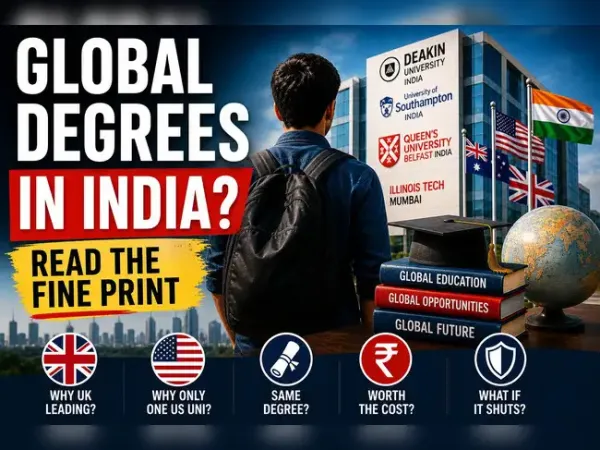
Global degrees on Indian soil: A great deal, with the fine print to consider (AI-generated image)
For decades, the path to a foreign university degree ran through a visa office, a currency exchange counter, and a one-way flight. That path is being rerouted.
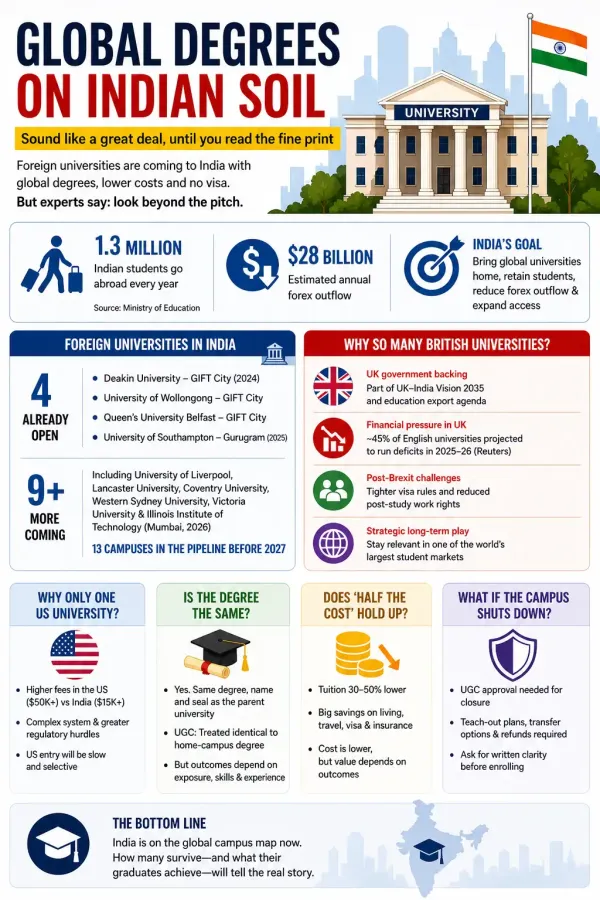
India's decision to open its doors to foreign universities was driven by a specific gap. Every year, roughly 1.3 million Indian students go abroad for higher education, according to Ministry of Education data, taking with them an estimated $28 billion in annual foreign exchange outflow.
Also Read: Beyond Big Four: Indian students are dumping default study abroad settings
The UGC's 2023 Foreign Higher Education Institutions regulations were designed to address this: bring global institutions to India, retain students, reduce the forex drain, and expand access to internationally recognised degrees without requiring students to relocate.
(Join our ETNRI WhatsApp channel for all the latest updates)
In less than two years, India has gone from having no foreign degree-granting university campuses to hosting four, with at least a dozen more in various stages of launch before 2027. Deakin University from Australia was the first to open at GIFT City in Gujarat in 2024, under these regulations. The University of Wollongong followed at the same address. Queen's University Belfast set up at GIFT City. The University of Southampton enrolled its first batch in Gurugram in 2025.
Behind them, a queue has formed. The University of Liverpool and Lancaster University are targeting Bengaluru launches in 2026. Coventry University, Western Sydney University, and Victoria University from Melbourne have received UGC approvals. Illinois Institute of Technology from Chicago, the first American university to receive UGC approval, opens in Mumbai in Fall 2026.
Thirteen campuses in roughly three years, in a country that was entirely absent from the global branch campus map before 2024. The pitch to students is straightforward: the same degree, the same university name on the certificate, no visa queue, no forex burn, and tuition that in many programmes runs at roughly half the overseas cost. Education consultants and industry experts, however, say the questions students need to ask go well beyond the pitch.
In late 2025, the UK government confirmed approvals for nine universities to open in India, concentrated in Bengaluru, Gurugram, and GIFT City. The announcement was framed explicitly as part of a trade mission and education-export agenda.
UK universities are under financial pressure. Around 45 percent of English higher education institutions are projected to run deficits in 2025-26, Reuters has reported. Following Brexit, visa restrictions tightened post-study work rights and international student recruitment slowed across several markets.
"The UK's expansion into India reflects both a strategic government effort and a commercial response from universities," said Aritra Ghosal, CEO and Founder of OneStep Global. "Post-study work rights have become less generous, migration rules have tightened, and institutions that were heavily dependent on overseas enrolment are now looking for ways to preserve their relationship with Indian students even if those students choose not to relocate."
Ashish Gupta, Co-Founder and CEO of EdNex Global, says the motive is layered. "This is strategic long-term positioning. Setting up campuses in India allows them to stay relevant, accessible, and competitive in one of the world's largest student markets."
The India-UK Vision 2035 framework places education as a central pillar of bilateral engagement, with Whitehall backing these campuses as part of a broader soft power and trade agenda.
Adarsh Khandelwal, Co-Founder and Director of Collegify, points to data that adds context: official UK Home Office figures show Indian nationals remained the single largest nationality for sponsored study visas in the year ending December 2025, with over 95,000 visas granted to main applicants. "This is not the UK replacing outbound Indian students," he said. "It is the UK diversifying how it captures Indian demand."
Indian students form one of the largest overseas cohorts at US universities, over 300,000 enrolments annually, and yet only Illinois Tech has made the move. No Ivy League institution, no major state university system, no research powerhouse has committed to a campus.
Anirudh Singh, Founder of DreamLadder Consultancy, points to the revenue equation.
"A student paying $50,000 annually in the US generates far more revenue than one paying $15,000 in India. Even if enrollment increases, the overall financial return may decline." Gupta points to institutional structure as a separate factor. "The US system is inherently more complex. Accreditation, governance, and risk appetite differ significantly from the UK and Australia. American universities are also more cautious about brand dilution and regulatory ambiguity." On the timeline, Gupta said: "The US will come, but expect a phased, selective entry rather than a rapid expansion."
Also Read: Can you fulfil your study abroad dream without going broke? Here are 7 ways to minimise costs
Reports have named the University of Michigan and Purdue University as institutions exploring India, but neither has announced a confirmed campus. Illinois Tech is widely seen by observers as a test case. Strong enrolments and employer acceptance in Mumbai would likely accelerate American interest.
According to the UGC's 2023 Foreign Higher Education Institutions regulations, degrees from Indian branch campuses carry the name and seal of the parent university, require no further equivalency verification for Indian employment or higher education admission, and are treated as identical to the home-campus qualification.
The question experts raise is about what surrounds the degree, not the degree itself. Gupta said: "The degree opens doors, but outcomes will depend on the student's profile, not just the campus location." In India, he noted, acceptance is growing among progressive employers. In the US and Europe, recruiters tend to value the brand first and the campus second, but internships and exposure remain decisive factors.
Ghosal said recruiters look beyond the certificate. "They assess academic rigour, internships, international exposure, communication skills, and the ability to operate in a global workplace." Within India, multinational firms and Global Capability Centres in consulting, technology, analytics, and financial services are expected to respond positively. In the US and Europe, local work experience and in-country professional networks carry weight that a domestic campus cannot replicate.
Khandelwal said families need to draw a clear distinction before enrolling. "Students should not confuse degree parity with experience parity. A branch campus can deliver the same qualification; it does not automatically deliver the same alumni density, local employer network, overseas exposure, or immigration pathway as studying in Chicago, Southampton, or Wollongong itself." Singh cited early placement data: branch campus graduates are entering the market with starting salaries running 10 to 25 percent lower than peers who completed the same programme overseas. "This is not necessarily due to differences in ability, but differences in exposure and access," he said.
Reuters reported that programmes costing more than £25,000 in the UK were being priced at approximately £10,000 to £12,000 at new Indian campuses. University of Wollongong India lists its Master of Computing at AUD 27,900; the equivalent programme at UOW Australia is listed at AUD 65,160 before overseas living costs are factored in.
The larger savings come from relocation costs that simply disappear. Rent, flights, food, insurance, visa fees, and currency risk are not part of the equation for a student studying in India. Gupta said the claim broadly holds. "Tuition at branch campuses is typically 30 to 50 percent lower, and you save significantly on living expenses. But it is not always half in absolute terms, especially for premium programmes. The real value lies in cost versus outcome."
Singh entered a corrective on the domestic comparison. At Rs 15 to 20 lakh annually, branch campuses are among the most expensive options within India. Students are weighing them against not just overseas education but also IITs, NITs, and established private universities with deep placement networks. Students who study in the US typically have starting salaries of $60,000 to $80,000, which over time can offset the higher upfront cost of going abroad. "The 'half the cost' claim is accurate in terms of upfront expenses," Singh said, "but incomplete in terms of value."
Branch campus closures are a documented global pattern, with failures recorded across the Middle East, Southeast Asia, and beyond, typically due to low enrolment, high operating costs, or a parent institution exiting a market. Times Higher Education has tracked multiple such closures over the past two decades. India is not immune, and the first wave of campuses has not yet been tested against a difficult financial cycle.
The UGC framework sets out a clear requirement: foreign universities cannot close or discontinue a programme without prior approval, and parent institutions must ensure teach-out plans, transfer pathways, and transcript continuity for affected students. Gupta described the protections as meaningful. "Foreign universities cannot discontinue any course, programme, or close the campus without the UGC's prior approval. In case of disruption, the parent entity is responsible for providing alternative arrangements to affected students."
Also Read: Germany to shift beyond student mobility; strengthen research, institutional collaboration in India
Khandelwal said families should go beyond regulatory assurances. "Ask for the teach-out plan, transcript continuity, transfer pathway, and refund terms in writing before enrolling. GIFT City campuses operate under a separate International Financial Services Centres Authority (IFSCA) framework rather than the standard UGC route, and that distinction families must understand before signing up," he said. Ghosal said the more likely risk is not sudden closure but gradual strain: institutions that enter India without a clear understanding of local sectoral recruitment demand may find it difficult to sustain growth over time.
India is now on the foreign university campus map in a way it was not two years ago. How many of these campuses are still operational a decade from now, and what their graduates are earning, will determine whether this moment represents a structural shift in how Indian students access global education, or the opening chapter of a more complicated story.
India's decision to open its doors to foreign universities was driven by a specific gap. Every year, roughly 1.3 million Indian students go abroad for higher education, according to Ministry of Education data, taking with them an estimated $28 billion in annual foreign exchange outflow.
Also Read: Beyond Big Four: Indian students are dumping default study abroad settings
The UGC's 2023 Foreign Higher Education Institutions regulations were designed to address this: bring global institutions to India, retain students, reduce the forex drain, and expand access to internationally recognised degrees without requiring students to relocate.
(Join our ETNRI WhatsApp channel for all the latest updates)
In less than two years, India has gone from having no foreign degree-granting university campuses to hosting four, with at least a dozen more in various stages of launch before 2027. Deakin University from Australia was the first to open at GIFT City in Gujarat in 2024, under these regulations. The University of Wollongong followed at the same address. Queen's University Belfast set up at GIFT City. The University of Southampton enrolled its first batch in Gurugram in 2025.
Behind them, a queue has formed. The University of Liverpool and Lancaster University are targeting Bengaluru launches in 2026. Coventry University, Western Sydney University, and Victoria University from Melbourne have received UGC approvals. Illinois Institute of Technology from Chicago, the first American university to receive UGC approval, opens in Mumbai in Fall 2026.
Thirteen campuses in roughly three years, in a country that was entirely absent from the global branch campus map before 2024. The pitch to students is straightforward: the same degree, the same university name on the certificate, no visa queue, no forex burn, and tuition that in many programmes runs at roughly half the overseas cost. Education consultants and industry experts, however, say the questions students need to ask go well beyond the pitch.
Why do nearly half of India's planned foreign campuses turn out to be British?
In late 2025, the UK government confirmed approvals for nine universities to open in India, concentrated in Bengaluru, Gurugram, and GIFT City. The announcement was framed explicitly as part of a trade mission and education-export agenda.
UK universities are under financial pressure. Around 45 percent of English higher education institutions are projected to run deficits in 2025-26, Reuters has reported. Following Brexit, visa restrictions tightened post-study work rights and international student recruitment slowed across several markets.
"The UK's expansion into India reflects both a strategic government effort and a commercial response from universities," said Aritra Ghosal, CEO and Founder of OneStep Global. "Post-study work rights have become less generous, migration rules have tightened, and institutions that were heavily dependent on overseas enrolment are now looking for ways to preserve their relationship with Indian students even if those students choose not to relocate."
Ashish Gupta, Co-Founder and CEO of EdNex Global, says the motive is layered. "This is strategic long-term positioning. Setting up campuses in India allows them to stay relevant, accessible, and competitive in one of the world's largest student markets."
The India-UK Vision 2035 framework places education as a central pillar of bilateral engagement, with Whitehall backing these campuses as part of a broader soft power and trade agenda.
Here's how the numbers matter
Adarsh Khandelwal, Co-Founder and Director of Collegify, points to data that adds context: official UK Home Office figures show Indian nationals remained the single largest nationality for sponsored study visas in the year ending December 2025, with over 95,000 visas granted to main applicants. "This is not the UK replacing outbound Indian students," he said. "It is the UK diversifying how it captures Indian demand."
With 300,000 Indian students already in the US, why is only one American university here?
Indian students form one of the largest overseas cohorts at US universities, over 300,000 enrolments annually, and yet only Illinois Tech has made the move. No Ivy League institution, no major state university system, no research powerhouse has committed to a campus.
Anirudh Singh, Founder of DreamLadder Consultancy, points to the revenue equation.
"A student paying $50,000 annually in the US generates far more revenue than one paying $15,000 in India. Even if enrollment increases, the overall financial return may decline." Gupta points to institutional structure as a separate factor. "The US system is inherently more complex. Accreditation, governance, and risk appetite differ significantly from the UK and Australia. American universities are also more cautious about brand dilution and regulatory ambiguity." On the timeline, Gupta said: "The US will come, but expect a phased, selective entry rather than a rapid expansion."
Also Read: Can you fulfil your study abroad dream without going broke? Here are 7 ways to minimise costs
Reports have named the University of Michigan and Purdue University as institutions exploring India, but neither has announced a confirmed campus. Illinois Tech is widely seen by observers as a test case. Strong enrolments and employer acceptance in Mumbai would likely accelerate American interest.
Is the degree you get in India the same as the one you would get abroad?
According to the UGC's 2023 Foreign Higher Education Institutions regulations, degrees from Indian branch campuses carry the name and seal of the parent university, require no further equivalency verification for Indian employment or higher education admission, and are treated as identical to the home-campus qualification.
The question experts raise is about what surrounds the degree, not the degree itself. Gupta said: "The degree opens doors, but outcomes will depend on the student's profile, not just the campus location." In India, he noted, acceptance is growing among progressive employers. In the US and Europe, recruiters tend to value the brand first and the campus second, but internships and exposure remain decisive factors.
Ghosal said recruiters look beyond the certificate. "They assess academic rigour, internships, international exposure, communication skills, and the ability to operate in a global workplace." Within India, multinational firms and Global Capability Centres in consulting, technology, analytics, and financial services are expected to respond positively. In the US and Europe, local work experience and in-country professional networks carry weight that a domestic campus cannot replicate.
Khandelwal said families need to draw a clear distinction before enrolling. "Students should not confuse degree parity with experience parity. A branch campus can deliver the same qualification; it does not automatically deliver the same alumni density, local employer network, overseas exposure, or immigration pathway as studying in Chicago, Southampton, or Wollongong itself." Singh cited early placement data: branch campus graduates are entering the market with starting salaries running 10 to 25 percent lower than peers who completed the same programme overseas. "This is not necessarily due to differences in ability, but differences in exposure and access," he said.
Does 'half the cost' actually hold up?
Reuters reported that programmes costing more than £25,000 in the UK were being priced at approximately £10,000 to £12,000 at new Indian campuses. University of Wollongong India lists its Master of Computing at AUD 27,900; the equivalent programme at UOW Australia is listed at AUD 65,160 before overseas living costs are factored in.
The larger savings come from relocation costs that simply disappear. Rent, flights, food, insurance, visa fees, and currency risk are not part of the equation for a student studying in India. Gupta said the claim broadly holds. "Tuition at branch campuses is typically 30 to 50 percent lower, and you save significantly on living expenses. But it is not always half in absolute terms, especially for premium programmes. The real value lies in cost versus outcome."
Singh entered a corrective on the domestic comparison. At Rs 15 to 20 lakh annually, branch campuses are among the most expensive options within India. Students are weighing them against not just overseas education but also IITs, NITs, and established private universities with deep placement networks. Students who study in the US typically have starting salaries of $60,000 to $80,000, which over time can offset the higher upfront cost of going abroad. "The 'half the cost' claim is accurate in terms of upfront expenses," Singh said, "but incomplete in terms of value."
What happens to your degree if the campus shuts down?
Branch campus closures are a documented global pattern, with failures recorded across the Middle East, Southeast Asia, and beyond, typically due to low enrolment, high operating costs, or a parent institution exiting a market. Times Higher Education has tracked multiple such closures over the past two decades. India is not immune, and the first wave of campuses has not yet been tested against a difficult financial cycle.
The UGC framework sets out a clear requirement: foreign universities cannot close or discontinue a programme without prior approval, and parent institutions must ensure teach-out plans, transfer pathways, and transcript continuity for affected students. Gupta described the protections as meaningful. "Foreign universities cannot discontinue any course, programme, or close the campus without the UGC's prior approval. In case of disruption, the parent entity is responsible for providing alternative arrangements to affected students."
Also Read: Germany to shift beyond student mobility; strengthen research, institutional collaboration in India
Khandelwal said families should go beyond regulatory assurances. "Ask for the teach-out plan, transcript continuity, transfer pathway, and refund terms in writing before enrolling. GIFT City campuses operate under a separate International Financial Services Centres Authority (IFSCA) framework rather than the standard UGC route, and that distinction families must understand before signing up," he said. Ghosal said the more likely risk is not sudden closure but gradual strain: institutions that enter India without a clear understanding of local sectoral recruitment demand may find it difficult to sustain growth over time.
India is now on the foreign university campus map in a way it was not two years ago. How many of these campuses are still operational a decade from now, and what their graduates are earning, will determine whether this moment represents a structural shift in how Indian students access global education, or the opening chapter of a more complicated story.