
Listen to this article in summarized format
Loading...
××
Subscribe to

Unlock AI Briefing and Premium Content
New Year Offer 24 Hours Left
Subscribe NowAlready a member? Sign In
What's Included
- Exclusive Stories
- Daily ePaper Access
- Smart Market Tools
- Curated Investment Ideas
- Ad-lite Experience
Subscription

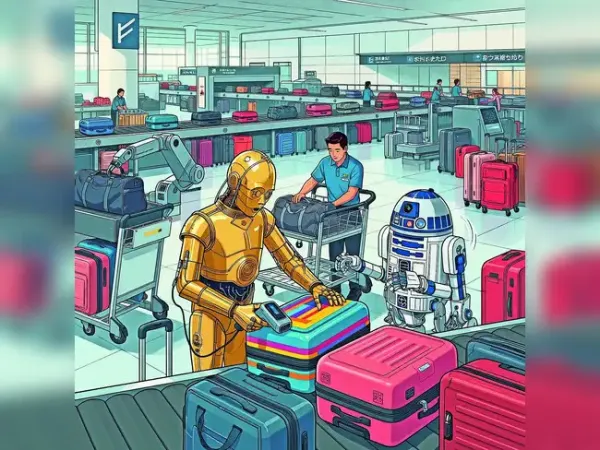
Travellers with poor experience of airport baggage handling will be particularly interested in Japan Airlines' experiment with giving jobs to robots at Tokyo's Haneda airport. Trials beginning this month will use Unitree's humanoid robots to move baggage, cargo and equipment across the airport.
Depending on how they perform, their role could be widened to other ground-handling services like cleaning aircraft cabins. These are 'cobots', designed to collaborate with humans doing the same work, but at an entirely different level of productivity. If the experiment is successful, it will offer a solution to Japan's ageing population and a surge in tourism. And if it works at Haneda, it can surely work at Heathrow and JFK.
Robots are replacing workers the world over in manufacturing, construction, logistics. The fastest-growing segment is humanoid robots that can mimic human activity. This requires programming on a much larger scale than in robots built for specific repetitive tasks. The programming constraint is not as binding with advances in AI.
Hardware costs are also falling. Initial costs of deploying robots remain high. But they are offset by gains in productivity. The choice is thrust on economies with advanced manufacturing capabilities facing labour shortages. China, Japan and South Korea are driving up global stock of robots as their populations decline.
Asia is leading the charge in robots because of its manufacturing base and immigration policies. The US and Europe trail due to deindustrialisation and immigration, which keeps a check on labour shortages. Yet, cost of using robots has fallen below wage floors of most advanced economies, and labour displacement can be tackled through upskilling. Tech has brought down the entry barrier for automation.
Even countries like India with large labour pools are automating at rates well over their economic growth. Efficiency gains can contribute to income redistribution while pushing the labour force into higher- value employment. So, at some point wherever you are, Asimov will give way to Terminator.
Depending on how they perform, their role could be widened to other ground-handling services like cleaning aircraft cabins. These are 'cobots', designed to collaborate with humans doing the same work, but at an entirely different level of productivity. If the experiment is successful, it will offer a solution to Japan's ageing population and a surge in tourism. And if it works at Haneda, it can surely work at Heathrow and JFK.
Robots are replacing workers the world over in manufacturing, construction, logistics. The fastest-growing segment is humanoid robots that can mimic human activity. This requires programming on a much larger scale than in robots built for specific repetitive tasks. The programming constraint is not as binding with advances in AI.
Hardware costs are also falling. Initial costs of deploying robots remain high. But they are offset by gains in productivity. The choice is thrust on economies with advanced manufacturing capabilities facing labour shortages. China, Japan and South Korea are driving up global stock of robots as their populations decline.
Asia is leading the charge in robots because of its manufacturing base and immigration policies. The US and Europe trail due to deindustrialisation and immigration, which keeps a check on labour shortages. Yet, cost of using robots has fallen below wage floors of most advanced economies, and labour displacement can be tackled through upskilling. Tech has brought down the entry barrier for automation.
Even countries like India with large labour pools are automating at rates well over their economic growth. Efficiency gains can contribute to income redistribution while pushing the labour force into higher- value employment. So, at some point wherever you are, Asimov will give way to Terminator.