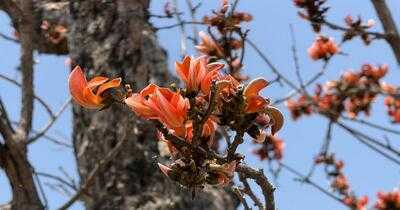
“If the flower of the palash is fully bloomed, that means it will be a good summer, and it will rain well that year,” says Sarita Devi, sitting under a tree in front of her home. “And if it does not bloom on time, the rains will not be good either.”
Sarita, 40, is a resident of Kundri village in Palamu district, Jharkhand. She belongs to the Dalit community. For generations, people here have predicted the weather through the palash tree. Their livelihoods also depend on it.
The palash tree is used to grow lac, a natural resin produced by the insect Kerria lacca (rangeeni), which farmers harvest and sell in the market. On the palash tree, lac is produced twice a year: once in the rainy season (harvested in October-November) and once in the summer (harvested in June–July).
For years, Sarita worked at the Kundri lac farm, widely described by officials as Asia’s largest lac plantation. Every October, she tied lac-bearing twigs to palash branches. Over the next few months, the resin slowly builds up on the branches and is later harvested and processed.
“We used to do all the lac work,” she says. “Putting it on the trees, taking it off, peeling it, collecting it. It gave us very good...
Read more
-
IPL 2026: Rahul, Starc Lead Delhi Capitals To Dominant 7-Wicket Win

-
'Lack Of Consistency Not Pressure Hurting Mumbai Indians,' Says Coach Mahela Jayawardene Ahead Of Crucial Clash

-
RR Vs DC: Riyan Parag Wins Toss, Rajasthan Royals Opt To Bat First In Jaipur; Mitchell Starc Returns For Delhi

-
Ek Din, Devil Wears Prada 2, Raja Shivaji Box Office Collection Day 1 Prediction: Aamir's Film To Take Low Opening, Hollywood Release & Riteish's Movie Heading For Good Start

-
Caught On Cam: K9 Alerts Secret Service Officers About Suspect Cole Allen Moments Before White House Correspondents’ Dinner Shooting