
In the UAE’s economic narrative, visibility is often mistaken for value. Attention typically gravitates towards sectors that are consumer-facing and globally marketed, particularly tourism, real estate, and financial services. Yet beneath this surface, a different economic engine is operating with far greater consistency and scale. Ras Al Khaimah has built its growth model around industrial output, positioning itself as one of the most export-driven and manufacturing-focused economies in the country.
This is not a recent shift. It is the result of a long-term structural approach that prioritises production over perception. While larger emirates have pursued visibility through large-scale developments and global positioning, Ras Al Khaimah has concentrated on sectors that underpin economic activity: construction materials, manufacturing, and pharmaceuticals. The outcome is a diversified industrial base with sustained global reach.
Industrial concentration as a strategic model
Ras Al Khaimah’s industrial ecosystem is defined by scale, integration, and export orientation. The presence of companies such as RAK Ceramics, Stevin Rock, and Julphar reflects a coordinated industrial framework that spans raw materials, finished products, and high-value manufacturing.
This vertical alignment is critical. It allows the emirate to capture value at multiple stages of the supply chain, from extraction and processing to production and distribution. More importantly, it reduces reliance on external inputs and strengthens supply chain control, which has become increasingly relevant in a volatile global environment.
RAK Ceramics
RAK Ceramics remains one of the most prominent indicators of Ras Al Khaimah’s industrial capacity. Established in 1989, the company has evolved into a global manufacturer serving more than 150 countries, supported by an extensive network of production and distribution hubs.
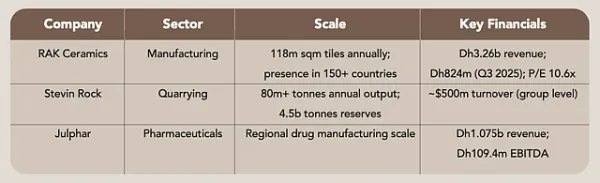
Its operational scale is substantial. The company produces 118 million square metres of tiles annually, alongside 5.7 million pieces of sanitaryware, 36 million pieces of porcelain tableware, and 2.6 million faucets. These outputs are generated across 23 manufacturing plants located in the UAE, India, Bangladesh, and Europe.
From a financial perspective, RAK Ceramics demonstrates a diversified revenue structure. Ceramic products account for Dh3.26 billion in sales, while faucets contribute Dh565.93 million and other industrial segments add Dh201.35 million. The company’s market capitalisation stands at approximately Dh2.52 billion.
Performance indicators reflect stability rather than volatility. Earnings increased by 1.8% over the past year, outperforming a building materials sector that contracted by 1.5%. Despite a net debt-to-equity ratio of 68.6%, the company maintains an EBIT interest coverage ratio of 4.2x, indicating sufficient operating income to meet financial obligations.
Minimalist sanityware design.
Recent results further reinforce this position. In third quarter of 2025, the company reported revenues of Dh824 million and net income of Dh66 million. Its price-to-earnings ratio of 10.6x remains below the UAE market average, suggesting relative valuation efficiency.
Group CEO Abdallah Massaad stated: “We continue to operate as normal, with a disciplined approach to serving market requirements. As a local manufacturer and diversified multinational, we were able to respond swiftly and bridge supply gaps, ensuring uninterrupted support for businesses and projects that rely on our products.”
He added: “Our focus remains on maintaining availability and accessibility of our products for our customers and partners. We are aligned with the UAE’s broader emphasis on continuity, stability and reliable market access.” These statements underscore the company’s emphasis on operational continuity and responsiveness to market conditions, both of which are essential for maintaining competitiveness in global supply chains.
Stevin Rock
At the upstream level, Stevin Rock provides the foundational materials required for construction and industrial activity. The company is among the largest crushed rock producers globally, with a production capacity exceeding 80 million tonnes per annum across limestone, dolomite, and gabbro.
Its reserves, estimated at approximately 4.5 billion tonnes, provide long-term resource security and enable sustained production without immediate supply constraints. This scale of reserves is a strategic asset, particularly in a region characterised by continuous infrastructure development.
The company’s product portfolio includes aggregates for asphalt and ready-mix concrete, materials for land reclamation, and specialised inputs such as armour rock for marine construction projects. Additionally, its output serves as feedstock for industries including cement, steel, glass, and chemicals. With a workforce exceeding 3,500 employees and over four decades of operational history, Stevin Rock has established a consistent growth trajectory. Its operational model is built on efficiency, safety, and continuous improvement, supported by investments in technology and infrastructure.
CEO Naser Al Bustami has highlighted the company’s strategic direction, noting that its focus remains on maintaining leadership in quarry operations while advancing sustainability and long-term resource management. This upstream capacity positions Ras Al Khaimah as a critical supplier within regional and international construction supply chains.
Julphar
Julphar represents a different dimension of Ras Al Khaimah’s industrial base. Operating within the pharmaceutical sector, the company requires compliance with stringent regulatory standards, alongside investment in research, production, and distribution capabilities.
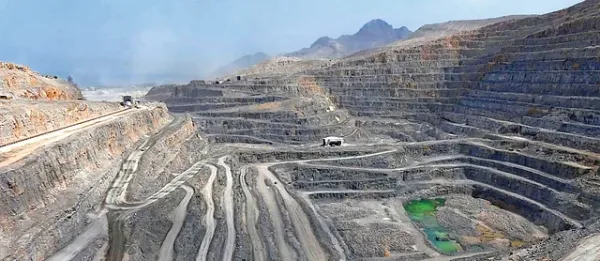
Large-scale industrial production.
For the financial year ending December 31, 2025, Julphar reported revenues of Dh1.075 billion, reflecting an 8.4% increase in reported currency and a 9% increase on a constant currency basis. EBITDA from continuing operations increased by 22.2% year-on-year to Dh109.4 million.
Net profit reached Dh173.3 million, although this includes a one-off capital gain of Dh111.2 million. Net operating profit from continuing operations stood at Dh43.9 million, indicating improved underlying business performance. The company maintains a strong balance sheet, with total assets of Dh1.78 billion and shareholder equity of Dh959.8 million, supporting its long-term growth strategy.
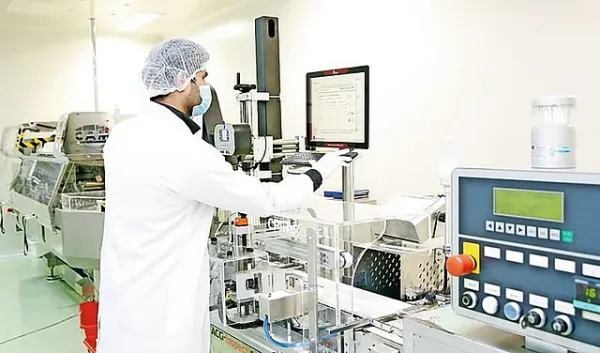
Precision manufacturing in action.
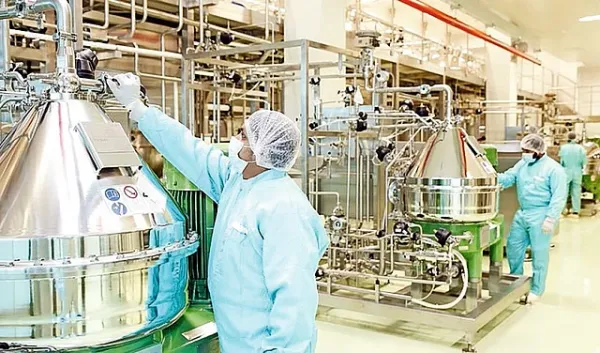
Large-scale industrial production.
Sheikh Saqer bin Humaid Al Qasimi, Chairman of Julphar, stated: “Continued focus on resilience, responsible growth, and long-term sustainability remains central to strengthening the company’s position and supporting its future ambitions across evolving markets.”
CEO Basel Ziyadeh added: “These results highlight our continued progress in maintaining a strong balance between investments, a solid capital structure, and sustainable long-term shareholder value creation.”
Structural drivers
Ras Al Khaimah’s industrial output is supported by a set of structural advantages that enable sustained production and export efficiency. Cost competitiveness remains a key factor. Industrial operations benefit from comparatively lower land and operational costs, allowing for large-scale manufacturing without the cost pressures associated with larger urban centres.
Logistics and connectivity provide additional support. The emirate’s access to ports and proximity to major shipping routes facilitate efficient export operations, particularly for high-volume producers.
Resource availability is another critical component. The presence of substantial natural reserves ensures long-term supply stability, reducing reliance on imported raw materials. Policy alignment further strengthens the ecosystem. Government support for industrial development, combined with regulatory clarity, creates a stable environment for investment and operational continuity.
Export orientation
A defining characteristic of Ras Al Khaimah’s economy is its export-driven structure. Industrial output is distributed across global markets, reducing dependency on domestic consumption and providing diversification across regions. This model enhances resilience, particularly in periods of economic volatility. Industrial exporters are able to adjust production and redirect supply based on demand fluctuations across markets, maintaining operational continuity even when specific regions experience slowdowns.
The response of companies such as RAK Ceramics to supply chain disruptions illustrates this adaptability. By maintaining production levels and addressing supply gaps, the company was able to sustain operations and support downstream industries. This capacity for adjustment is a critical advantage in a global environment characterised by uncertainty.
Output over optics
The prevailing perception of economic performance often prioritises visibility. However, in practical terms, output remains the more relevant metric. Ras Al Khaimah’s economic contribution is defined by measurable industrial production rather than sectoral prominence.
Companies operating in the emirate supply essential materials, manufactured goods, and pharmaceuticals to international markets, embedding Ras Al Khaimah within global supply chains. This role is less visible but structurally significant. The emirate’s ability to sustain production across multiple sectors, supported by disciplined financial management and operational efficiency, positions it as a stabilising component within the UAE economy.
 The silent industrial powerhouse: Why RAK is outproducing flashier emirates The geographical advantage: Ras Al Khaimah as the UAE's logistics backdoor Free zones anchor Ras Al Khaimah's growth strategy
-
UP JEECUP 2026: Registration Deadline for UP Polytechnic Exam Extended; Apply Soon..

-
Maharashtra 12th Result 2026: The Maharashtra HSC result will be released tomorrow at 1 PM on mahahsscboard.in.

-
UP Board Scrutiny 2026: Registration for UP Board Class 10 and 12 Scrutiny Begins—Apply Instantly in These 5 Steps..
-
Jharkhand 12th Result 2026: The toppers' list will also be released soon, along with the Intermediate results..

-
Maharashtra 12th Board Result 2026: Maharashtra Board HSC Results to be Released Tomorrow; 'Coming Soon' Alert on DigiLocker..