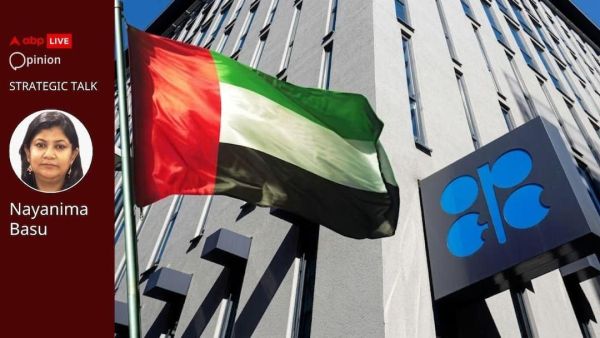
The United Arab Emirates (UAE) has officially declared its decision to withdraw from the Organization of the Petroleum Exporting Countries (OPEC) and the broader OPEC+ alliance, with the exit taking effect on May 1, 2026. By exiting OPEC, the UAE is no longer bound by production quotas and plans to increase output from 3 million to 5 million barrels per day (bpd) by 2027. This increased supply creates downward pressure on global crude prices, directly lowering India's massive oil import costs. In terms of strategic goal, the UAE plans to ramp up its oil production to 5 million bpd by 2027 to monetise its reserves faster and fund its long-term economic diversification.
Interestingly enough, the UAE Energy Minister Suhail Al Mazrouei said that the "policy decision" was made without consulting Saudi Arabia or other OPEC members. As the announcement came to light, oil prices initially dipped on news of a potential supply glut but rebounded as the US-Iran war and the Strait of Hormuz blockade continued to risk premiums. In terms of supply constraints, the Strait of Hormuz crisis prevents the UAE from exporting at full capacity, meaning the practical impact of the exit will be more pronounced once shipping routes reopen.
UAE’s exit from OPEC has weakened the latter’s capacity to keep the prices of crude stabilised. The move is expected to also bring in structural weaknesses for OPEC as the oil cartels may get more fragmented even as other major oil producing countries such as Iran and Iraq can take a similar decision or increase prices of oil. The UAE's exit occurs against the backdrop of the US-Iran war and the ongoing Strait of Hormuz blockade. As the war in Iran began on 28 February, OPEC’s role had already been dwindling even as its share in global oil production was steadily plummeting. It is feared that after UAE, others like Saudi Arabia and Iran can also follow suit thereby changing the dynamics of the oil market completely changed.
Council on Foreign Relations notes in a report that the UAE’s decision to end a fifty-eight-years membership in the cartel is a reflection of an alliance that was strained by the pressures of regional war and fractured diplomacy. The Emirati government has long taken issue with the quotas and price controls instituted by the cartel, and so it views this as in its best interest. The UAE’s departure has raised some pointed concerns about OPEC’s long-term cohesion, but it remains to be seen whether this change will have a serious effect on the cartel, noted CFR.
Coming to India, the larger commentary from experts had been that UAE’s exit from OPEC will translate into a substantial strategic victory for India, since it relies heavily on foreign oil, importing more than 85% of its crude oil needs. The UAE's departure from these oil-producing coalitions is anticipated to potentially reduce energy expenses for India and enhance the already growing bilateral relations between the two countries. This is also expected to lower India’s oil import bill on the long-term as increased supplies from UAE is expected to exert downward pressure on global crude prices, benefitting India, which imports over 85% of its oil. Analysts also suggest that New Delhi will now be able to negotiate independent, long-term supply agreements with the Abu Dhabi National Oil Company (ADNOC) without cartel interference. This is also an opportunity for India to further the oil-for-rupee trade settlement program, supporting India's de-dollarisation efforts.
However, all these depend on how UAE plans to play the oil game because it entails several risks and challenges that could negatively impact the Indian economy. The primary risk is a lack of price stability. OPEC has historically functioned as a "swing producer" that stabilizes prices by managing supply. Without a unified cartel to smooth out imbalances, oil prices could become more susceptible to rapid, extreme spikes during geopolitical crises, making energy budgeting difficult for India. A structurally weaker OPEC may find it harder to calibrate supply, leading to a fragmented landscape where prices are driven by chaotic market forces rather than coordinated discipline.
A sustained decline in global oil prices—caused by the UAE ramping up its production to 5 million barrels per day—is not universally good for Indian companies. Indian upstream companies like ONGC and Oil India, which explore and produce oil domestically, see their revenues directly tied to global crude prices. Lower prices could significantly squeeze their profitability and valuations. Besides, due to exchange rate uncertainty, sharp movements in crude prices can lead to sudden shifts in demand for US dollars, causing the Indian Rupee to fluctuate unexpectedly, which complicates planning for Indian exporters and importers alike. Also, if the government chooses to intervene to protect consumers from price spikes, it could result in a heavier subsidy bill or financial hits to state-run Oil Marketing Companies (OMCs). Therefore, while India has welcomed the decision taken by the UAE with optimism, it needs to take a cautious approach as the oil market dynamics are poised to undergo a paradigm shift for the world.
Nayanima Basu is a senior independent journalist.
-
From Authority to Adversity: The Story of Julie Adivasi

-
Nationwide 'check the rules' warning over £100 payments into customer accounts

-
Look: From Halo-Halo to Bingsu and Baraf Ka Gola, how Asia beat the summer heat

-
John Parrott's huge net worth, rarely-seen wife and why he quit BBC's A Question of Sport

-
Kolkata Weather LATEST Update: Heavy Rain, Storms Forecast Issued For THESE Places; Check