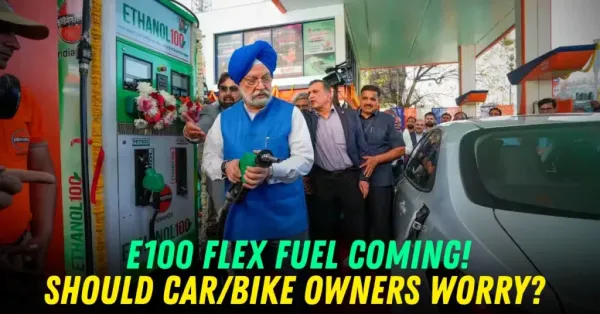
As part of its push for cleaner mobility, the government of India has issued draft rules to introduce E85 (85% ethanol blended petrol) and E100 (nearly pure Ethanol) into the country’s fuel mix. This move comes shortly after the nationwide rollout of E20 (20% Ethanol-blended) petrol was completed. The news has created concerns among existing car and two-wheeler owners regarding the future of their vehicles. Worry not! E85/E100 rollout will not affect existing cars and two-wheelers. These will be sold alongside the regular blend, which now is the E20, and will not replace it.
The Ministry of Road Transport and Highways has issued a draft notification proposing amendments to the Central Motor Vehicles Rules. These are designed to create a regulatory framework for introducing higher ethanol blends like E85 and E100 in India.
India achieved its E20 target in 2025, well ahead of the original 2030 deadline. With that milestone completed, policymakers now want to increase the blending significantly. E85 is a blend of 85 percent ethanol and 15 percent petrol. E100, on the other hand, refers to near-pure ethanol fuel.
The government has invited public feedback on this draft. After reviewing responses, a final policy decision is expected to be made in the coming months. If approved, initial trials could begin as early as December this year.
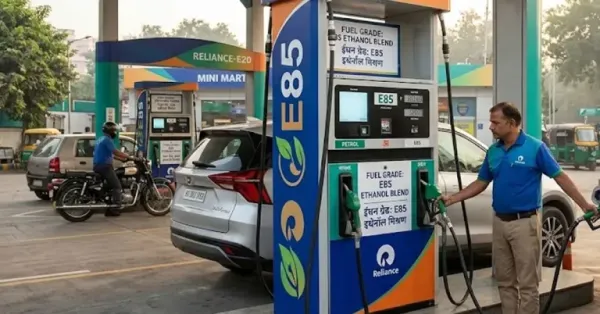
Firstly, it is the nature of the fuel itself. E85 and E100 have high Ethanol content in them and the same make them unfit for use on regular cars and two-wheelers. The vehicles that we have around us can only tolerate up to E20 petrol- 20% Ethanol-blended petrol.
Using E85 or E100 fuel in these can cause severe issues like a steep loss in efficiency and engine damage. The internals and components of normal vehicles, particularly the seals, hoses and fuel systems are not capable of handling high alcohol content and corrosive nature of higher blends.
Even when the draft notification is approved, the actual rollout of E85 and E100 fuels will not happen overnight. More importantly, these will not replace E20 petrol. India is likely to follow the Brazil model and sell the E20, E85 and E100 fuels side by side.
The E20 will continue to serve existing vehicles while the higher blends will only be used by Flex-Fuel Vehicles (FFVs). Petrol bunks will have separate storage tanks and dispensers for E20, E85 and E100 fuels. For citizens, E85 or E100 will be a choice, not a mandate.
The new rules coming into effect will encourage automakers to come up with Flex-Fuel Vehicles. Royal Enfield is already testing the FFV version of the Classic 350. Other majors like TVS and Bajaj are also developing flex-fuel powertrains. These, when launched, will use E85 fuel or higher blends and will have significantly cleaner emissions.
So, what happens to regular petrol? E20 is now the standard. Previously, there were rumours of the government considering E27 petrol- 27% Ethanol blending. Initially the Government of India had denied these. In late July 2025, however, Union Minister Nitin Gadkari announced that the government would soon finalise guidelines for E27 petrol.
The most recent reports, however, paint a different picture. According to them, the government is likely to take Ethanol blending in petrol to roughly 21 percent, or to a maximum of 22 percent (E21 or E22). Heavy Industries Additional Secretary Hanif Qureshi recently hinted at the same, saying that the Bureau of Indian Standards (BIS) allows a tolerance band of plus or minus 1%. Transitioning to E21 or E22 petrol would make life difficult for older petrol engines.
India’s aggressive push for higher blending has its roots in the country’s aspirations of achieving self reliance in energy and reducing crude imports. The recent West Asia war added to this.
Commenting on the E85/E100 vision, Arushi Jain, Joint Secretary, Grain Ethanol Manufacturers Association (GEMA), said that recent global conflicts have put pressure on petroleum prices and oil manufacturing companies have absorbed the cost of imported fuel without passing it to the consumers. This will not be viable in the long run.
The country needs to be self reliant in energy and Ethanol blended fuel is a practical way to do it. ‘The move towards E85 and E100 is a welcome step by the government, with positive implications for the entire Indian economy.’ Jain said.
-
8 Delicious Snacks That Let You Cook Without Actually Cooking

-
4 members of a family died after eating watermelon? Are you also making this mistake? Know the doctor’s opinion

-
Make instant Masala Shakkarpara for guests, know the recipe
-
Why did the co-founder of Zoho request the youth of India to leave America and come to India?
-
Which was Rohit Sharma’s first car? Today the collection includes everything from Lamborghini to Mercedes – know how much is his net worth