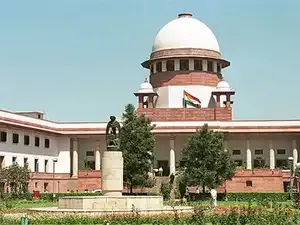
New Delhi: The Supreme Court on Wednesday termed the situation at various benches of the National Company Law Tribunal (NCLT) as "grim and dismal" and took suo motu cognisance of delays in approving resolution plans for companies undergoing insolvency proceedings.
The court noted a report by the registrar of the tribunal's principal bench stating that 383 applications for approval of resolution plans are pending. Delays range from 48 days to 738 days, and in some cases extend up to four years
Key reasons cited include inadequate infrastructure, half-day sittings due to changing bench compositions and a large number of objections filed by stakeholders. "We take suo motu cognisance of the issue in larger public interest," a bench of justices J B Pardiwala and K V Viswanathan said. "The issues need to be addressed on war footing. Otherwise, the purpose of enacting IBC (Insolvency and Bankruptcy Code, 2016) would stand frustrated. As we have taken suo motu cognisance, let the matter be placed before Chief Justice Surya Kant for further orders." The court also flagged a severe shortage of members affecting time-bound functioning. Against a sanctioned strength of 63 members, only 28 judicial members and 26 technical members are currently in place across benches.
Last week, the Supreme Court had asked the Insolvency and Bankruptcy Board of India (IBBI) and the NCLT principal bench at New Delhi to provide nationwide data on pending resolution plan approvals and reasons for delays.
The direction came while hearing a case involving AVJ Developers (India), where approval of a resolution plan has been pending for nearly two years before the NCLT.
The court had also sought details from the NCLT principal bench on the number of pending applications, the duration of pendency and reasons for delays in disposal.
The court noted a report by the registrar of the tribunal's principal bench stating that 383 applications for approval of resolution plans are pending. Delays range from 48 days to 738 days, and in some cases extend up to four years
Key reasons cited include inadequate infrastructure, half-day sittings due to changing bench compositions and a large number of objections filed by stakeholders. "We take suo motu cognisance of the issue in larger public interest," a bench of justices J B Pardiwala and K V Viswanathan said. "The issues need to be addressed on war footing. Otherwise, the purpose of enacting IBC (Insolvency and Bankruptcy Code, 2016) would stand frustrated. As we have taken suo motu cognisance, let the matter be placed before Chief Justice Surya Kant for further orders." The court also flagged a severe shortage of members affecting time-bound functioning. Against a sanctioned strength of 63 members, only 28 judicial members and 26 technical members are currently in place across benches.
Last week, the Supreme Court had asked the Insolvency and Bankruptcy Board of India (IBBI) and the NCLT principal bench at New Delhi to provide nationwide data on pending resolution plan approvals and reasons for delays.
The direction came while hearing a case involving AVJ Developers (India), where approval of a resolution plan has been pending for nearly two years before the NCLT.
The court had also sought details from the NCLT principal bench on the number of pending applications, the duration of pendency and reasons for delays in disposal.