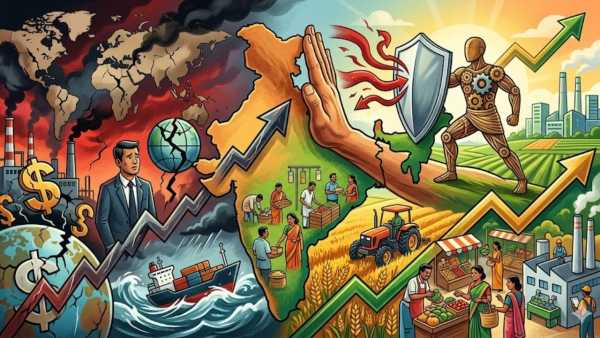
Due to the effect of 'El Nino', the south-west monsoon is expected to be below normal this year. Due to this, most of the districts are expected to receive below average rainfall. Image Credit source: Google Gemini
Risks to inflation, trade and financial flows have increased due to the major supply side shock from the West Asia conflict. However, strong domestic demand, policy support, strong financial system and public investment will provide some protection to the Indian economy. The Finance Ministry has said this in its monthly report. In the Monthly Economic Review for the month of April, it has been said that prolonged uncertainty regarding energy and fertilizer supply can test the strength of the country's macroeconomic stability. Along with this, the report has expressed the possibility that the south-west monsoon will be below normal this year due to the effect of 'El Nino'. Due to this, most of the districts are expected to receive below average rainfall. 'El Nino' is a special climatic condition in which the waters of the Pacific Ocean become warmer than normal, thereby weakening the monsoon in India.
risk of inflation rising
The ministry's report says that under these circumstances, there is a risk of inflation, fiscal deficit and current account deficit increasing, while economic growth may come under pressure. According to the report, India was making a strong move in the financial year 2026-27 and the growth rate was estimated to be 7-7.4 percent, but this estimate has been affected by the change in the global economic scenario due to the West Asia war. The growth rate of the Indian economy is estimated to be 7.6 percent in the financial year 2025-26.
Ministry's warning
The report warned of supply side shocks amid the West Asia crisis and said that the decline in demand due to rising prices and slowing pace of economic activity is also a matter of concern. Along with this, inflation may also increase due to the increasing costs being passed on to consumers by the companies. This will have a massive impact on the processing and marketing industries that make final products from raw materials. Due to their dependence on the petroleum sector, cost pressure may increase in the entire economy.
Government took steps
To reduce cost pressure in critical sectors like agriculture, the government has taken steps like increasing gas allocation for fertilizer production, exemption in customs duty and increase in nutrient-based subsidy by about 12 percent for the Kharif season. According to the report, investor confidence has been affected by the West Asia crisis, which has had a greater impact on emerging economies. Weakness of rupee can also increase inflation because it makes imports expensive.
no shortage of cash
The ministry said that it may take several months for the oil and gas supply structure in the Gulf region to return to normal. If this is coupled with a weak monsoon, then inflationary pressure may increase further. However, the report said that key indicators of the banking and financial system – capital adequacy, liquidity and asset quality – remain strong, posing no major threat to financial stability. The Reserve Bank will also remain active to maintain adequate cash.
FTA will boost exports
According to the report, the recently signed Free Trade Agreements (FTAs) will help in promoting Indian exports and strengthening connectivity in the global supply chain. The Finance Ministry said that global instability, which is a challenge for many countries, can also become an opportunity for India. With a strong domestic base and strategic autonomy, India can strengthen its position as a manufacturing, services and large consumer market.


-
Met Gala 2026: Will Deepika Padukone pull a Rihanna? Alia under fire

-
Columbo legend Peter Falk's daughter tragically dies by suicide

-
Inside Rory McIlroy's turbulent relationship with Donald Trump including 8-year ban

-
Hollywood legend Mel Gibson heartbroken as his 'secret love' dies in swimming pool

-
The Hidden Dangers of Keeping Your Wallet in Your Back Pocket