

Listen to this article in summarized format
Loading...
××
Subscribe to

Unlock AI Briefing and Premium Content
New Year Offer 24 Hours Left
Subscribe NowAlready a member? Sign In
What's Included
- Exclusive Stories
- Daily ePaper Access
- Smart Market Tools
- Curated Investment Ideas
- Ad-lite Experience
Subscription

Puducherry exit polls 2026: BJP, DMK or TVK; Who holds the edge in Puducherry's fragmented contest?
Exit polls for the 2026 Assembly elections in Puducherry have been released, offering the first indications of whether the BJP/DMK/AINRC-TVK has the edge in a high-stakes, multi-cornered contest shaped by alliance arithmetic, minority sentiment, and the disruptive entry of actor-turned-politician Vijay.
Axis My India exit poll for Puducherry projects the NDA in the lead with an estimated 40 per cent vote share, followed by the Congress-DMK alliance at 30 per cent. TVK+ is pegged at 17 per cent, while others account for 13 per cent, indicating a clear edge for the ruling alliance in overall vote share.
Also Read: People of Puducherry won't fall prey to Rangasamy's tactics: Congress' Wasnik
As per People's Pulse, NDA 16–19 seats, SPA 10–12; Majority mark 16. As exit poll projections for the Puducherry Assembly elections 2026 emerge, the NDA is estimated to be in a strong position with 16–19 seats, while the SPA is projected at 10–12. With the majority mark set at 16.
The age-wise break-up suggests a sharp trend among younger voters, with TVK+ leading in the 18–29 category, securing over 50 per cent among first-time voters.
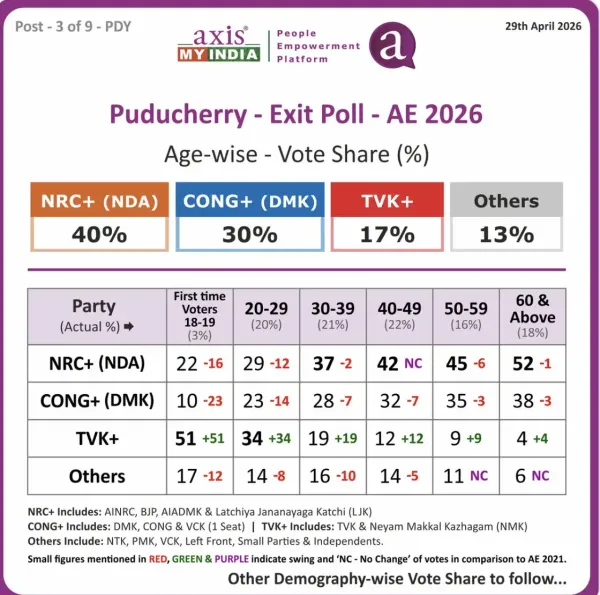
However, the NDA shows growing dominance with age, leading comfortably among voters aged 40 and above, including a strong 52 per cent support in the 60+ category, reflecting a split demographic mandate.
Exit polls are surveys conducted immediately after voters cast their votes. These polls aim to predict election outcomes based on voter responses and trends.
Also Read: People of Puducherry won't fall prey to Rangasamy's tactics: Congress' Wasnik
The projections come days after polling on April 9 recorded a robust 89.87% voter turnout, reflecting high engagement across the Union Territory and its enclaves of Karaikal, Mahe and Yanam. Voting was held across 1,099 polling stations, with authorities reporting steady participation from early morning, aided by extensive voter-friendly measures.
While the final outcome will only be known on May 4, exit polls are expected to offer an early snapshot of whether the ruling NDA combine can retain power or if the opposition, or emerging players, have altered the political landscape.
High turnout, smooth polling
Polling day saw steady queues across constituencies, with turnout already touching 72.40% by 3 pm before climbing further by the close of voting.
Authorities deployed 4,836 government personnel, 2,791 police staff, 173 micro-observers and 2,198 student volunteers to ensure smooth conduct. Drone surveillance and monitoring led to seizures of Rs 77.25 lakh in cash and Rs 68.5 lakh in liquor, allegedly meant to influence voters.
Special emphasis was placed on accessibility, with provisions such as wheelchairs, braille ballots and assistance via the Saksham mobile application. In a push for inclusivity, 30 polling stations were managed entirely by women, 15 by young officers, and two by persons with disabilities.
Exit polls to test ‘Vijay factor’
A key variable these exit polls will attempt to decode is the impact of Tamilaga Vettri Kazhagam (TVK) chief Vijay, whose political debut has injected unpredictability into an already fragmented contest.
Vijay has positioned his party as an alternative to both the Congress-DMK alliance and the AINRC-BJP-AIADMK combine, attacking them as entrenched formations that have failed to deliver.
“I have selected candidates who stand with the people on the ground. I have entrusted them to you. We stand on the side of our people. Our people stand on your side," Vijay said at a campaign rally.
His appeal, particularly among younger voters, has raised concerns among established parties about vote-splitting.
“I am voting for the TVK and so are all my friends,” said Nitish J, a first-time voter. “We have given a chance to everyone for so long, so why not give someone younger a chance?”
Also read: Exit poll predictions: What pollsters got right (and wrong) in previous assembly elections in Assam, West Bengal, Kerala, Tamil Nadu and Puducherry
Others, however, remain sceptical. “Vijay has no experience in politics. That is the bottom line,” said Satish E, 24.
Alliances, identity and minority sentiment
The contest has also been shaped by sharp ideological battles, particularly between the BJP-led alliance and the DMK-Congress bloc.
Tamil Nadu Deputy Chief Minister Udhayanidhi Stalin accused the BJP of trying to expand its footprint in the Union Territory. “Today in such UT, the infiltration of fascist BJP forces has increased significantly. It has become a testing ground for all of the BJP's anti-people policies,” he said during campaigning.
Minority sentiment, especially among Christians, who make up around 6.3% of the population—has emerged as another critical factor. Sections of the community have expressed concerns over policy changes and funding restrictions.
“They don’t want us involved in the social upliftment of the poor, downtrodden and the rejected,” Father AJ Philomindoss told ET's Dia Rekhi, referring to amendments to the Foreign Contribution (Regulation) Act (FCRA).
At the same time, local dynamics remain complex, with some voters indicating that candidate credibility could outweigh party affiliations in several constituencies.
Core issues: Statehood, economy, governance
The demand for full statehood has remained a central theme in the campaign, with opposition parties framing the election as a referendum on the Union Territory’s autonomy and its relationship with the Centre.
Economic concerns, including rising living costs, unemployment and the proposed privatisation of the electricity department—have also figured prominently in voter discussions.
The ruling alliance has leaned on welfare schemes and governance stability, while the opposition has focused on economic distress and institutional friction.
Axis My India exit poll for Puducherry projects the NDA in the lead with an estimated 40 per cent vote share, followed by the Congress-DMK alliance at 30 per cent. TVK+ is pegged at 17 per cent, while others account for 13 per cent, indicating a clear edge for the ruling alliance in overall vote share.
Also Read: People of Puducherry won't fall prey to Rangasamy's tactics: Congress' Wasnik
As per People's Pulse, NDA 16–19 seats, SPA 10–12; Majority mark 16. As exit poll projections for the Puducherry Assembly elections 2026 emerge, the NDA is estimated to be in a strong position with 16–19 seats, while the SPA is projected at 10–12. With the majority mark set at 16.
The age-wise break-up suggests a sharp trend among younger voters, with TVK+ leading in the 18–29 category, securing over 50 per cent among first-time voters.
Puducherry exit polls
However, the NDA shows growing dominance with age, leading comfortably among voters aged 40 and above, including a strong 52 per cent support in the 60+ category, reflecting a split demographic mandate.
Exit polls are surveys conducted immediately after voters cast their votes. These polls aim to predict election outcomes based on voter responses and trends.
Also Read: People of Puducherry won't fall prey to Rangasamy's tactics: Congress' Wasnik
The projections come days after polling on April 9 recorded a robust 89.87% voter turnout, reflecting high engagement across the Union Territory and its enclaves of Karaikal, Mahe and Yanam. Voting was held across 1,099 polling stations, with authorities reporting steady participation from early morning, aided by extensive voter-friendly measures.
While the final outcome will only be known on May 4, exit polls are expected to offer an early snapshot of whether the ruling NDA combine can retain power or if the opposition, or emerging players, have altered the political landscape.
High turnout, smooth polling
Polling day saw steady queues across constituencies, with turnout already touching 72.40% by 3 pm before climbing further by the close of voting.
Authorities deployed 4,836 government personnel, 2,791 police staff, 173 micro-observers and 2,198 student volunteers to ensure smooth conduct. Drone surveillance and monitoring led to seizures of Rs 77.25 lakh in cash and Rs 68.5 lakh in liquor, allegedly meant to influence voters.
Special emphasis was placed on accessibility, with provisions such as wheelchairs, braille ballots and assistance via the Saksham mobile application. In a push for inclusivity, 30 polling stations were managed entirely by women, 15 by young officers, and two by persons with disabilities.
Exit polls to test ‘Vijay factor’
A key variable these exit polls will attempt to decode is the impact of Tamilaga Vettri Kazhagam (TVK) chief Vijay, whose political debut has injected unpredictability into an already fragmented contest.
Vijay has positioned his party as an alternative to both the Congress-DMK alliance and the AINRC-BJP-AIADMK combine, attacking them as entrenched formations that have failed to deliver.
“I have selected candidates who stand with the people on the ground. I have entrusted them to you. We stand on the side of our people. Our people stand on your side," Vijay said at a campaign rally.
His appeal, particularly among younger voters, has raised concerns among established parties about vote-splitting.
“I am voting for the TVK and so are all my friends,” said Nitish J, a first-time voter. “We have given a chance to everyone for so long, so why not give someone younger a chance?”
Also read: Exit poll predictions: What pollsters got right (and wrong) in previous assembly elections in Assam, West Bengal, Kerala, Tamil Nadu and Puducherry
Others, however, remain sceptical. “Vijay has no experience in politics. That is the bottom line,” said Satish E, 24.
Alliances, identity and minority sentiment
The contest has also been shaped by sharp ideological battles, particularly between the BJP-led alliance and the DMK-Congress bloc.
Tamil Nadu Deputy Chief Minister Udhayanidhi Stalin accused the BJP of trying to expand its footprint in the Union Territory. “Today in such UT, the infiltration of fascist BJP forces has increased significantly. It has become a testing ground for all of the BJP's anti-people policies,” he said during campaigning.
Minority sentiment, especially among Christians, who make up around 6.3% of the population—has emerged as another critical factor. Sections of the community have expressed concerns over policy changes and funding restrictions.
“They don’t want us involved in the social upliftment of the poor, downtrodden and the rejected,” Father AJ Philomindoss told ET's Dia Rekhi, referring to amendments to the Foreign Contribution (Regulation) Act (FCRA).
At the same time, local dynamics remain complex, with some voters indicating that candidate credibility could outweigh party affiliations in several constituencies.
Core issues: Statehood, economy, governance
The demand for full statehood has remained a central theme in the campaign, with opposition parties framing the election as a referendum on the Union Territory’s autonomy and its relationship with the Centre.
Economic concerns, including rising living costs, unemployment and the proposed privatisation of the electricity department—have also figured prominently in voter discussions.
The ruling alliance has leaned on welfare schemes and governance stability, while the opposition has focused on economic distress and institutional friction.