The ratio went up from 45% last year. In specific, nearly 7,700 new electric cars were registered out of the 13,300 units, according to government data cited by The Straits Times.
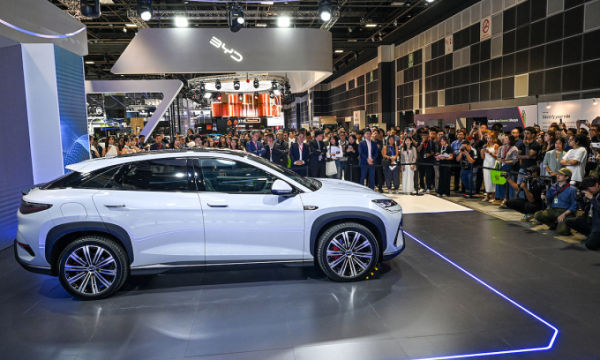
Chinese automotive giant BYD recorded 3,239 registrations, or 24% of new cars, extending its lead from a 21% market share at the end of 2025.
Three other Chinese brands, Chery (seventh), GAC (eighth) and MG (ninth), entered the top 10 best-selling car brands in Singapore for the first time, joining BYD, according to Land Transport Authority registration data.
They replaced South Korean brands Hyundai and Kia, which ranked seventh and ninth respectively in 2025, as well as Japanese marque Mazda, which was eighth that year.
|
Visitors watch a BYD Sealion 7 electric vehicle (EV) by Chinese car manufacturer BYD on display at Singapore Motorshow in Singapore on January 9, 2025. Photo by AFP |
Despite a relatively limited EV lineup, Toyota held on to second place with 1,932 registrations and a 14.5% market share in the first quarter of 2026, up 0.3 percentage points from 2025.
U.S. electric vehicle maker Tesla captured 11.4% of the market with 1,515 registrations, rising to become the third best-selling brand in Singapore from sixth place in 2025.
Under current incentives aimed at reducing the cost of EV ownership, buyers can receive up to $30,000 in rebates on upfront vehicle taxes, while non-EVs may face penalties of up to $35,000 depending on emissions.
Walter Theseira, a transport economist at the Singapore University of Social Sciences, said that beyond the inherent advantages of EVs, their manufacturers have been more aggressive in marketing, helping to drive consumer interest compared with sellers of combustion engine vehicles.
He added that while EV adoption is accelerating, it remains challenging for all new car registrations to be fully electric, particularly for high-mileage drivers, for whom hybrid models remain more practical.
Automotive consultant Say Kwee Neng said, as quoted by The Business Times: “We are seeing an acceleration of the fundamental reshaping of the dynamics of our car industry, which began when EV adoption grew in 2024 and 2025.”
Hal Serudin, a partner at automotive consultancy Lumina 3 Sixty, said the surge in sales of Chinese and EV brands mirrors trends seen in other regional markets, including Malaysia and Thailand, where these players have disrupted established incumbents across both mass-market and luxury segments.
“Chinese brands have moved from the early adopter phase to the early-middle majority phase,” said Serudin.
“The Chinese brands have carefully catered to local needs and gained customer acceptance with their ‘value for money’ offerings, which are now well-designed and engineered… (with) aggressive, localized marketing campaigns, adding significant pressure to legacy players like BMW and Mercedes-Benz.”
-
Hyderabad Police handover 11 lost mobile phones to owners

-
Its official – TRS is now Telangana Rakshana Sena

-
Why Vijay, Rashmika are suddenly making separate appearances?

-
Shakib Al Hasan Slams Bangladesh’s T20 World Cup Boycott, Calls It A 'Blunder'

-
'Stopped Operation Sindoor Voluntarily, On Our Own Terms': Rajnath Singh