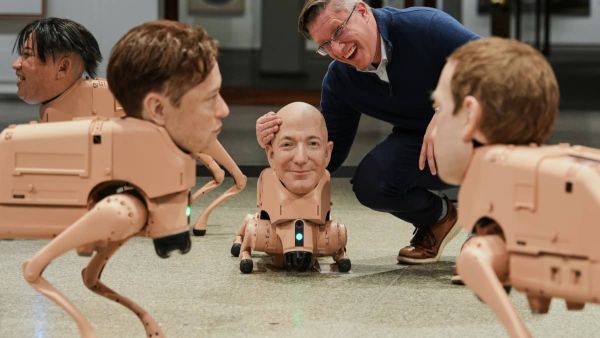
Robot dogs with hyper-realistic silicone heads modelled after world-renowned figures — including Elon Musk, Mark Zuckerberg, Jeff Bezos, Andy Warhol and Pablo Picasso — can be seen roaming around a Berlin museum, occasionally “pooing” printed images of their surroundings which they've previously captured with integrated cameras.
The animals are part of an interactive installation by American artist Beeple (Mike Winkelmann) currently showing at Berlin's Neue Nationalgalerie.
Each printed image shows a snippet of reality transformed by AI to resemble the personality of the dog or, in other words, the worldview of the human figure on its shoulders (i.e., the Picasso dog will produce images in Cubist style and Warhol's in pop art).
It's a commentary on how our perceptions are shaped by algorithms and technology platforms, the organisers of the exhibition write in the description of the event.
“In the past, our view of the world was shaped in part by how artists saw the world,” Beeple told the AP. “How Picasso painted changed how we saw the word, how Warhol talked about consumerism, pop culture, that changed how he saw those things.”
Now our view of the world is shaped by tech billionaires who own powerful algorithms that decide what we see and what we don’t see, the artist added.
“That's an immense amount of power that I don’t think we’ve fully understood, especially because when they want to make a change, they don’t need to lobby the U.N. They don’t need to get something through Congress or the EU, they just wake up and change these algorithms.”
The dogs also wear heads in Beeple’s own image.
Lisa Botti, the curator of the exhibition in Berlin, said that artificial intelligence was one of the phenomena most impacting our lives today and that “museums are the places where society can reflect” on such transformations, which is why she wanted to have Beeple’s work shown.
The work, entitled “Regular Animals,” was first shown at Art Basel Miami Beach 2025.
Beeple is a graphic designer from South Carolina who does a variety of digital artwork. He is one of the founders of the “everyday” movement in 3D graphics: For years, he has been creating a picture every day and posting it online without missing a single day.
According to Christie's, he is the third most expensive living artist to sell at auction, after David Hockney and Jeff Koons.
In the spring of 2021, Christie’s opened bidding for Beeple's digital collage entitled “Everydays: The First 5000 Days,” with the sale ultimately closing at over $69 million. The auction house described the artwork as “critiques of modern society, the government and social media” in the form of “grotesque, dystopian futures, often featuring celebrities like Donald Trump and Kanye West.”
Christie’s said the sale marked the first time a major auction house offered a digital-only artwork with a non-fungible token as a guarantee of its authenticity, as well as the first time cryptocurrency has been used to pay for an artwork at auction.
Non-fungible tokens, known as NFTs, are electronic identifiers confirming a digital collectible is real by recording the details on a digital ledger known as a blockchain. The tokens have swept the online collecting world recently, an offshoot of the boom in cryptocurrencies.
At the Art Basel 2025 event, Beeple gave away the photos pooed by his dogs to audience members, accompanied by a certificate that read “100% organic GMO-free dog shit.” Some prints had QR codes that gave access to free NFTs, which in practice meant Beeple was giving away his digital art for free for people (sometimes the subjects of the photos themselves) to potentially monetise.
-
James Comey Indicted Over Controversial Seashell Photo Linked to Trump

-
Designer Tailor Faces Legal Action Over Delayed Blouse Delivery

-
Michael Portillo discovers what really happens on state visits in scary encounter

-
Arsenal duo out of Atletico Madrid clash as Mikel Arteta offers five-man injury update

-
High street favourite with 102 stores shuts shop in UK town