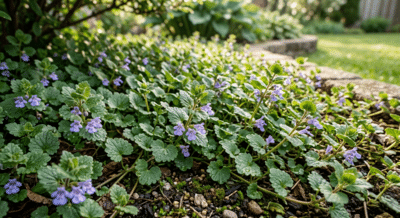
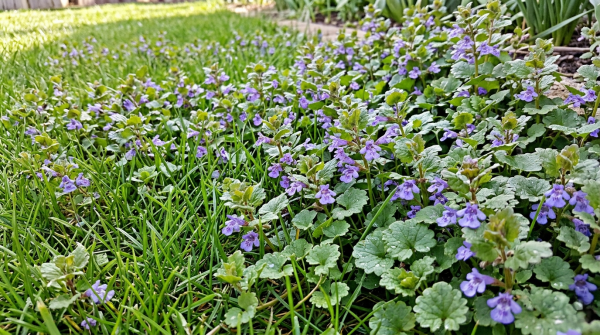
You finally found a Saturday for the yard. You mow, you edge, you step back, and for a brief moment, feel like someone who has their life together. Then you see it. A thick, low-growing carpet of little scalloped leaves weaves through your grass as if it owns the place. If it has little purple flowers blooming from it in spring, chances are you have ground ivy, aka Creeping Charlie. Yes, the name does a lot of the work.
Ground ivy (Glechoma hederacea) is a mint family invasive perennial that’s native to Europe, but which has taken up residence with extreme comfort in most of the US, from USDA Hardiness Zones 3a all the way down to 10b. It remains short, less than 12 inches tall, but spreads aggressively by underground roots and long, creeping stems that root wherever they touch soil. Left to its own devices, it will take over your lawn, your flower beds and your general sense of peace.
Why it might as well be a welcome mat for your yard
Here’s the annoying bit: ground ivy doesn’t need good conditions to thrive. In fact, it prefers the opposite: compacted, poorly drained, low-nutrient soil. It likes shade, moisture and neglect. If you have a large tree with a patchy lawn underneath that you’ve been meaning to fix, that’s prime Creeping Charlie territory.
The weed spreads in two ways: by seeds after it flowers and by stolons, long stems that arch over and take root at several points along the ground. A study in the found that stolons can grow well over a metre, with new roots taking hold at regular intervals. Once the root system is underground, even going dormant in summer heat doesn’t stop it. It just sits and waits.
How to actually get rid of it
The good news is that ground ivy can be managed. The bad news is that it takes consistency. Here’s what works:
If you caught it early, hand pull with a garden trowel, making sure to get the roots. This will work as long as the patch is still small. Do this before it blooms in spring to break the seed cycle.
If it’s already rampant, take the entire affected area out with a sod lifter and reseed or resod.
For the stubborn parts, your best bet is broadleaf herbicides with triclopyr or 2,4-D. The study,
Cultural and Chemical Control of Ground Ivy (Glechoma hederacea), found that a combination of cultural practices and targeted herbicide applications resulted in significantly better long-term control than either method alone. Importantly, fall applications were better than spring applications, as the plant actively pulls nutrients (and your herbicide) down into its roots as it prepares for winter. Apply in late September, then check back in four weeks. One tip you might want to consider: alternate active ingredients, or buy a product with both, since ground ivy can develop tolerance to a single herbicide.
When applying near flower beds, protect adjacent plants with a cardboard box or plastic sheeting. For tight spots, wear rubber gloves, dampen a sponge with herbicide, and wipe the leaves directly.
The longer term: stop it coming back
A thick, healthy lawn is the best defence because it leaves no room for the ground ivy to move in. That means watering, mowing to the proper height for your grass type and regular fertilising. Trim any tree branches you can to let more sunlight reach the lawn. If you have a shady, damp corner that just can’t compete with the ivy no matter what you do, then consider a total change of strategy. Swap the grass for shade-tolerant ground cover or a thick layer of mulch (at least six inches deep). Don’t bother with plastic or metal edging; the roots underground laugh at physical barriers.
Ground ivy is a fight worth serious fighting. It spreads faster than most people expect, and once established, eradication is a multi-season project. If you catch it early and stay consistent, your lawn actually has a chance.
-
Numerology Number 1 Prediction Today, April 30, 2026: Positive day ahead for Number 1, but stay alert in financial matters

-
Numerology Number 9 Prediction Today, April 30, 2026: Memorable Moments Await with Partner, Enthusiasm in Financial Deals

-
Virgo Tarot Horoscope Today, April 30, 2026: Avoid Negativity and Stay Focused on Your Goals

-
Daily Numerology (Dainik Ank Jyotish 30 April 2026): Today the luck of people with these radix numbers will shine, the combination of numbers 3 and 8 will bring success.

-
In Darbhanga, a girl became a mother without marriage, now her lover drove her away from the house along with the child’ – News Himachali News Himachali