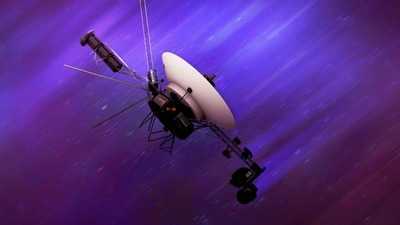
Why NASA shut down an instrument on Voyager 1 probe
28 Apr 2026
NASA has deactivated another scientific instrument on Voyager 1, the farthest spacecraft from Earth.
The decision was taken to save power as the probe continues its journey through uncharted interstellar space.
The instrument, known as the Low-energy Charged Particles experiment (LECP), measures the structure of interstellar space and was also turned off on Voyager 2 in March 2025.
Status of the 2 Voyager probes
Space exploration
Launched in 1977, the two Voyager probes were equipped with 10 science instruments each for their flybys of Jupiter, Saturn, Uranus, and Neptune.
Now, Voyager 1 is some 25.4 billion kilometers away from Earth, while its twin is about 21.35 billion kilometers away.
These are the only active spacecraft outside the heliosphere, the Sun's bubble of magnetic fields and particles that extends far beyond Pluto's orbit.
Why are engineers switching off instruments?
Energy conservation
Both Voyager probes are powered by radioisotope thermoelectric generators, which convert heat from decaying plutonium into electricity.
Since their launch nearly five decades ago, they've been losing an estimated four watts of power every year.
This gradual power drain has forced engineers to turn off different instruments over time to preserve each spacecraft's limited power supply, and keep them operational beyond their expected lifespan of five years.
Power levels dropped during Voyager 1's scheduled roll maneuver
Power drop
During a scheduled roll maneuver on February 27, the mission team observed an unexpected drop in Voyager 1's power levels.
The spacecraft regularly performs these maneuvers to calibrate its magnetometer instrument, which measures the magnetic fields and environments in interstellar space.
If the power levels were to drop any further, it could trigger an automatic failsafe called the undervoltage fault protection system.
What is the LECP instrument?
Instrument details
The LECP has been measuring charged particles such as ions, electrons and cosmic rays from our solar system and the Milky Way galaxy for nearly 49 years.
Its data has given scientists unprecedented insights into regions of varying density beyond the heliosphere.
The instrument's subsystems include a telescope and magnetospheric particle analyzer with a 360-degree view, thanks to a rotating platform powered by a stepper motor.
-
Get coolness even in 45°C without AC, this smart trick will cool the room in minutes

-
This is the zodiac sign of Nita Ambani, the girls of this person can get in-laws as rich as Ambani.

-
Are you troubled by frequent constipation? Try these 5 home remedies; Gut will remain clear

-
How to keep the room cool in summer, know easy ways

-
900 kg Adulterated Paneer Worth Rs 2.25 Lakh Destroyed By Food Safety Team In Ghaziabad