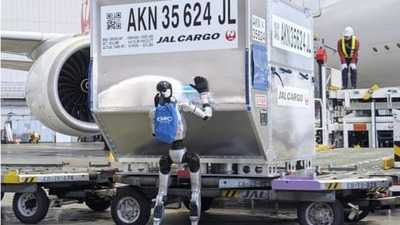
Humanoid robots to work as baggage handlers at Tokyo airport
28 Apr 2026
Japan Airlines (JAL) is set to deploy humanoid robots at Tokyo's Haneda airport, one of the world's busiest.
The move comes as part of a trial run starting from May and will continue until 2028.
The initiative is aimed at addressing the country's labor shortage amid a surge in inbound tourism.
The Chinese-made robots will be used for moving luggage and cargo on the tarmac.
The robots will help in moving cargo
Operational details
The humanoid robots, developed by Unitree Robotics, stand about 130cm tall and are capable of performing physically demanding tasks.
During a recent demonstration, one of them was seen pushing cargo onto a conveyor belt next to a JAL passenger plane.
Yoshiteru Suzuki, President of JAL Ground Service, said these machines would, "inevitably reduce the burden on workers and provide significant benefits to employees."
The move comes amid a surge in inbound tourism
Human oversight
Despite their capabilities, the robots won't be taking over critical tasks like safety management. These will continue to be performed by human employees.
The move comes as Japan grapples with a surge in foreign tourists and an aging, declining population.
In just the first two months of 2026, over seven million people visited Japan, according to the Japan National Tourism Organization (JNTO).
Japan is facing a labor crunch
Workforce demands
By 2040, Japan will need, according to one estimate, over 6.5 million foreign workers to meet its growth targets, as the native workforce continues to shrink.
After a massive increase in the foreign population in recent years, the government is now facing political pressure to curb immigration.
Tomohiro Uchida of GMO AI and Robotics said while airports seem highly automated, their backend operations still rely heavily on human labor and face serious labor shortages.
Move is part of larger trend toward automation
Automation expansion
The humanoid robots can work continuously for two to three hours, and the companies plan to deploy them for other tasks like cleaning aircraft cabins.
This move is part of a larger trend toward automation in industries that have long depended on human precision and discipline.
If successful, this trial could pave the way for wider adoption across airports and other sectors.
-
Get coolness even in 45°C without AC, this smart trick will cool the room in minutes

-
This is the zodiac sign of Nita Ambani, the girls of this person can get in-laws as rich as Ambani.

-
Are you troubled by frequent constipation? Try these 5 home remedies; Gut will remain clear

-
How to keep the room cool in summer, know easy ways

-
900 kg Adulterated Paneer Worth Rs 2.25 Lakh Destroyed By Food Safety Team In Ghaziabad