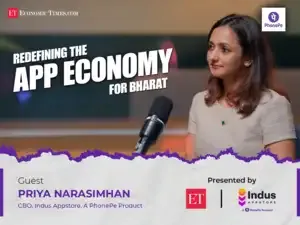
Walk into the Indus Appstore office in Bengaluru on any given day, and the energy is palpable, the kind that comes from a deep commitment to a significant mission. For Priya Narasimhan, the company's CBO, that mission is about addressing a fundamental imbalance: while India is the world's largest consumer of apps, it has historically had a limited voice in how its own app economy is shaped and governed.
In an interview with ET, Narasimhan opened with some stark numbers. According to Business of Apps, global app downloads numbered over 142 billion in 2025, with India leading the world in download volume and the most hours spent on apps. But when you look past the consumption and into the operations, a different picture emerges. Only a fraction of active developers worldwide are Indian, and a lion's share of the top apps downloaded in India are built by foreign companies. India's app revenue, while growing fast, was a modest $3.8 billion in 2024 compared to the global figure.
"We are shoppers," Narasimhan told ET. "But we are not the shopkeepers in this market."
It is a line she returned to throughout the conversation, and it cut to the heart of what Indus Appstore, a PhonePe subsidiary, is trying to fix. The premise is not complicated even if the mechanics are. Google and Apple control the majority of all app downloads, she said. In India, Android dominates and Google Play comes pre-loaded on virtually every device. And because of the way these platforms are structured, bundled tightly with the operating system, equipped with system-level permissions, and locked into agreements with device manufacturers, any alternative is effectively shut out before it gets started.
Narasimhan described the situation like a house with locked doors. Or a school with an official canteen that has a deal with the administration, while a better, cheaper food stall just outside the gate gets a note sent home warning parents that eating there may cause stomach infections.
"What the gatekeepers in the app store ecosystem have done is they have deemed everything else scary and everything else as unsafe," she said. "It's a psychology of defaults."
That psychology, she explained, is structural. When a user in India tries to download an app from outside the official store through a process called sideloading, the phone flashes warnings, often in red, cautioning that the source is unverified. Even if the user pushes through, the third-party app doesn't have the system permissions needed to function properly. This friction is designed, she argued.
The impact falls hardest on two groups: developers and users, though not in ways most people immediately recognise. For developers, the pay-to-play reality of the current ecosystem means that visibility is essentially purchased. Discovery, Narasimhan said, does not come to good products by default but has to be engineered, and engineering costs money that most independent or mid-sized developers do not have. Meanwhile, the standard 15%-30% commission that platforms charge can make an otherwise viable business model collapse.
“Large players can routinely negotiate side deals that bring their effective commissions down to 10% or lower. [You can only do this if] you have the muscle and your business is already big enough,” Narasimhan pointed out.
For users, the cost is less visible but just as real. Higher prices get quietly passed on as developers factor in platform costs. Choice is an illusion dressed up as a menu. When Indus Appstore ran its own experiment to remove the pre-selected English option from its language screen and let users choose, 40-50% of users picked something other than English. Retention went up and so did downloads.
So, what would it take to change things? Narasimhan's answer was two-pronged. First, a standardised framework for security and compliance that India defines for itself rather than deferring to the internal policies of private platforms. Second, and more fundamentally, technology unbundling: decoupling the operating system from the app store so that no single platform has a structural head start. Level the technical playing field, she reasons, and innovation will follow.
Google has recently introduced the concept of "registered app stores", a mechanism that would give legitimate third-party stores a clearer path to users without requiring the sideloading gauntlet. Narasimhan is cautiously optimistic. "It's like putting streetlights on a dark alley," she said. "You're not changing the route. You're just legitimising it."
The vision Indus’ CBO described for the homegrown appstore was competitive rather than combative. She wants an ecosystem where the best product wins, where a developer in a Tier-II Indian city building an app in Tamil can get discovered by users who would actually use it, without needing a marketing budget that rivals a Fortune 500 company. Where a user can choose their app store the way they choose their bank and take their data with them if they leave. Where India, in short, stops just consuming the app economy and starts building it.
"We need to become creators and builders and not just consumers, so that we can innovate more,” she concluded.
India's campaign for an open app ecosystem | In conversation with Priya Narasimhan
India is the world's largest market for app downloads. So why do Indian developers make up just 3-5% of the global developer base? Why do foreign apps dominate the top charts? And what will it take to move from a closed ecosystem to an open one?In this interview with ET, Priya Narasimhan, Chief Business Officer (CBO) of Indus Appstore, speaks about everything from data portability and interoperability to how the pay-to-play model is unfair to Indian developers.‘Redefining the App Economy for Bharat’ is a series exploring the forces shaping India's digital landscape.#AppEconomy #DigitalIndia #IndusAppstore #PhonePe #DigitalSovereignty
"We are shoppers," Narasimhan told ET. "But we are not the shopkeepers in this market."
It is a line she returned to throughout the conversation, and it cut to the heart of what Indus Appstore, a PhonePe subsidiary, is trying to fix. The premise is not complicated even if the mechanics are. Google and Apple control the majority of all app downloads, she said. In India, Android dominates and Google Play comes pre-loaded on virtually every device. And because of the way these platforms are structured, bundled tightly with the operating system, equipped with system-level permissions, and locked into agreements with device manufacturers, any alternative is effectively shut out before it gets started.
Narasimhan described the situation like a house with locked doors. Or a school with an official canteen that has a deal with the administration, while a better, cheaper food stall just outside the gate gets a note sent home warning parents that eating there may cause stomach infections.
"What the gatekeepers in the app store ecosystem have done is they have deemed everything else scary and everything else as unsafe," she said. "It's a psychology of defaults."
That psychology, she explained, is structural. When a user in India tries to download an app from outside the official store through a process called sideloading, the phone flashes warnings, often in red, cautioning that the source is unverified. Even if the user pushes through, the third-party app doesn't have the system permissions needed to function properly. This friction is designed, she argued.
The impact falls hardest on two groups: developers and users, though not in ways most people immediately recognise. For developers, the pay-to-play reality of the current ecosystem means that visibility is essentially purchased. Discovery, Narasimhan said, does not come to good products by default but has to be engineered, and engineering costs money that most independent or mid-sized developers do not have. Meanwhile, the standard 15%-30% commission that platforms charge can make an otherwise viable business model collapse.
“Large players can routinely negotiate side deals that bring their effective commissions down to 10% or lower. [You can only do this if] you have the muscle and your business is already big enough,” Narasimhan pointed out.
For users, the cost is less visible but just as real. Higher prices get quietly passed on as developers factor in platform costs. Choice is an illusion dressed up as a menu. When Indus Appstore ran its own experiment to remove the pre-selected English option from its language screen and let users choose, 40-50% of users picked something other than English. Retention went up and so did downloads.
So, what would it take to change things? Narasimhan's answer was two-pronged. First, a standardised framework for security and compliance that India defines for itself rather than deferring to the internal policies of private platforms. Second, and more fundamentally, technology unbundling: decoupling the operating system from the app store so that no single platform has a structural head start. Level the technical playing field, she reasons, and innovation will follow.
Google has recently introduced the concept of "registered app stores", a mechanism that would give legitimate third-party stores a clearer path to users without requiring the sideloading gauntlet. Narasimhan is cautiously optimistic. "It's like putting streetlights on a dark alley," she said. "You're not changing the route. You're just legitimising it."
The vision Indus’ CBO described for the homegrown appstore was competitive rather than combative. She wants an ecosystem where the best product wins, where a developer in a Tier-II Indian city building an app in Tamil can get discovered by users who would actually use it, without needing a marketing budget that rivals a Fortune 500 company. Where a user can choose their app store the way they choose their bank and take their data with them if they leave. Where India, in short, stops just consuming the app economy and starts building it.
"We need to become creators and builders and not just consumers, so that we can innovate more,” she concluded.
In Video:
India's campaign for an open app ecosystem | In conversation with Priya Narasimhan