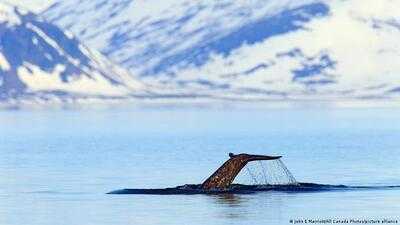
Known as the "unicorns of the sea," narwhals are fleeing Canada's far north. Researchers suspect a link to noise pollution from increasing ship traffic.For Alex Ootoowak, watching the speckled gray narwhals migrate in the icy waters of the Arctic during hunting season is a cherished childhood memory. "It felt like a never-ending, looped-over scene of whales just constantly swimming past you all in the same direction, all migrating throughout the day, sometimes more than a day," said Ootoowak, who lives in Mittimatalik, also known as Pond Inlet, in Canada's far north. "You're always taught to be extra, extra quiet and careful […] because they're so sensitive." The world's 80,000-plus narwhals mainly live in northeastern Canada and Greenland. For Ootoowak and others in Canada's Inuit communities, narwhal meat has been key to their survival for at least 1,000 years. It's an important source of protein, iron and vitamin C, and hunting is regulated by the government. "This is our means of staying healthy and connected to the land and our culture," Ootoowak told DW. "It's not something we do just to kill and take animals for sport." Narwhal numbers dwindling But Ootoowak hasn't seen a migration like those of childhood for a long time. Over the last 20 years, hunters have noticed that the whales have become skinnier, and harder to catch. By 2021, there were only about 2,000 left in the area — a 90% drop from more than 20,000 in the early 2000s. It's not clear why the whales are disappearing, and what's driving them away. Researchers suspect climate change may be playing a role, with the Arctic region warming four times faster than the rest of the planet. "A whole host of things are changing — not just the ice, the water temperature, species, all the way from the bottom of the food chain all the way up," said Kristin Westdal, a marine mammal expert with Canadian marine conservation network Oceans North. But she said the effects of climate change are gradual, and the drop in the whale population came over a relatively short time period. "And the only thing that changed that quickly in that habitat was the volume of ships coming through." In 2015, a local mine run by a company called Baffinland opened a port nearby. Within two years, roughly 4 million tons of iron ore were shipped through the waters off Mittimatalik — and noise pollution increased dramatically. Noise pollution may be driving whales away Concerned about what the new noise was doing to the narwhals, Ootoowak and Westdal set up two listening stations in Milne Inlet, to the west of Mittimatalik. Within a couple years, they were able to expand their acoustic monitoring program by collaborating with acoustics experts at the Scripps Institution of Oceanography, based in San Diego. By lowering special microphones called hydrophones through holes in the ice and 800 meters (nearly half a mile) down into the water, they've listened to the Arctic seascape 24/7 — marine life like barking seals and clicking narwhals foraging for food, but also rumbling engines from growing ship traffic. And they've found that these ship noises may be behind the drop in narwhal numbers. The monitoring team published a study in 2025 which found that "narwhals appear to either move away or stop vocalizing" when vessels came within 12 to 24 miles (20 to 40 kilometers). And the whales were responding to noises below the threshold of 120 decibels — like a loud thunderclap, or a roaring chain saw — which is considered the disturbance threshold for midsized whales like the narwhal. Hunters, too, have noticed that narwhals begin behaving differently when a ship is nearby. "As soon as the ship starts their engines, they move away or stop feeding, stop doing their deep dives where they're feeding on fish at the bottom of the ocean," said Ootoowak. Whales, he said, have learned to avoid the heavily traveled shipping channel when boats are in the area. Are narwhals heading to Greenland? Ootoowak said it wasn't clear where the whales were going, but he has a theory. On a visit to northern Greenland in 2024, to the east across Baffin Bay — where narwhals usually spend the summer months — he spoke with local hunters who told him of whales that had started showing up in their waters, right around the time shipping increased off Mittimatalik. "They said narwhal that were appearing were 'foreign' because they were longer and skinnier and behaved very different to their narwhal," said Ootoowak. The hunters, he added, said the whales were easier prey, and tasted different, too. Outi Tervo, a senior scientist at the Greenland Institute of Natural Resources, has also been researching narwhals and noise pollution. She has observed that noises from shipping and air gun pulses from oil and gas exploration can cause narwhals to stop foraging for food, which lines up with Ootoowak's observation of seeing skinnier narwhals. Tervo said she hasn't seen any evidence that the whales have relocated from Canada to Greenland, but said an increase in unfamiliar sounds could be pushing them to migrate. For narwhals, who rely on echolocation to communicate and hunt, she said the ability to hear is what the ability to see is to humans. So just like bright headlights or a flashlight to the eyes would temporarily blind us humans, sounds that interfere with narwhal echolocation profoundly disrupt their activity and push them to be "ready to escape," she said. Tervo said habitats for narwhals are limited, and they've adapted to life in the Arctic. "They can't swim to the Caribbean and spend the winter there," she pointed out. "So I do think that it's very important to take the needs of the animals into consideration and try to make some safe havens for them." Noise a growing concern as Arctic opens up The good news, however, is that the sound monitoring project spearheaded by Ootoowak and Westdal has raised awareness about noise pollution in Canada's Arctic. The local mining company, Baffinland, has lowered its shipping speed to 9 knots and is using fixed routes. It's also agreed to stricter rules for when ice breakers can be deployed. Cruise ships have also been quick to get on board, agreeing to speed limits and no-go zones. "I would say it's generally positive," said Ootoowak, pointing out that the 2025 hunt was the first time in a decade that people were happy with what they caught during the fall migration. "It's going to take some time working with industry, working with government to get these things moved forward into policy." Westdal said stronger oversight, cooperation with local communities and much more data would be key to keeping noise pollution under control, especially as companies eye the increasingly ice-free waters of the Northwest Passage for international shipping. "We are seeing a slow and steady increase of people showing interest and trying to get through there, whether it be cruise ships, pleasure vessels or the occasional commercial vessel," she said. "And I think that having policies and regulations in place in the Arctic is going to be really important in getting ahead of what's coming." This article was based on an episode of Living Planet produced by Kathleen Schuster. Edited by: Sarah Steffen
-
Vijay Visits Tiruchendur Temple Ahead Of Tamil Nadu Vote Counting, Sparks Political Buzz

-
Vinesh Phogat Alleges Exclusion From National Open Ranking Tournament, WFI Denies Bias, Says Event Open To All Amid Selection Row

-
'We Don't Ship Technology For Technology's Sake': Apple's Next CEO John Ternus Lays Out His AI Vision at Town Hall

-
IHM-Indore Students Secure Placement In Top Hotels Like Taj, ITC & Oberoi

-
AP EAMCET 2026 Hall Ticket Released At cets.apsche.ap.gov.in; Download Admit Card Now