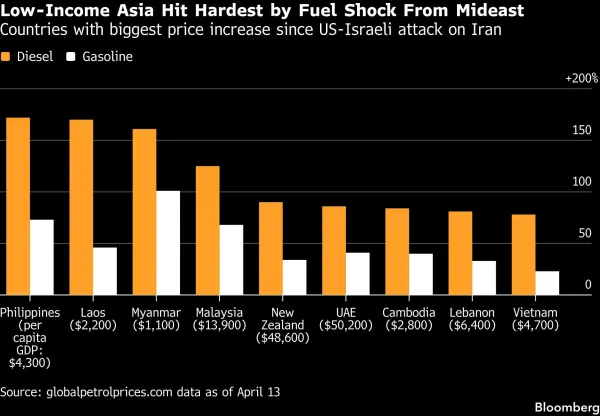
Asian nations face the prospect of prolonged strain on crucial energy supplies as the conflict in the Middle East grinds past the two-month mark, with the Strait of Hormuz still largely off-limits to shipping.
Governments have already raided their policy toolkits by amping up subsidies to keep a lid on energy prices, restricting fuel use and ordering public officials to work from home. Officials have shuttled across the globe to secure alternate oil and gas supplies, including from sanctions-hit Russia. It’s all coming at a cost to their budgets.
Also read: India plugs oil gap as Middle East supplies sink
The disruption has laid bare how reliant the region is on Middle East energy, and how dwindling stockpiles may hit everything from Taiwan’s chip supply chain to rice harvests, Asia’s biggest food staple.
“Subsidies, export curbs, and WFH mandates blunt the immediate pain but won’t prevent deeper trouble if disruptions linger,” said Alicia Garcia-Herrero, chief economist for Asia-Pacific at Natixis. “They’re political band-aids — popular short-term, fiscally costly, and market-distorting.”
Even if the Strait of Hormuz reopens, it will take time to recover, with Asian countries having had a wakeup call to improve fiscal strength and energy security.
The worst-case scenario if the war drags on would be blackouts, price spikes in food or fertilizer, and factory slowdowns, Garcia-Herrero said. If the strait were to reopen, she said “APAC recovery should be swift — weeks for rerouting and refinery flows to stabilize.”
“It all depends on how long the conflict and high prices last. But most in Asia simply cannot afford to hold out for too long,” said Roland Rajah, lead economist and director at the Lowy Institute’s Indo-Pacific Development Center. “Repeated shocks quickly exhaust fiscal space,” he said, citing examples such as the Covid-19 pandemic and tariffs.
Here’s a snapshot of how the region has responded so far to the fuel squeeze:
Also read: Trump’s Hormuz blockade has deepened a historic shipping crisis
Governments have already raided their policy toolkits by amping up subsidies to keep a lid on energy prices, restricting fuel use and ordering public officials to work from home. Officials have shuttled across the globe to secure alternate oil and gas supplies, including from sanctions-hit Russia. It’s all coming at a cost to their budgets.
Also read: India plugs oil gap as Middle East supplies sink
The disruption has laid bare how reliant the region is on Middle East energy, and how dwindling stockpiles may hit everything from Taiwan’s chip supply chain to rice harvests, Asia’s biggest food staple.
“Subsidies, export curbs, and WFH mandates blunt the immediate pain but won’t prevent deeper trouble if disruptions linger,” said Alicia Garcia-Herrero, chief economist for Asia-Pacific at Natixis. “They’re political band-aids — popular short-term, fiscally costly, and market-distorting.”
Even if the Strait of Hormuz reopens, it will take time to recover, with Asian countries having had a wakeup call to improve fiscal strength and energy security.
The worst-case scenario if the war drags on would be blackouts, price spikes in food or fertilizer, and factory slowdowns, Garcia-Herrero said. If the strait were to reopen, she said “APAC recovery should be swift — weeks for rerouting and refinery flows to stabilize.”
“It all depends on how long the conflict and high prices last. But most in Asia simply cannot afford to hold out for too long,” said Roland Rajah, lead economist and director at the Lowy Institute’s Indo-Pacific Development Center. “Repeated shocks quickly exhaust fiscal space,” he said, citing examples such as the Covid-19 pandemic and tariffs.
Here’s a snapshot of how the region has responded so far to the fuel squeeze:
China
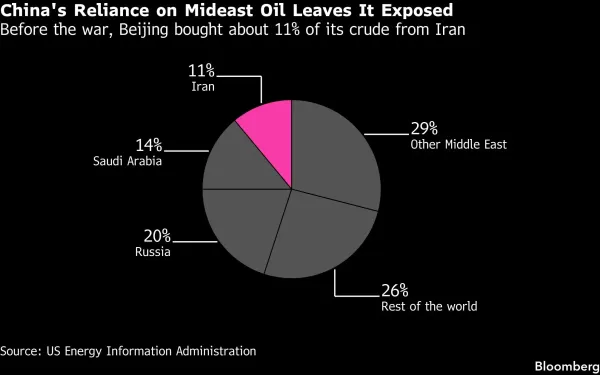
The world’s largest crude importer — and the biggest buyer of Iranian oil — has managed to mitigate the hit by diversifying its fuel sources for years. It hasn’t resorted to touching its national oil reserves, which Bloomberg Intelligence estimates to be as much as 1.4 billion barrels, though it allowed state-run refiners to tap some commercial reserves. It imposed price controls on energy and was said to have ordered private refiners to maintain 2025-level production at any cost. Officials considered relief for struggling state-run airlines, according to people familiar with the matter. As part of a broader strategy, China is reviving coal-to-gas projects. Underlining its healthy stockpiles, Chinese tankers appeared to be delivering diesel and other fuel to neighbors such as Vietnam and the Philippines.India
The world’s No. 3 oil importer is racing to shore up supplies. It is due to receive nearly 16 million barrels of Venezuelan crude in May and June, while state refiners snagged millions of barrels from Russia after the US issued a waiver. It raised export taxes on diesel and jet fuel, though officials were forced to quickly scale back a doubling of plane fuel prices. State-run oil firms have been ordered to keep fuel prices stable, averting widespread hikes at the pump. However, some owners of trucks — which move nearly 70% of the nation’s cargo — have reported facing diesel rationing.Also read: Trump’s Hormuz blockade has deepened a historic shipping crisis
Singapore
Singapore, which gets about 60% of its fossil fuels by sea in the form of LNG, is sourcing supplies from Latin America and Africa, and requiring power firms to maintain diesel reserves. It unveiled a S$1 billion ($784 million) support package including tax rebates and increased cost-of-living payments. It even ordered government facilities to set air conditioning at 25°C (77°F) or higher and turn off non-essential equipment when not in use. Officials also delayed a world-first sustainable aviation fuel levy until Oct. 1.Australia
Despite being a major energy exporter, its refined fuel stockpile is among the lowest in the developed world. Australia rolled out a suite of measures including halving fuel excise duty and pausing a sales-tax increase. It announced A$1 billion ($713 million) in interest-free loans for affected businesses, relaxed diesel standards and released fuel reserves. Prime Minister Anthony Albanese urged citizens to use public transport and avoid panic buying, while one state made public transport free for a period. Even before a fire hit one of the nation’s two oil refineries, the government began diversifying fuel sources, buying from the US and Mexico. Albanese embarked on an Asian tour to secure extra diesel from South Korea, Brunei and Malaysia, while his foreign minister is sounding out countries including China and Japan.Japan
Japan relies on the Middle East for more than 90% of its oil, leaving it vulnerable to the war shock, though it has made efforts to cut dependency on LNG from the Gulf. It rolled out gasoline subsidies and tapped into national and private-sector oil reserves. It allowed less efficient coal-fired power plants to participate in auctions for a year, which — combined with restarting a Tokyo Electric Power Co. nuclear plant — is expected to offset about 40% of LNG imports previously received through the Strait of Hormuz. Japan is also cracking down on gas-price gouging. While fortifying its own supplies, Japan pledged $10 billion in funds for Southeast Asia to help source oil and secure critical supply chains.Malaysia
Malaysia has kept some of the world’s lowest petrol prices, at 1.99 ringgit ($0.50) per liter for eligible drivers, by spending billions on fuel subsidies. The government is now said to be considering a more targeted approach to subsidies after footing a $1.8 billion monthly bill since the Iran war began. Authorities deployed police to more than 100 petrol stations to combat smuggling, slashed monthly fuel quotas to 200 liters per citizen, and mandated government employees work from home starting April 15. Malaysia also plans to increase biodiesel blends and diversify fuel sources. Prime Minister Anwar Ibrahim urged a crackdown on what he called fake news about fuel prices.