India is facing inflation threats from heat waves and below normal rainfall this year, creating new economic pressures for policymakers already grappling with soaring energy costs.
Temperatures of as high as 47C (117F) degrees Celcius have gripped parts of northern India this week, and power demand has surged to a record in the country as households cranked up air conditioners and fans to cool down. The government is also predicting below-normal rains between the June and September monsoon season, which is crucial for farming activity.
Also read: Hormuz disruption, $100 oil pose risks to India's inflation, rupee: Union Bank
For most of last year, inflation in India languished below the Reserve Bank of India’s target of 4%, largely because of declining vegetable prices. This year’s adverse weather conditions will likely push inflation above 5% in the fiscal year beginning April 1, exceeding the RBI’s projection of 4.6%, according to economists.
“The ongoing heat wave and erratic monsoon will all impart upside risk to food prices that have remained well behaved so far,” said Dhiraj Nim, an economist at Australia & New Zealand Banking Group. The rain forecasts “along with high energy prices and agricultural inputs costs, make for a perfect storm for food prices down the line,” he said. Nim expects inflation to average close to 5% this fiscal year.
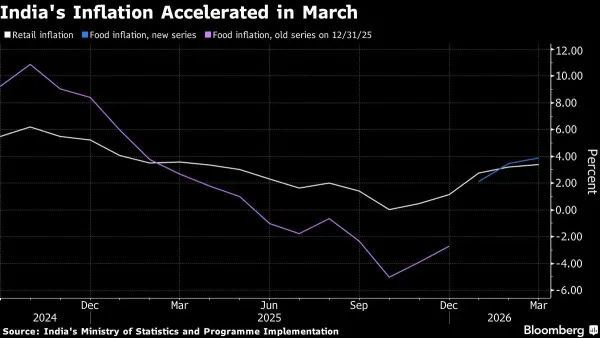
Food has a weight of 37% in the consumer price index, and although that’s down from 46% after recent revisions, the category remains the largest in the inflation basket.
More than 60% of India’s population also live in rural areas and are dependent on agriculture and allied activities for their livelihood. Poor harvests could hit incomes, curbing demand in rural areas, and weigh on economic growth.
The double whammy from high food and energy costs will complicate the RBI’s monetary policy going forward. Governor Sanjay Malhotra signaled earlier this month the central bank will stay on hold for longer as it assesses inflation and growth risks. The RBI is projecting the economy will expand 6.9% this fiscal year.
Bloomberg Economics’s Abhishek Gupta sees inflation reaching 5.8% this fiscal year if monsoon rains are below normal. In 2023, when rainfall was 5.4% below normal, crop production fell 3.5%, while average food inflation surged to 8%.
“Our call that the RBI will pause for a prolonged period is starting to look shaky — a poor monsoon season could increase the chances of a pivot to tightening,” he said in a report.
Below-normal rains mean farmers may be forced to use diesel-powered irrigation to water their lands, which would raise their costs further. With crude oil above $100 a barrel because of the ongoing Iran war, producers may be forced to pass on some of those costs to consumers.
“Particularly worrying is that if crop sowing is impacted, the rebound in rural demand could start petering off,” said Sakshi Gupta, an economist at HDFC Bank Ltd.
Some economists like Sonal Varma at Nomura Holdings Inc. say the impact on food prices could be minimized because of India’s strong buffer stocks of rice and wheat.
Also read: The billion-barrel Hormuz oil shock is about to crash demand
“The impact of El Niño on food production has moderated over time due to better irrigation and climate-resistant seeds,” she said.
The RBI remains sanguine for now. Deputy Governor Poonam Gupta said in an interview with a local newspaper last week that the central bank’s inflation projections already factor in a 7%–9% rainfall deficit. Past El Niño episodes with similar deficits didn’t hit farm output, she said.
Still, the outlook remains uncertain. Skymet, a private weather forecaster, sees a 30% chance of drought-like conditions as rains turn more erratic.
“The risk will be more pronounced if rainfall is affected in July and August, the key sowing months,” said Gaura Sengupta, an economist at IDFC First Bank Ltd.
Temperatures of as high as 47C (117F) degrees Celcius have gripped parts of northern India this week, and power demand has surged to a record in the country as households cranked up air conditioners and fans to cool down. The government is also predicting below-normal rains between the June and September monsoon season, which is crucial for farming activity.
Also read: Hormuz disruption, $100 oil pose risks to India's inflation, rupee: Union Bank
For most of last year, inflation in India languished below the Reserve Bank of India’s target of 4%, largely because of declining vegetable prices. This year’s adverse weather conditions will likely push inflation above 5% in the fiscal year beginning April 1, exceeding the RBI’s projection of 4.6%, according to economists.
“The ongoing heat wave and erratic monsoon will all impart upside risk to food prices that have remained well behaved so far,” said Dhiraj Nim, an economist at Australia & New Zealand Banking Group. The rain forecasts “along with high energy prices and agricultural inputs costs, make for a perfect storm for food prices down the line,” he said. Nim expects inflation to average close to 5% this fiscal year.
Food has a weight of 37% in the consumer price index, and although that’s down from 46% after recent revisions, the category remains the largest in the inflation basket.
More than 60% of India’s population also live in rural areas and are dependent on agriculture and allied activities for their livelihood. Poor harvests could hit incomes, curbing demand in rural areas, and weigh on economic growth.
The double whammy from high food and energy costs will complicate the RBI’s monetary policy going forward. Governor Sanjay Malhotra signaled earlier this month the central bank will stay on hold for longer as it assesses inflation and growth risks. The RBI is projecting the economy will expand 6.9% this fiscal year.
Bloomberg Economics’s Abhishek Gupta sees inflation reaching 5.8% this fiscal year if monsoon rains are below normal. In 2023, when rainfall was 5.4% below normal, crop production fell 3.5%, while average food inflation surged to 8%.
“Our call that the RBI will pause for a prolonged period is starting to look shaky — a poor monsoon season could increase the chances of a pivot to tightening,” he said in a report.
Below-normal rains mean farmers may be forced to use diesel-powered irrigation to water their lands, which would raise their costs further. With crude oil above $100 a barrel because of the ongoing Iran war, producers may be forced to pass on some of those costs to consumers.
“Particularly worrying is that if crop sowing is impacted, the rebound in rural demand could start petering off,” said Sakshi Gupta, an economist at HDFC Bank Ltd.
Some economists like Sonal Varma at Nomura Holdings Inc. say the impact on food prices could be minimized because of India’s strong buffer stocks of rice and wheat.
Also read: The billion-barrel Hormuz oil shock is about to crash demand
“The impact of El Niño on food production has moderated over time due to better irrigation and climate-resistant seeds,” she said.
The RBI remains sanguine for now. Deputy Governor Poonam Gupta said in an interview with a local newspaper last week that the central bank’s inflation projections already factor in a 7%–9% rainfall deficit. Past El Niño episodes with similar deficits didn’t hit farm output, she said.
Still, the outlook remains uncertain. Skymet, a private weather forecaster, sees a 30% chance of drought-like conditions as rains turn more erratic.
“The risk will be more pronounced if rainfall is affected in July and August, the key sowing months,” said Gaura Sengupta, an economist at IDFC First Bank Ltd.