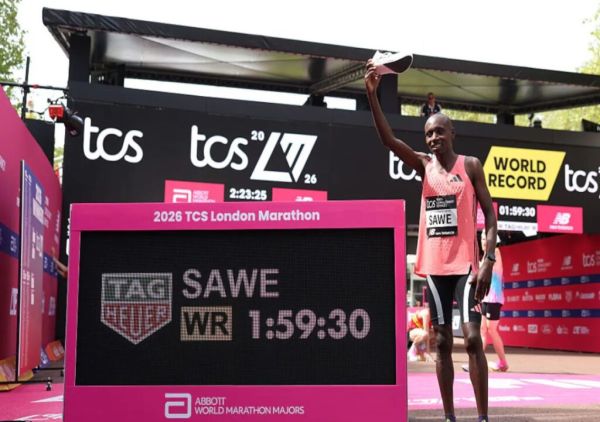
London: In a groundbreaking moment for athletics, Kenya’s Sebastian Sawe etched his name into history by becoming the first athlete to officially complete a marathon in under two hours, clocking an astonishing 1:59:30 at the London Marathon 2026 on Sunday.
The 31-year-old delivered on his pre-race promise of “fireworks,” producing a performance that has redefined the boundaries of human endurance. His remarkable feat came in warm spring conditions and stunned the global athletics community, as not just Sawe, but the top three finishers all surpassed the previous world record.
Historic race rewrites record books
Sawe’s time of 1:59:30 shaved a massive 65 seconds off the previous men’s world record of 2:00:35 set by the late Kelvin Kiptum at the Chicago Marathon in 2023.
In an extraordinary race, Ethiopia’s Yomif Kejelcha finished second in 1:59:41, marking the fastest marathon debut in history. Uganda’s Jacob Kiplimo secured third place with a time of 2:00:2
This marked the first time in history that three athletes finished inside the previous world record in the same race, underscoring the exceptional pace and competitive intensity witnessed on London’s streets.
Sawe’s decisive surge seals victory
The race unfolded with a leading pack of six elite runners, including Olympic champion Tamirat Tola, maintaining a blistering tempo. They crossed the halfway mark at 1:00:29, already on course for history.
As the race progressed, the group thinned out, leaving Sawe and Kejelcha locked in a gripping duel. The pair remained stride for stride until the closing stages, showcasing remarkable endurance and tactical discipline.
With just one mile remaining, Sawe made his decisive move, breaking away from Kejelcha and surging ahead with unmatched strength. Running solo in the final stretch, he powered to the finish line, sealing a historic victory.
Breaking barriers and inspiring a generation
Speaking after the race, Sawe expressed immense pride in his achievement and its significance for future athletes.
“I’ve made history today in London, and for the new generation, it shows that running a record is possible,” he said. “It depends on the preparation and discipline. I have shown that nothing is impossible. Everything is possible with time.”
His achievement inevitably drew comparisons to Eliud Kipchoge, who famously ran a sub-two-hour marathon in 2019. However, Kipchoge’s time of 1:59:40 was not officially recognised due to controlled conditions, including specialised pacing and non-standard race rules.
Sawe’s performance, by contrast, meets official competition criteria, making it the first ratified sub-two-hour marathon in history.
Kipchoge himself hailed the moment, calling it a “historical day for marathon running” and a sign of the sport’s evolving potential.
Technology and preparation play key roles
Sawe’s success also highlighted the role of cutting-edge technology in modern athletics. He competed wearing Adidas’s latest Pro Evo 3 supershoes, weighing under 100 grams, designed to maximise speed and efficiency.
The Kenyan had hinted before the race that both course and world records were within reach, and his meticulous preparation, combined with discipline and favourable race dynamics, proved decisive.
Tigst Assefa shines in women’s race
In the women’s event, Ethiopia’s Tigst Assefa delivered another stellar performance, successfully defending her title while breaking her own women-only world record.
Assefa crossed the finish line in 2:15:41, improving her previous mark by nine seconds. She was locked in a fierce contest with Kenya’s Hellen Obiri and Joyciline Jepkosgei before pulling away in the final stages.
Obiri finished second in a personal best of 2:15:53, narrowly edging Jepkosgei, who took third place in a dramatic sprint finish.
Global praise and national pride
Sawe’s achievement drew widespread acclaim, including from Kenya’s President William Ruto, who described the feat as a defining moment in sporting history.
“This is more than a win,” he said. “It is a defining moment. Your triumph places you firmly among the greats and reaffirms Kenya as a dominant force in distance running.”
The race also reignited discussions about the evolving limits of human performance, with experts pointing to improved training methods, nutrition, and equipment as contributing factors.
A defining moment in marathon history
The 2026 London Marathon will be remembered as a watershed moment in athletics. With Sawe’s historic sub-two-hour run now officially recognised, the once unimaginable barrier has finally been broken under standard race conditions.
As the sport enters a new era, Sawe’s achievement stands as a powerful reminder that human potential continues to expand. His record-breaking performance not only rewrites history but also sets a new benchmark for generations to come.