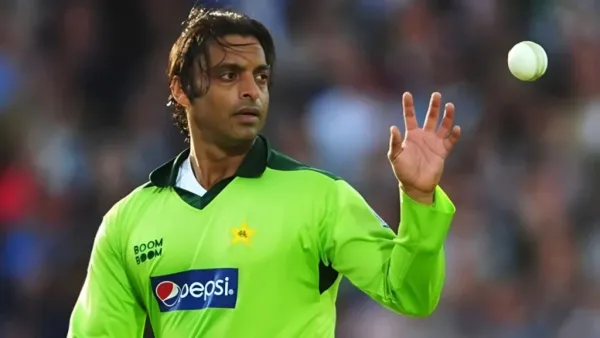
Twenty-four years ago today at the Gaddafi Stadium in Lahore, a young Pakistani fast bowler with a slingy action and a fearless attitude did something that the sport of cricket had never seen before.
On April 27, 2002, Shoaib Akhtar bowled a delivery to New Zealand’s Craig McMillan that was clocked at 161 kilometers per hour, 100.04 miles per hour and in doing so became the first human being to genuinely threaten and then breach the 100 miles per hour barrier in professional cricket.
The ICC refused to officially recognize it. Shoaib Akhtar could not have cared less.
On this Day in 2002: The 100 mph delivery by Shoaib Akhtar
Pakistan had already won the three-match ODI series against New Zealand before the third game even began, making the Lahore fixture essentially inconsequential in terms of the series result. Pakistan batted first and posted 278, then Akhtar and Waqar Younis took the new ball as the chase began.
What followed was one of the most remarkable sustained spells of fast bowling seen in the format. Shoaib Akhtar bombarded the New Zealand top order with deliveries at speeds consistently above 99 miles per hour, Craig McMillan faced one at 99.3 mph that must have felt like standing in front of an oncoming train, before the delivery that stopped everyone in their tracks.
The speed gun showed either 100.04 mph or 99.9 mph depending on which report you read at the time, and that discrepancy became the first source of controversy around a record that was never going to be straightforward.
Why the ICC refused to recognize it
The International Cricket Council declined to officially sanction Shoaib Akhtar’s achievement on the grounds that the speed gun used in the match had been provided by one of the match’s sponsors rather than being the ICC’s own standard measuring equipment.
The Pakistan Cricket Board put out a statement confirming what their own data showed but the ICC’s position was clearm without a standardized tool they could not recognize the record.
Shoaib Akhtar’s response was as direct and uncomplicated as his run-up. “It doesn’t matter to me whether somebody recognizes the speed gun or not. For me it’s satisfying that I have bowled the fastest-ever delivery,” he said. It was the answer of a man who knew exactly what he had done and needed no official stamp to validate it.
The record Shoaib Akhtar made official a year later
Shoaib Akhtar did not have to wait long to put the debate to rest permanently. On February 22, 2003, in a World Cup Group A match at Newlands Stadium in Cape Town against England, he bowled a delivery clocked at 161.3 kilometers per hour, a fraction faster than the Lahore delivery and this time with equipment that the ICC was prepared to recognise.
That ball remains the fastest delivery ever officially recorded in the history of cricket and it has stood untouched for over two decades. Brett Lee came closest, clocking 161.1 kilometers per hour against New Zealand in 2005, with Shaun Tait matching Lee’s speed at Lord’s in 2010. Nobody has gone faster since.
The broader legacy of that Lahore night
What April 27, 2002 represented went beyond the numbers on a speed gun. Fast bowling has always been about more than pace, it is about the psychological warfare, the theatre, the particular kind of fear that only a genuinely quick bowler can generate in a batter.
Jeff Thomson, who held the previous unofficial fastest delivery record at 99.8 miles per hour from a 1975 test at the WACA, once claimed that if his deliveries had been measured from the bowler’s end rather than the batting end as modern speed guns do, he would have been clocking close to 180 kilometers per hour.
Thomson famously said you need to be a little mad to become a fast bowler a sentiment Akhtar would have understood completely. On this day in 2002, Akhtar channeled whatever madness he had into one delivery in Lahore and gave cricket a moment it has been talking about ever since.
-
Nigeria: Gunmen attack orphanage, abduct 23 pupils; 15 later rescued

-
Biryani, watermelon turn deadly for family of four in Mumbai

-
Hyderabad: Sigma Advanced Systems inks Rs 3,800 cr agreement with Rolls-Royce

-
Explained: Why is Hyderabad facing a fuel shortage again?

-
Pune: CSMT-Solapur Vande Bharat Coach Derails While Entering Station