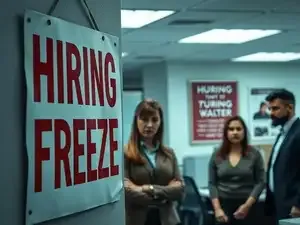
The concept of a hiring freeze seems straightforward. Positions are left unfilled; interviews become more difficult, and departments are instructed to manage using current assets. However, behind closed doors, these freezes may be indicative of something larger happening. Not all hiring freezes signal pending layoffs or organizational problems. Some may simply be part of a short-term cost-saving measure, while others are a result of uncertain economic times.
Nevertheless, workplace professionals argue that hiring freezes could be a subtle warning that management is gearing up for organizational restructuring, budget cuts, or a change in business direction.
Labor accounts for the largest share of an organization’s budget, and as such, cutting down on new hires is a good way to save money during a period of uncertainty as management reviews the situation in the market. McKinsey & Company, a leading management consulting company, reveals that many organizations look into adjusting their workforce planning process before opting for restructuring measures, because they are riskier than other strategies.
According to economists, hiring freezes tend to occur in situations where there will be reduced demand, increased cost, or investor pressure on the organization.
As per the Society for Human Resource Management workforce studies, organizations typically conduct a staffing audit before proceeding to hire differently in their transformation phase. Examples of such transformations include digital transformation, change in leadership, mergers, and shifts in operational models.

In instances where there is no addition of people to the existing staff because of hiring freezes, employees will likely have more responsibility. Some companies will opt for automation, consolidation of roles, or elimination of unnecessary management layers.
According to Deloitte, changes in talent management and staffing usually precede organizational change.
This does not necessarily translate to job losses, but it can mean the company is evaluating its processes.
Executives may refrain from hiring due to uncertainties regarding growth strategies, pending financial decisions, or changes in economic indicators. In such cases, a hiring freeze may appear more protective than revolutionary.
Statistics provided by the U.S. Chamber of Commerce have often pointed out that businesses can be hesitant to hire even if there is a shortage of skilled workers, especially amid uncertainty.
This ambivalence is precisely why employees are often unsettled by hiring freezes. It is not the freeze itself that causes anxiety but the ambiguity surrounding its aftermath.
The context is important too. A hiring freeze in the context of high performance and growth plans may have a different meaning compared to a hiring freeze in the context of declining revenues and cost reduction. Employees gain insights from contextual clues rather than from a hiring freeze itself.
That is why such suspensions usually generate so much interest. Hiring freezes are not normally seen as mere recruiting actions. At times, the hiring freeze really is exactly that: a temporary halt. However, at other times, the hiring freeze can signal a possible organizational change taking place in the background.
That is the reason why employees pay attention to hiring freezes – they indicate that something may be brewing within the organization.
Nevertheless, workplace professionals argue that hiring freezes could be a subtle warning that management is gearing up for organizational restructuring, budget cuts, or a change in business direction.
Hiring freezes often begin as a financial cautionary move
Freezing hiring is another strategy through which organizations cut down expenses without immediately reducing the number of employees they have.Labor accounts for the largest share of an organization’s budget, and as such, cutting down on new hires is a good way to save money during a period of uncertainty as management reviews the situation in the market. McKinsey & Company, a leading management consulting company, reveals that many organizations look into adjusting their workforce planning process before opting for restructuring measures, because they are riskier than other strategies.
According to economists, hiring freezes tend to occur in situations where there will be reduced demand, increased cost, or investor pressure on the organization.
It can signal that a reorganization is being planned
At times, freezing the recruitment process does not necessarily have anything to do with cost-saving. An organization could stop recruiting until it figures out if there would be mergers, role alterations, or reallocation of work responsibilities. There could be signs of project shifts or unfilled positions taking longer than usual.As per the Society for Human Resource Management workforce studies, organizations typically conduct a staffing audit before proceeding to hire differently in their transformation phase. Examples of such transformations include digital transformation, change in leadership, mergers, and shifts in operational models.
Image Credit: TIL Creatives| Employees battle mounting workloads and stress in a dimly lit, understaffed office
Efficiency pushes can sometimes follow
The workforce will usually take notice if their leaders suddenly start talking about doing things like “doing more with less” or “optimizing resources and productivity.” This is because layoffs might happen along with the drive for efficiency.In instances where there is no addition of people to the existing staff because of hiring freezes, employees will likely have more responsibility. Some companies will opt for automation, consolidation of roles, or elimination of unnecessary management layers.
According to Deloitte, changes in talent management and staffing usually precede organizational change.
This does not necessarily translate to job losses, but it can mean the company is evaluating its processes.
It may reflect uncertainty at the top
Sometimes, a hiring freeze reveals more about the risk aversion of leaders than financial problems within a firm.Executives may refrain from hiring due to uncertainties regarding growth strategies, pending financial decisions, or changes in economic indicators. In such cases, a hiring freeze may appear more protective than revolutionary.
Statistics provided by the U.S. Chamber of Commerce have often pointed out that businesses can be hesitant to hire even if there is a shortage of skilled workers, especially amid uncertainty.
This ambivalence is precisely why employees are often unsettled by hiring freezes. It is not the freeze itself that causes anxiety but the ambiguity surrounding its aftermath.
A freeze does not automatically mean layoffs
For employees, it is quite normal to think that whenever there is a hiring freeze in an organization, layoffs will follow, but that need not necessarily be the case. Sometimes, organizations adopt hiring freezes to avoid laying off any of their employees altogether. At times, hiring freezes may be lifted once budgets are revised and the strategy is clarified.The context is important too. A hiring freeze in the context of high performance and growth plans may have a different meaning compared to a hiring freeze in the context of declining revenues and cost reduction. Employees gain insights from contextual clues rather than from a hiring freeze itself.
Why do employees pay attention to the signal
Although hiring freezes are considered to be administrative decisions, they are usually perceived by employees as cultural signals. They can impact employee morale, employee workloads, and even their understanding of job security within the organization. Furthermore, a hiring freeze can influence employees’ perspectives on professional advancement within the organization.That is why such suspensions usually generate so much interest. Hiring freezes are not normally seen as mere recruiting actions. At times, the hiring freeze really is exactly that: a temporary halt. However, at other times, the hiring freeze can signal a possible organizational change taking place in the background.
That is the reason why employees pay attention to hiring freezes – they indicate that something may be brewing within the organization.