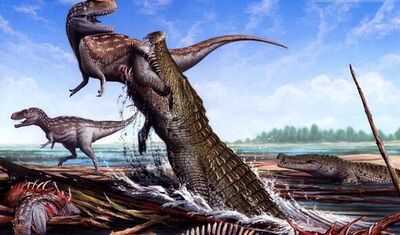
A bus-sized "terror croc" that could crush dinosaur bone with a bite stronger than the tyrannosaurus rex has roared back to life in stunning detail. Palaeontologists have unveiled the first scientifically accurate full skeleton of Deinosuchus schwimmeri, a monstrous crocodilian that ruled the swamps and rivers of Late Cretaceous North America more than 75 million years ago.
At up to 9.45 metres (31 feet) long - roughly the length of a school bus - and weighing several tonnes, the beast was an apex predator capable of ambushing and devouring large dinosaurs, including hadrosaurs and possibly even tyrannosaurs. The new life-size replica, now on display at Georgia's Tellus Science Museum, was two years in the making through a collaboration between Columbus State University and Triebold Paleontology Inc. It brings the "terrible crocodile" - the literal translation of Deinosuchus - into sharp focus for the first time.
Fossil evidence tells a brutal story. Tooth marks matching Deinosuchus teeth have been found on dinosaur bones, some partially healed, proving the giant croc attacked living prey rather than just scavenging.
Its skull stretched nearly two metres, armed with banana-sized teeth built for piercing and crushing. Studies of its robust jaws and musculature suggest a bite force exceeding that of Tyrannosaurus rex, making it one of the most powerful biters in Earth's history.
The study was led by Professor David Schwimmer (not to be confused with the Friends actor who ironically played a paleontologist in the 1990s sitcom).
He said: "It was a very serious predator." It lurked in coastal waterways, using its explosive power and perfected death-roll technique to drag dinosaurs into the water.
The eastern US populations of Deinosuchus schwimmeri thrived between 83 and 76 million years ago, coexisting with - and preying on - the dinosaurs that dominated the land.
While T. rex gets the headlines, this aquatic monster was a top-tier terror in its ecosystem, growing to sizes that dwarf modern crocodiles.
The Tellus exhibit marks the only place in the world where the public can stand face-to-snout with a full-scale Deinosuchus skeleton. It offers a rare glimpse into a time when giant crocs, not just giant lizards, ruled the food chain.
For visitors, the message is clear: 75 million years ago, the most dangerous thing near the water wasn't a shark or a snake. It was a bus-sized crocodile with a bite that could humble the king of the dinosaurs.
-
Mohini Ekadashi 2026: How Lord Vishnu's Mohini avatar cleanses karma and grants salvation

-
Why leadership often attracts 'dark' personality traits: A new study explains nuances of power and personality

-
Kumar's 'Bhooth Bangla' nears 180cr worldwide after 100cr milestone
-
'Leader' OTT release: Legend Saravanan film to stream on THIS platform - Reports

-
'Dhurandhar 2' box office collection day 39: Ranveer Singh's film continues to soar; mints Rs 3.40 cr amid 'Michael,' 'Bhooth Bangla' buzz