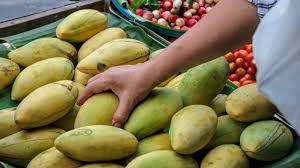
News India Live, Digital Desk: As soon as summer begins, the smell of the king of fruits ‘Mango’ has started spreading all around in the markets. Just hearing names like Hapus (Alphonso), Kesar, Dussehri and Langra makes the mouth water. But do you know that not every yellow and shiny mango available in the market is sweet or healthy? In order to earn more profits, many times traders cook mangoes with chemicals (calcium carbide). In such a situation, Live Hindustan has brought for you some ‘secret hacks’, by adopting which you can choose the best and naturally ripe mangoes from the market. 1. The ‘Magical’ Test of Water (The Water Test) This is the oldest and most effective method. After buying the mango or before buying, put it in a bucket of water: Real mango: The mango which is naturally ripe on the tree is heavy and will sink as soon as you put it in water. Fake mango: Chemically ripened mangoes are half raw from inside and contain air, so they will float on the water. Avoid buying such mangoes.2. Don’t go by the color, look at the spots. Often we buy dark yellow and blemish-free mangoes as soon as we see them, but this is the biggest mistake: Natural Mangoes: Naturally ripe mangoes do not have the same color. It may be light green at some places and yellow at others. Also, there are small brown or black spots on its peel. Chemical Mango: It is very beautiful to look at, shiny and completely of the same color (Uniformly Yellow). If white or blue marks are seen on the mango, then understand that it has been cooked with spices (carbide).3. Look and feel by ‘pressing’ Take the mango in your hand and press it lightly: Correct choice: Ripe mango is soft to touch but not mushy. Caution: If the mango feels very hard at some places and very soft at other places, then understand that it is not ripe properly. Natural mango feels equally soft from all sides.4. The Smell Test: The smell of mango is the biggest indicator of its purity: Real Identification: Smell the stem part of the mango. There should be a sweet, aromatic and natural aroma of the fruit coming from there. Danger sign: If there is no smell coming from the mango or if there is a chemical, alcoholic or pungent smell coming from it, then do not take it at all.5. Check the balance between weight and size by holding the mango in your hand. If the mango feels heavier than its size, it means it is full of juice. Dry and bland mangoes often turn out to be fibrous or tasteless inside.
-
'Curing diseased democracy': Why are voters attracted to political outsiders?

-
DC vs CSK, IPL 2026: Delhi Capitals, Chennai Super Kings in Must-Win Clash as Playoff Race Intensifies

-
All eyes on 'The Devil Wears Prada 2' stars as they bring couture drama to Met Gala 2026

-
Kiran Mazumdar-Shaw names niece Claire as Biocon successor

-
Road Rash! 39 Injured, 3 Critical After Speeding Truck Collides With Bus; Passengers Break Rear Glass To Escape -- VIDEO