Earlier this month, a group of climate-change deniers gathered at the Hotel Washington in the US capital to celebrate their takeover of the government. Their conference’s theme was “Climate Realism Rising.”
About a mile away, circling the Tidal Basin next to the National Mall, were thousands of Yoshino cherry trees in declining bloom. The genus to which they belong offers a far different, and far more realistic, version of climate realism.
The Washington cherry blossoms peaked on March 26 this year, not long after the start of the National Cherry Blossom Festival. It was the seventh consecutive year in which the trees flowered earlier than their 20-year average. And that average has fallen by about eight days since the 1940s. When the US entered World War II, peak blossom happened around April 6. Now, it happens around March 29.
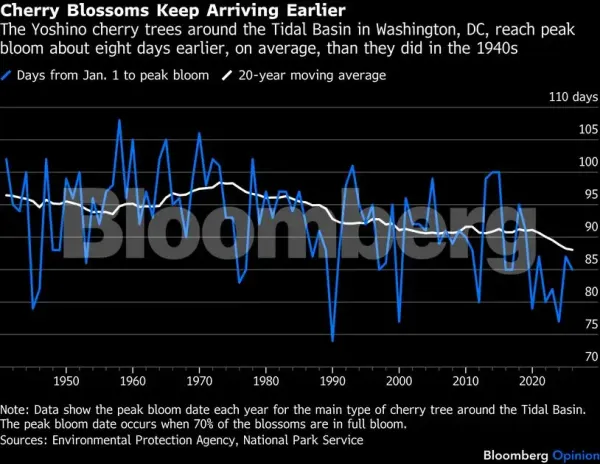 Cherry Blossoms Keep Arriving Earlier | The Yoshino cherry trees around the Tidal Basin in Washington, DC, reach peak bloom about eight days earlier, on average, than they did in the 1940s
But 80 years is barely longer than a human life, which is arguably not enough to establish a real trend. Fortunately, we have a 1,200-year data set that tells the same story even more convincingly.
The late Japanese climate scientist Yasuyuki Aono stitched together records of the blooms of Japanese mountain cherry trees in Kyoto going back to 812. His time series shows several big, climate-driven swings in peak-bloom dates over the centuries. But none of those are anything like what has happened since the 20th century began. The 30-year average peak bloom date has dropped from about April 16 on 1900 to April 4 this year. In 2023, Kyoto’s cherry blossoms peaked on March 25, the earliest in all 1,214 years of Aono’s data.
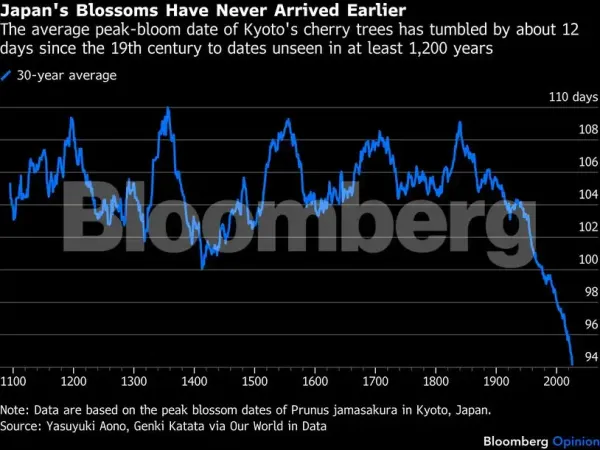 Japan's Blossoms Have Never Arrived Earlier | The average peak-bloom date of Kyoto's cherry trees has tumbled by about 12 days since the 19th century to dates unseen in at least 1,200 years
Climate change is the main reason for these drastic changes, according to science, something the Environmental Protection Agency under previous presidents once acknowledged. The planet has heated by about 1.4 degrees Celsius above preindustrial averages because of humanity’s carbon-dioxide emissions, raising the average March temperatures in Washington and Kyoto and encouraging trees to bloom earlier.
The “heat-island” effect of urbanization has played a role. A 2022 study by Aono and other scientists found urban heat accounted for about half of the shift in Kyoto’s peak-bloom dates. But they also found that climate change intensified urban heat and made extremely early blossom days 15 times more likely. More warming in the decades ahead will mean even earlier blossom dates and extremes becoming normal.
Some of the attendees of that “Climate Realism” conference at the Hotel Washington, sponsored by fossil-fuel-friendly groups such as the Heartland Institute and the CO2 Coalition, would deny any of this. Current EPA Administrator Lee Zeldin, who addressed the reported dozens of attendees, once acknowledged the reality of a changing climate. But lately he has helped marshal President Donald Trump’s attacks on every government effort to ameliorate it, including by rescinding his agency’s finding that carbon dioxide is a dangerous pollutant that needs regulation.
Zeldin and climate skeptics have shifted tactics in recent years, from questioning climate change’s reality to questioning its seriousness. Conveniently, both stances argue for the continued use of fossil fuels. Cherry blossoms arriving a couple of weeks early would seem to fall on the “not very serious” end of the spectrum of climate consequences — at least until you remember that cherry trees are plants, as are corn, wheat and other food crops also being affected by warped growing seasons.
Cherry blossoms are just photogenic bellwethers of an atmosphere going awry. You don’t have to look far to see other effects that are far less cheerful, including droughts, wildfires, destructive storms, soaring insurance costs and more. Climate deniers are famous for ignoring the facts beyond their noses, including flowers they can see from their hotel rooms. The rest of us can take a wider view.
About a mile away, circling the Tidal Basin next to the National Mall, were thousands of Yoshino cherry trees in declining bloom. The genus to which they belong offers a far different, and far more realistic, version of climate realism.
The Washington cherry blossoms peaked on March 26 this year, not long after the start of the National Cherry Blossom Festival. It was the seventh consecutive year in which the trees flowered earlier than their 20-year average. And that average has fallen by about eight days since the 1940s. When the US entered World War II, peak blossom happened around April 6. Now, it happens around March 29.
But 80 years is barely longer than a human life, which is arguably not enough to establish a real trend. Fortunately, we have a 1,200-year data set that tells the same story even more convincingly.
The late Japanese climate scientist Yasuyuki Aono stitched together records of the blooms of Japanese mountain cherry trees in Kyoto going back to 812. His time series shows several big, climate-driven swings in peak-bloom dates over the centuries. But none of those are anything like what has happened since the 20th century began. The 30-year average peak bloom date has dropped from about April 16 on 1900 to April 4 this year. In 2023, Kyoto’s cherry blossoms peaked on March 25, the earliest in all 1,214 years of Aono’s data.
Climate change is the main reason for these drastic changes, according to science, something the Environmental Protection Agency under previous presidents once acknowledged. The planet has heated by about 1.4 degrees Celsius above preindustrial averages because of humanity’s carbon-dioxide emissions, raising the average March temperatures in Washington and Kyoto and encouraging trees to bloom earlier.
The “heat-island” effect of urbanization has played a role. A 2022 study by Aono and other scientists found urban heat accounted for about half of the shift in Kyoto’s peak-bloom dates. But they also found that climate change intensified urban heat and made extremely early blossom days 15 times more likely. More warming in the decades ahead will mean even earlier blossom dates and extremes becoming normal.
Some of the attendees of that “Climate Realism” conference at the Hotel Washington, sponsored by fossil-fuel-friendly groups such as the Heartland Institute and the CO2 Coalition, would deny any of this. Current EPA Administrator Lee Zeldin, who addressed the reported dozens of attendees, once acknowledged the reality of a changing climate. But lately he has helped marshal President Donald Trump’s attacks on every government effort to ameliorate it, including by rescinding his agency’s finding that carbon dioxide is a dangerous pollutant that needs regulation.
Zeldin and climate skeptics have shifted tactics in recent years, from questioning climate change’s reality to questioning its seriousness. Conveniently, both stances argue for the continued use of fossil fuels. Cherry blossoms arriving a couple of weeks early would seem to fall on the “not very serious” end of the spectrum of climate consequences — at least until you remember that cherry trees are plants, as are corn, wheat and other food crops also being affected by warped growing seasons.
Cherry blossoms are just photogenic bellwethers of an atmosphere going awry. You don’t have to look far to see other effects that are far less cheerful, including droughts, wildfires, destructive storms, soaring insurance costs and more. Climate deniers are famous for ignoring the facts beyond their noses, including flowers they can see from their hotel rooms. The rest of us can take a wider view.