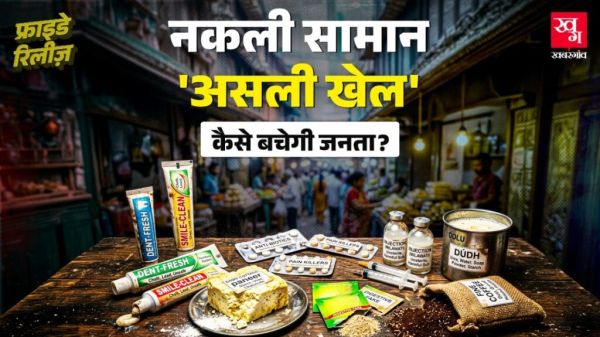
Usually, when you buy something under the name of a brand, you buy it with the assumption that the thing will be genuine and beneficial. Having a brand name printed on the packet, wrapper or box or purchasing a product from a reputable store assures customers that the product is genuine. Many incidents that break this trust have happened in recent times. Somewhere a fake toothpaste factory has been caught and somewhere someone is making and selling fake injections. Fake spices, fake medicines, cheese made from chemicals, food items made from harmful ingredients are shocking and are also breaking people’s trust.
Surprisingly, a very small number of people making such products are being caught. It has also been seen in many cases that people making such fake products have been working for a long time and by the time they were caught, they were selling goods worth lakhs of crores of rupees. These counterfeit items include everyday food items, medicines, cosmetics and other such products which can cause serious harm to the human body.
What does the study say?
A report ‘State of Counterfeiting in India 2025’ by Authentication Solution Providers Association and CRISIL Intelligence makes many important revelations regarding counterfeit products. This report shows that these counterfeit products are not limited to just stores. Such things are being sold indiscriminately on online market places and e-commerce platforms also. This report shows that last year i.e. in the year 2025, about 35 percent of Indian customers bought counterfeit goods. About 89 percent people in urban areas admitted that they had bought some counterfeit goods at least once in their life.
In this study conducted across the country, 1639 people from Delhi, Mumbai, Kolkata, Chennai, Bengaluru, Hyderabad, Ahmedabad, Jaipur and Indore were talked to. Out of these, 31 percent people admitted that the clothes they bought both online and offline were fake copies of some brand or the other. Similarly, 27 percent people admitted that they had purchased fast moving consumer goods i.e. items of household use such as food items, personal use items and household items and they turned out to be counterfeit.
This study shows that online platforms account for 53 percent of those selling counterfeit goods and through them the work of fraud has become easier.
You are eating fake things, not real ones.
On April 21, a factory was caught in the country’s capital Delhi which was manufacturing and packing fake ENO packets and Nescafe fake coffee. Police have also recovered fake raw material and fake packets. A large quantity of finished products have also been seized.
A few days ago, a factory was caught in Kanjhawala, Delhi, in which fake toothpaste of Sensodyne was being manufactured. In this, poor quality paste was being packed in Sensodyne packets. Police had recovered more than 10 thousand empty tubes, more than 1800 ready tubes and 130 kg of paste. Earlier in the month of March also, a factory was caught in Samaypur Badli, Delhi which was manufacturing fake Sensodyne paste. Similarly, in the month of October last year, a factory manufacturing fake toothpaste and ENO was caught in Jagatpur, Delhi.
On April 22, 2026, fake refined oil being sold in the name of Fortune Company was recovered in Ayodhya, Uttar Pradesh. According to the report, the fake oil was being sold with the branding of Fortune. Police have recovered more than 500 cartons of oil.
There is a lot of adulteration in spices too
Generally, the ground spices used at home are purchased from the market. Many times people buy spices of some famous brands while in some markets many spices with unknown names are sold. Adulteration people take advantage of this. Many times cases have come to light of mixing cheap chemicals, horse and donkey dung and even cow dung in spices. Such spices not only spoil the taste of food, consuming them for a long time can also have a bad effect on your health.
There have been cases of selling things like red colored powder containing chemicals in the name of chilli powder, cheap yellow powder in the name of turmeric and papaya seeds in the name of black pepper. When the consumption of these spices increases during festivals, such fake goods enter the market in abundance. People doing such work spend their money in the hustle and bustle of festivals and earn lakhs and crores of rupees.
A few years ago, a big factory was caught in Hathras, Uttar Pradesh, where spices were made from donkey dung and acid. Not only this, this fake spice was sold in wrappers and packets of branded companies.
In the month of February this year, a gang was caught in Gwalior, Madhya Pradesh which was manufacturing fake cumin seeds in the name of a Gujarat company. This gang was applying a chemical like cement on fennel and turning it into cumin and selling it in the name of another brand. Then Gwalior Police had recovered 46 bags of this fake cumin. Apart from this, there have also been cases of making fake cumin from cut pieces of broom, wild grass and many other things and selling it for a long time.
Most harm from dairy products
Most of the fake items are being found in dairy products. Seizing of fake ghee, fake khoya, synthetic cheese and adulterated sweets has become common. Recently, 1270 kg of smelly khoya was caught in Dholpur, Rajasthan. According to the report, it was being sent to be spent in weddings to be held in Uttar Pradesh but was caught on the way.
Most of the fraud is happening regarding cheese. Fake cheese is caught every other day. Recently 28 quintals of fake cheese was caught in Meerut. In the month of March, 1400 kg of fake cheese was caught in Surat, Gujarat which was being made from palm oil and other chemicals.
This fake cheese is so dangerous that it can harm even the kidneys and liver of humans. This is because cheap acids are used to make synthetic cheese. This acid is also used in making toilet cleaners and floor cleaning chemicals. Apart from this, flour, vegetable oil and other chemicals are also mixed indiscriminately which are extremely harmful.
Fake medicines are life threatening
Recently, a gang manufacturing fake Monjaro injections was busted in Gurugram. This gang was not only manufacturing Monjaro injection but was also selling it indiscriminately on reputed websites like Indiamart. Now the police and other departments are trying to find out to where this gang has delivered the fake injections. It is important to know that those who take such injections may have adverse effects on their health and may even fall ill.
In this case, it was also found that this gang used to import some raw medicine from China to make Monjaro injection and used to sell the liquid prepared by mixing it with water as an injection. This injection, which is available for Rs 3 to 10 thousand, is bought by diabetic patients or people who want to lose weight. Now, if you give a fake injection of water instead of this injection, it will hardly be of any benefit. It is definitely possible that fake injections may have a bad effect on your body.
One such case has come to light from Udham Singh Nagar of Uttarakhand. When the local administration team raided the Nagar Panchayat area, it found fake medicines. These medicines were being made from deer horns and other things and were being sold in the name of Ayurvedic and English medicines. These medicines were being sold in many other states including Assam, Bengal, Uttarakhand and Uttar Pradesh as well as abroad.
Similarly, companies manufacturing fake Zinc, Paracetamol, Azithromycin tablets in Gaya, Bihar, manufacturing fake skin care cream in Loni, Ghaziabad and pain relief cream in Ghaziabad have been busted. There have been many such cases in which it has been seen that the accused manufacturing fake medicines were arrested and when they came out of jail, they started doing the same thing again.
Apart from these things, counterfeit liquor, fake branded clothes, name brands similar to name brands and many other products have infiltrated the entire market system. In many places, many such products continue to be sold for a long time without being detected and neither the buyers nor the shopkeepers selling them realize that they are actually buying and selling counterfeit goods instead of genuine ones.
Why is fraud so easy?
Many experts say in media reports that such work does not happen on a small scale. A complete system works behind it and loopholes of the system are used at every level. This includes things ranging from fake packaging material, fake products and fake labeling to collusion with officials of various departments and making fake bills.
Many big shopkeepers also get trapped in the trap of these gangs due to fake GST bills being generated. This not only prevents buyers from getting counterfeit products, but also reduces the GST received by the government. Also, many genuine brand products are being kept and counterfeit goods are being sold in their name. The effect of copying everything at different levels is that now it has become like a parallel industry.
lack of awareness among people
Usually, people assume that the product will be genuine by looking at the brand name, its logo and other things to branding written on the packet. Such gangs are taking advantage of this and are selling fake products with imitations of original packaging. Neither the shopkeeper nor the customer has any immediate suspicion about this. Many small shopkeepers buy goods from people who deliver the goods to their homes by bike or other vehicle. In many areas, no fixed bill for these goods is available and the shopkeepers do not even ask for the bill. This is where fraud starts and such fake products are easily consumed.
Such an incident happened with journalist Ajay Singh of Khabargaon. When a factory of fake Sensodyne toothpaste was caught in Delhi, Ajay became suspicious because a few days ago he had purchased a Sensodyne toothpaste and it started causing problems to his teeth. At first he had no doubt but after reading this news he too was surprised when he scanned the bar code given on the toothpaste packet. The bar code itself was fake and the website that opened on scanning it was explaining the meaning of good conductors and bad conductors of electricity. This shows how many counterfeit products you are using or have used without you even realizing it. The reason for this is that the packaging of those things is exactly like the original brand.
When we talked to some shopkeepers in Noida about this, they told on the condition of anonymity that sometimes these dealers give good margins. For example, a shopkeeper told that the margin given on dish washing soap by the dealers of the real company is almost double the margin on the identical looking fake brand goods. A dealer selling such goods told that this work is so easy that the shopkeeper does not know about it at first and even if he walks away, he does not say anything out of greed for margin. The second big thing is that the packaging is perfect, the expiry date is correct, customers never check things like batch number, so the work goes on smoothly.
-
What is happening on 3rd May in Hyderabad’s Kokapet?

-
Three held for possessing drugs in Hyderabad, hash oil worth Rs 1 lakh seized

-
Man arrested with 3.83 kg ganja in Hyderabad’s Kondapur
-
Built in Hyderabad, Skyroot’s Vikram-1 readies for orbit

-
UP: Minors stripped, beaten, thrown into canal to die over ‘restaurant debt’