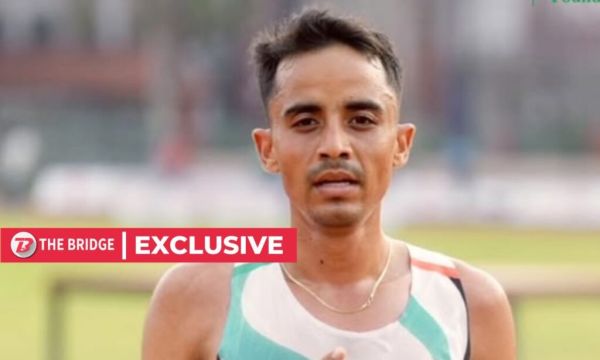
Sawan Barwal almost didn’t make it to Rotterdam.
A knee injury forced him out of the London Marathon last October, just ten days before the race. He took a month off, rebuilt his schedule from scratch, and spent much of December recovering before resuming training in January.
By the time he lined up at the NN Marathon Rotterdam on Sunday, he had already overcome more than most first-time marathoners face. What followed was history!
Barwal clocked 2:11:58s to break Shivnath Singh’s national record – a mark that had stood since 1978, making it the oldest in Indian athletics. He finished 20th in the elite field. The record fell two seconds. But Barwal is quick to put that in context.
“My target was around 2 hours eight or nine minutes,” he told Read.
“The preparation, the workouts everything was pointing there. Up to around the 38-40 kilometres mark, we were on. But in the last two kilometres, it got windy. Everything changed,” he rued.
The national record, then, arrived not as the ceiling of his ambition but almost as a consolation as he fought two blackouts to cross the finish line.
The journey to Rotterdam spans more than a decade. Barwal started running in ninth or tenth grade after his PT teacher, Rajendra Sir, took him out to the ground one morning.
He won a bronze medal at the National Games in the under-18 category, added junior federation medals in 2015 and 2016, and eventually moved to the Army Sports Institute.
Then the covid-19 pandemic hit. He returned in 2021, joined SpiceJet’s sports unit in 2022, and picked up a senior federation bronze that year.
The results kept improving an individual bronze at the Asian Half Marathon in 2024, a fourth-place finish at the Asian Athletics Championship in 2025, and meet records in both the 5000m and 10,000m at the National Games.
The push toward the marathon came from two directions at once.
“When the Asian Games (2023 in Hangzhou) came around, I missed them. I had gone away for training at the wrong time and there was a regret,” he said.
“I decided then that before the next Asian Games, I would try a full marathon at least once,” he added.
Around the same time, AFI’s foreign coach Scott Simon, who had watched him at the Asian Athletics Championship, pulled him aside.
“He said I had a good long-distance base and that I should try a marathon. That’s when things started.”
What changed in Barwal’s preparation wasn’t just the event, it was the mentality. He rejected the conventional wisdom that marathon runners should train slow. Instead, he trained alongside 5,000m and 10,000m athletes, keeping the same pace while increasing mileage.
“The old thinking was: it’s a marathon, we can’t train that fast. I broke that barrier,” he said.
“I trained at 5,000m and 10,000m pace. More mileage, but same speed. And once the coaches saw me train, they said I can dip under 2 hours and 10 minutes.”
For the six months leading up to Rotterdam, he based himself at altitude in Coonoor, Tamil Nadu.
“When you come down to sea level, your body adapts easily oxygen flows better, muscles respond better,” he said.
There was no hyperbaric chamber, no exotic science. Just altitude, volume, and a deliberate shift in how fast he was willing to push in training.
On the question of what makes the marathon harder the body or the mind Barwal doesn’t separate them.
“They’re connected,” he said.
“If you’re physically ready, the mental side isn’t as hard. If you know your body can do it, the stress in the final kilometres is manageable. But it is there. In my first marathon, I felt all of it at the end.
“Two-eight, two-nine that’s still the target,” he signed off.
-
The one pantry mistake that is quietly ruining your onions
-
Anupam Kher says he chose renting over owning, years after selling home to Alia Bhatt for Rs 8.99 crore: 'I wanted a simpler life'
-
A Simple Tomato Chutney That Adds Protein To Your Breakfast Plate
-
Urine infection increases due to consumption of ‘these’ sparkling foods in daily diet, take care of delicate organs in such a way

-
Realme C81 smartphone to launch in India soon; 4GB RAM, 6300mAh battery and…