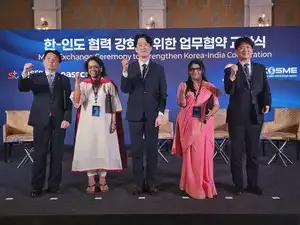
The Korea SMEs and Startups Agency, through its Global Business Center (GBC) in New Delhi, has signed a strategic Memorandum of Understanding (MoU) to enhance the entry and expansion of Korean small and medium enterprises (SMEs) into India.
The agreement was signed with the Maharashtra Industrial Development Corporation, the Government of Maharashtra’s key agency for industrial infrastructure development and investment facilitation. The signing ceremony took place at The Leela Palace New Delhi.
From KOSME, the delegation was led by Jang Hyuk Park, Vice President, Global Business Development Division, along with Yongheon Kim, Senior Manager, Global Cooperation, and Jae Kyeong Lee, Managing Director, KOSME Global Business Center, New Delhi.
The MoU was signed on behalf of MIDC by P. Velrasu IAS, Chief Executive Officer with participation from Varsha Thakur Ghuge, IAS, Joint CEO, Vikas Suryawanshi, General Manager Marketing, and Varad Deshpande, Consultant.
The partnership aims to establish a structured support system for Korean SMEs entering India, particularly in Maharashtra, one of the country’s leading industrial and manufacturing hubs.
The cooperation will focus on three key areas:
- Investment Promotion & Facilitation
- Human capital development and workforce capability enhancement
- Collaboration in advanced and emerging technologies
This initiative aligns with India’s industrial development policies, including Make in India, and reflects growing opportunities for global manufacturing and investment.
KOSME has been actively supporting Korean companies entering India through its Global Business Center operations and ecosystem initiatives in Pune. The collaboration with MIDC is expected to further strengthen this support by leveraging local industrial infrastructure and institutional networks.
JangHyuk Park, Vice President, KOSME, said in a statement that the agreement will serve as a “strategic bridgehead” to accelerate the entry of Korean SMEs into India amid evolving global supply chains.
The collaboration is also expected to open new avenues in advanced sectors such as manufacturing, digital transformation, and startup ecosystem development, contributing to stronger Korea–India economic ties.
The agreement was signed with the Maharashtra Industrial Development Corporation, the Government of Maharashtra’s key agency for industrial infrastructure development and investment facilitation. The signing ceremony took place at The Leela Palace New Delhi.
From KOSME, the delegation was led by Jang Hyuk Park, Vice President, Global Business Development Division, along with Yongheon Kim, Senior Manager, Global Cooperation, and Jae Kyeong Lee, Managing Director, KOSME Global Business Center, New Delhi.
The MoU was signed on behalf of MIDC by P. Velrasu IAS, Chief Executive Officer with participation from Varsha Thakur Ghuge, IAS, Joint CEO, Vikas Suryawanshi, General Manager Marketing, and Varad Deshpande, Consultant.
The partnership aims to establish a structured support system for Korean SMEs entering India, particularly in Maharashtra, one of the country’s leading industrial and manufacturing hubs.
The cooperation will focus on three key areas:
- Investment Promotion & Facilitation
- Human capital development and workforce capability enhancement
- Collaboration in advanced and emerging technologies
This initiative aligns with India’s industrial development policies, including Make in India, and reflects growing opportunities for global manufacturing and investment.
KOSME has been actively supporting Korean companies entering India through its Global Business Center operations and ecosystem initiatives in Pune. The collaboration with MIDC is expected to further strengthen this support by leveraging local industrial infrastructure and institutional networks.
JangHyuk Park, Vice President, KOSME, said in a statement that the agreement will serve as a “strategic bridgehead” to accelerate the entry of Korean SMEs into India amid evolving global supply chains.
The collaboration is also expected to open new avenues in advanced sectors such as manufacturing, digital transformation, and startup ecosystem development, contributing to stronger Korea–India economic ties.