
MUMBAI: Prime residential prices in India continued to rise in 2025, reducing the space $1 million can buy across Mumbai, Delhi and Bengaluru, even as all three cities improved their global rankings, showed Knight Frank’s Prime International Residential Index.
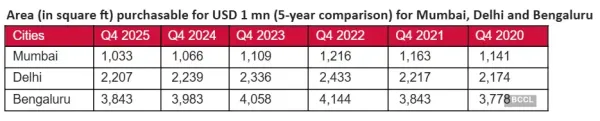
A budget of $1 million can now buy 1,033 sq ft in Mumbai, down from 1,066 sq ft in 2024 reflecting a 3% year-on-year price increase. In Delhi, the same amount can fetch 2,207 sq ft, compared with 2,239 sq ft last year, marking a 1.4% rise.
Bengaluru recorded the steepest change of 3.5%, with purchasable space declining to 3,843 sq ft from 3,983 sq ft.
Globally, Monaco retained its position as the most expensive prime residential market, where $1 million buys just 172 sq ft.
“The unabated growth in India’s economy has been instrumental in this growth in prime residential demand as the number of HNWIs and UHNWIs record steady rise. Globally, markets such as Tokyo and Dubai reflect how luxury real estate continues to be driven by capital flows and evolving lifestyle preferences. India remains well-positioned within this landscape, offering strong long-term growth potential,” said Shishir Baijal, International Partner, CMD, Knight Frank India.
The PIRI 100, which tracks 100 global luxury housing markets, recorded an average 3.2% year-on-year increase in prime residential prices in 2025, outperforming mainstream housing for the second consecutive year. Of the 100 markets, 73 registered price growth while 24 saw declines, indicating uneven global performance.
“In many markets, prime residential property has pulled away from the broader housing sector, underpinned by the strength of wealth creation. While mainstream markets remain exposed to wider economic pressures, the pace at which wealth is being generated is helping to keep demand for luxury property more resilient, even against recent volatility in debt costs,” said Liam Bailey, global head of research at Knight Frank.
Indian cities also saw an improvement in rankings. Bengaluru emerged as a standout performer, jumping 32 places from 40th in 2024 to 8th in 2025, supported by a 9.4% increase in luxury residential prices. Mumbai moved up from 21st to 10th position with an 8.7% rise, driven by strong demand in prime and super-prime segments, including record new-build sales above $2 million. Delhi improved from 18th to 17th place, with prices rising 6.9% year-on-year.
India’s rising share in global wealth is reinforcing demand for prime residential assets. The country now accounts for 2.8% of the world’s ultra-high-net-worth individuals (UHNWIs) in 2026, up from just over 2% five years ago, with its trajectory continuing to strengthen.
The UHNWI population is projected to grow from 19,877 currently to 25,217 by 2031, making India the sixth-largest wealth market globally.
This expansion, driven by sustained wealth creation across technology, industrials and capital markets, is increasingly translating into deeper demand for luxury housing.
Regionally, the Middle East led with a 9.4% increase, driven largely by Dubai’s 25.1% rise. Latin America and the Caribbean followed with 4.7% growth, while Asia-Pacific (3.6%) and Europe (3.3%) posted comparable gains. North America remained the only region in decline, falling 0.9%.
A budget of $1 million can now buy 1,033 sq ft in Mumbai, down from 1,066 sq ft in 2024 reflecting a 3% year-on-year price increase. In Delhi, the same amount can fetch 2,207 sq ft, compared with 2,239 sq ft last year, marking a 1.4% rise.
Bengaluru recorded the steepest change of 3.5%, with purchasable space declining to 3,843 sq ft from 3,983 sq ft.
Globally, Monaco retained its position as the most expensive prime residential market, where $1 million buys just 172 sq ft.
“The unabated growth in India’s economy has been instrumental in this growth in prime residential demand as the number of HNWIs and UHNWIs record steady rise. Globally, markets such as Tokyo and Dubai reflect how luxury real estate continues to be driven by capital flows and evolving lifestyle preferences. India remains well-positioned within this landscape, offering strong long-term growth potential,” said Shishir Baijal, International Partner, CMD, Knight Frank India.
| City | How many square Ft USD 1m buys in 2025 | How many square ft USD 1m buys in 2024 | How many square ft USD 1m buys in 2020 |
| Monaco | 172 | 205 | 183 |
| Hong Kong | 248 | 237 | 248 |
| Geneva | 301 | 355 | 398 |
| Singapore | 301 | 344 | 388 |
| London | 355 | 366 | 334 |
| New York | 366 | 366 | 377 |
| Los Angeles | 388 | 398 | 538 |
| Tokyo | 398 | 624 | 667 |
| Paris | 398 | 452 | 452 |
| Vienna | 420 | 484 | 441 |
| Sydney | 452 | 484 | 474 |
| Shanghai | 474 | 474 | 538 |
| Milan | 495 | 560 | 646 |
| Miami | 624 | 624 | 1,044 |
| Berlin | 635 | 743 | 710 |
| Dubai | 667 | 840 | 1,970 |
| Madrid | 807 | 958 | 1,001 |
| Lisbon | 861 | 990 | 1,001 |
| Melbourne | 893 | 936 | 850 |
| Mumbai | 1,033 | 1,066 | 1,130 |
The PIRI 100, which tracks 100 global luxury housing markets, recorded an average 3.2% year-on-year increase in prime residential prices in 2025, outperforming mainstream housing for the second consecutive year. Of the 100 markets, 73 registered price growth while 24 saw declines, indicating uneven global performance.
“In many markets, prime residential property has pulled away from the broader housing sector, underpinned by the strength of wealth creation. While mainstream markets remain exposed to wider economic pressures, the pace at which wealth is being generated is helping to keep demand for luxury property more resilient, even against recent volatility in debt costs,” said Liam Bailey, global head of research at Knight Frank.
Indian cities also saw an improvement in rankings. Bengaluru emerged as a standout performer, jumping 32 places from 40th in 2024 to 8th in 2025, supported by a 9.4% increase in luxury residential prices. Mumbai moved up from 21st to 10th position with an 8.7% rise, driven by strong demand in prime and super-prime segments, including record new-build sales above $2 million. Delhi improved from 18th to 17th place, with prices rising 6.9% year-on-year.
India’s rising share in global wealth is reinforcing demand for prime residential assets. The country now accounts for 2.8% of the world’s ultra-high-net-worth individuals (UHNWIs) in 2026, up from just over 2% five years ago, with its trajectory continuing to strengthen.
The UHNWI population is projected to grow from 19,877 currently to 25,217 by 2031, making India the sixth-largest wealth market globally.
This expansion, driven by sustained wealth creation across technology, industrials and capital markets, is increasingly translating into deeper demand for luxury housing.
Regionally, the Middle East led with a 9.4% increase, driven largely by Dubai’s 25.1% rise. Latin America and the Caribbean followed with 4.7% growth, while Asia-Pacific (3.6%) and Europe (3.3%) posted comparable gains. North America remained the only region in decline, falling 0.9%.