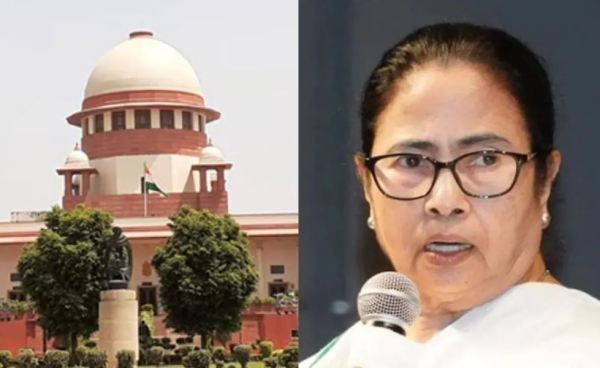
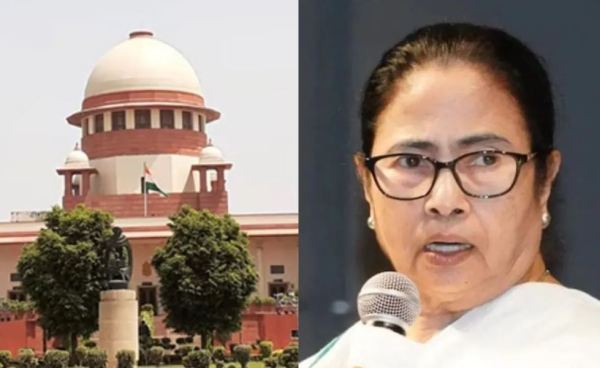
New Delhi, 22 April. The Supreme Court on Wednesday expressed strong displeasure over the action of West Bengal Chief Minister and Trinamool Congress (TMC) chief Mamata Banerjee in which she reached the house of I-PAC co-founder Prateek Jain during the Enforcement Directorate (ED) raid in January this year. The court said that such a step could put democracy in danger.
The bench of Justice PK Mishra and Justice NV Anjaria was hearing the ED’s petition, in which a demand has been made to get the case investigated by the CBI. The Supreme Court bench made a strong comment and said, ‘The Chief Minister of any state cannot interfere in the investigation, this puts democracy in danger. Later to say that this should not be made a dispute of Center versus State is not acceptable. This was a step taken by a person who incidentally is the Chief Minister of a state. This poses a threat to the democratic system.
Actually, this controversy is to the raid conducted by ED in January on Prateek Jain’s residence in an alleged money laundering case. The central agency alleges that Mamata Banerjee reached the spot during the investigation and took important documents with her, due to which the matter became a big political controversy. The Supreme Court also said that constitutional experts – HM Seervai and BR Ambedkar – could not possibly have envisioned a situation where a sitting Chief Minister would interfere in an investigation.
During the hearing, senior advocate Abhishek Manu Singhvi, appearing for the West Bengal government, argued that ED as an agency cannot claim fundamental rights. He said that the agency is not a separate judicial entity and it does not have any fundamental right to investigate.
Mamta’s lawyer gave these arguments
At the same time, senior advocate Maneka Guruswamy, appearing for Mamata Banerjee, said that the writ jurisdiction of the court is limited to ‘judicial persons’ and the fundamental rights are meant to protect the citizens from illegal actions of the state (government) and not for the state to claim violation of its own rights.
Maneka Guruswamy also argued that the central government was trying to change established constitutional principles and cited several examples, including the Kesavananda Bharati case. He said that the State cannot be simultaneously the ‘constitutional offender and victim’ and writ jurisdiction has essentially evolved against the State.
During the hearing, the Supreme Court repeatedly expressed concern over what implications a sitting Chief Minister could have for interfering in an ongoing investigation. The top court also said that this case raises serious questions to institutional limits and the rule of law.
-
India's digital currency push targets its leaky welfare system

-
Microsoft to integrate Anthropic's Mythos into its security development programme

-
Intel lands key first customer for chip '14A' chip tech with Tesla's Terafab project: Elon Musk

-
Microsoft bets big on AI in Australia with $18 billion investment

-
SoftBank seeks $10 billion margin loan backed by OpenAI shares: Report