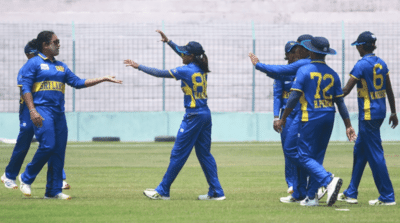
Sri Lanka Cricket has confirmed a six-match white-ball series against New Zealand Women A in May 2026, with Sri Lanka opting to field their senior national side in what is effectively a preparatory assignment ahead of the ICC Women’s T20 World Cup. The series, comprising three ODIs and three T20Is, will be staged entirely at the Rangiri Dambulla International Cricket Stadium, offering consistent conditions as the hosts look to finalize combinations.
Scheduled for May 12, 15 and 18 (ODIs), followed by May 21, 23, and 25 (T20Is), the matches will begin at 10:00 AM local time. The visiting squad is set to arrive on May 7, allowing limited acclimatization before the fixtures commence. With the global tournament approaching, Sri Lanka’s decision to deploy their senior side reflects a shift from experimental fixtures to performance-oriented preparation.
SL vs NZ-A six-match series schedule
| Match type | Date | Venue | Start Time Local |
| 1st ODI | May 12, 2026 | Rangiri Dambulla International Stadium | 10:00 AM |
| 2nd ODI | May 15, 2026 | Rangiri Dambulla International Stadium | 10:00 AM |
| 3rd ODI | May 18, 2026 | Rangiri Dambulla International Stadium | 10:00 AM |
| 1st T20I | May 21, 2026 | Rangiri Dambulla International Stadium | 10:00 AM |
| 2nd T20I | May 23, 2026 | Rangiri Dambulla International Stadium | 10:00 AM |
| 3rd T20I | May 25, 2026 | Rangiri Dambulla International Stadium | 10:00 AM |
Read also: Colombo's SSC Ground to debut as SLC announces Lankan Premier League dates
Structured build-up and tactical evaluation
The series follows Sri Lanka’s recent engagements against Bangladesh, creating a continuous run of competitive fixtures. This sequence is expected to assist in maintaining match rhythm while enabling targeted assessment of squad roles. Areas under focus include batting depth, bowling combinations and fielding efficiency, particularly under match pressure.
Playing all matches at Dambulla introduces a controlled variable, where pitch behaviour—typically supportive of spin—remains consistent. This allows the team management to evaluate adaptability and execution without the uncertainty of changing venues. The structure also enables repeated exposure to similar match scenarios, aiding in refining tactical responses.
While the fixtures carry bilateral status, their functional purpose aligns more closely with tournament rehearsal, where combinations are tested within a defined framework rather than isolated experimentation.
Opposition context and developmental angle
For New Zealand, the deployment of an ‘A’ squad positions the tour as a developmental exercise. However, facing a full-strength Sri Lankan side introduces a competitive imbalance that also enhances learning conditions for emerging players. Exposure to subcontinental surfaces and dual-format cricket expands the scope of assessment for the visiting unit.
The single-venue format further ensures gradual adaptation, allowing players to adjust techniques across matches. For Sri Lanka, this continuity provides measurable indicators of readiness as selection decisions approach.
As preparations for the ICC Women’s T20 World Cup progress, the series serves as a structured checkpoint, balancing competitive outcomes with squad evaluation in a controlled environment
-
Crackdown on sub-standard drugs in Rajasthan, seven medicines banned

-
Horror in Benidorm as two dead after scaffolding collapses 13 floors high

-
Payal Kapadia sets Cannes return, serves as president of the jury for the French Riviera

-
Labour given bombshell warning over migrant hotel and cash support - 'not far enough'

-
Iran's Internet Shutdown Risk Amid Ongoing Tensions